



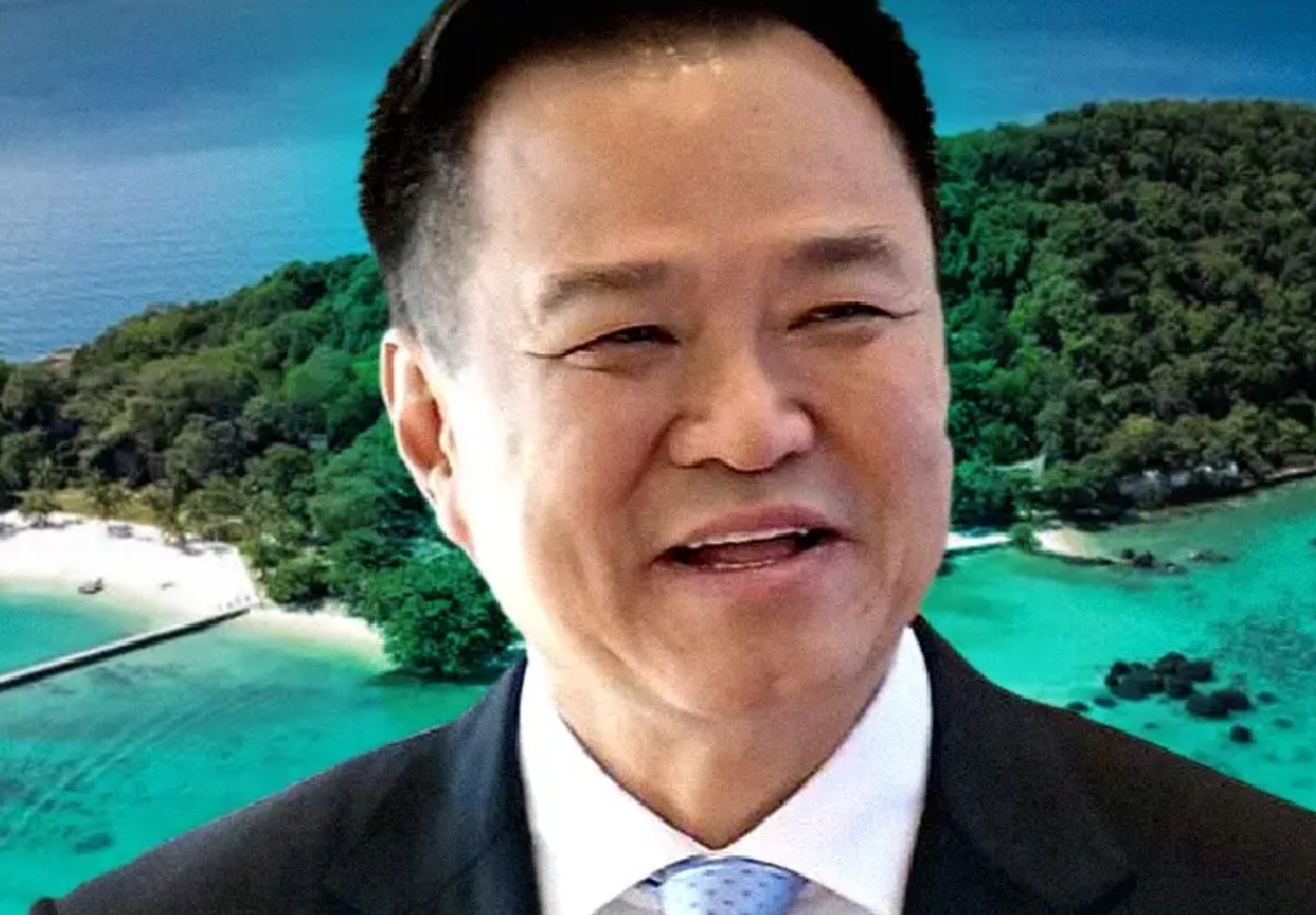

Prime Minister Anutin Charnvirakul has insisted that Koh Kood remains part of Thailand following the government’s decision to cancel the 2001 memorandum of understanding known as MOU 44, which concerned overlapping maritime claims in the Gulf of Thailand.
Get today's headlines by email 
Posting on his personal Facebook account while attending the ASEAN Summit in Cebu, Philippines, Anutin said he met Cambodian Prime Minister Hun Manet at the request of Philippine President Ferdinand Marcos Jr to help ease tensions between the two countries ahead of the regional gathering.
During the meeting, Anutin said he directly informed Hun Manet that Thailand had formally decided to cancel MOU 44. According to the Thai premier, Cambodia formally acknowledged the decision during the talks.
Anutin said the Cambodian prime minister expressed disappointment over Thailand’s move and informed him that Cambodia would pursue the compulsory conciliation mechanism under the United Nations Convention on the Law of the Sea (UNCLOS) regarding future maritime benefit negotiations.
The Thai prime minister described the development as beneficial for both countries, saying future discussions would now proceed under the same legal framework and principles after Cambodia ratified UNCLOS earlier in 2026.
He added that the face-to-face meeting accelerated communication between the two governments. Without the meeting, Thailand may have needed to send formal diplomatic notification through official channels, a process he said could have taken several months.
Anutin also sought to reassure the Thai public over sovereignty concerns linked to Koh Kood. “Once there is no MOU 44, there will no longer be any maritime line crossing Koh Kood that could create doubt or concern,” he said, adding: “Koh Kood belongs to Thailand.”
The issue has generated significant debate online, with Anutin accusing some social media users of spreading misinformation designed to create division and hatred. He said the government would continue handling the matter carefully and transparently while prioritising Thailand’s interests under international law and mutually accepted principles.
On broader bilateral relations, Anutin said Thailand and Cambodia agreed to continue border negotiations through existing mechanisms including the Joint Boundary Commission (JBC) and the General Border Committee (GBC). Both countries also agreed to increase meetings between senior officials.
The prime minister added that police from both countries would strengthen cooperation against call-centre gangs and online scam networks, with tougher legal action expected against criminal groups operating across borders.
Anutin stressed that the meeting did not include discussions on reopening border checkpoints or wider cooperation initiatives. Instead, both sides agreed that preserving peace and avoiding military confrontation remained the top priority.
The Nation reported that he also urged the public to remain confident in the government’s handling of the dispute, saying he had been directly involved in the issue since serving as deputy prime minister and interior minister before returning for a second term as premier.
Related story
Thai-cabinet-ends-2001-maritime-pact-with-Cambodia
Join the discussion? 
Already a member? 
 Adapted by ASEAN Now Nation 10 May 2026
Recommended Comments
Create an account or sign in to comment