



Skip to content
View in the app

A better way to browse. Learn more.

ASEAN NOW

A full-screen app on your home screen with push notifications, badges and more.

To install this app on iOS and iPadOS
  1. Tap the Share icon in Safari
  2. Scroll the menu and tap Add to Home Screen.
  3. Tap Add in the top-right corner.
To install this app on Android
  1. Tap the 3-dot menu (⋮) in the top-right corner of the browser.
  2. Tap Add to Home screen or Install app.
  3. Confirm by tapping Install.

Bangkok declares all 50 districts flood disaster areas

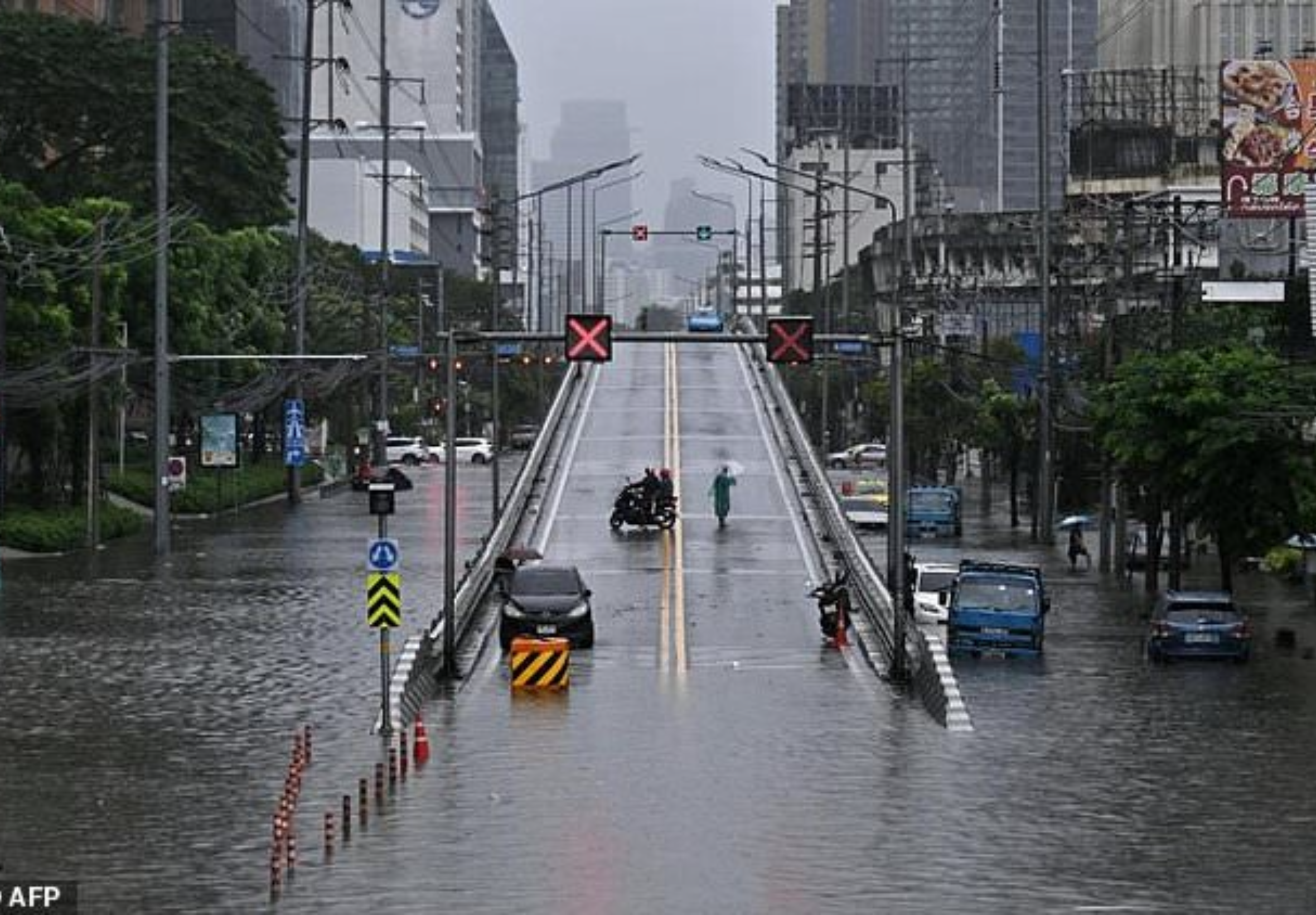
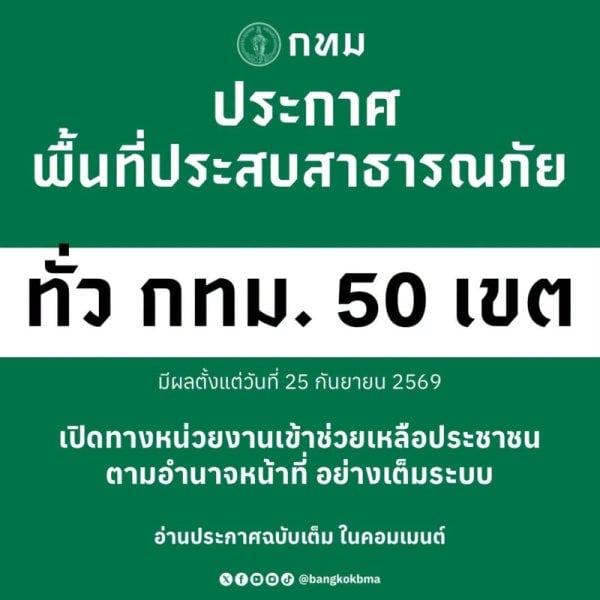
Bangkok Governor Chadchart Sittipunt has declared all 50 districts of the capital flood-disaster areas after heavy rain for a third consecutive day caused widespread flooding on Saturday, September 26.

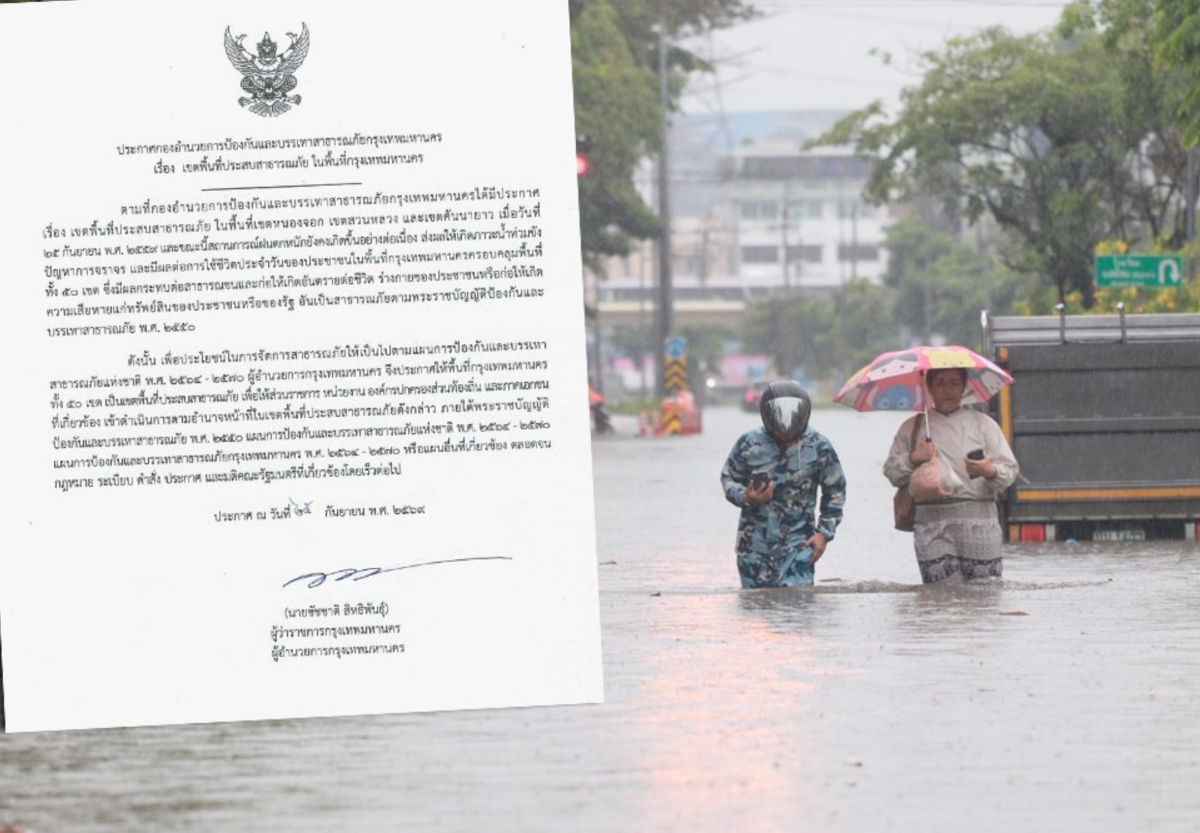
The city-wide designation expands an earlier declaration covering three districts. It allows government agencies and local authorities to act more quickly and in a coordinated way within their legal powers to respond to flooding and assist residents.

Almost 300 millimetres of rain has fallen since Thursday afternoon, according to Chadchart. Rain has fallen almost continuously, flooding roads, swelling canals and sending water into homes and restaurants beside them.

Canals full as eastern Bangkok is hardest hit

Chadchart said eastern Bangkok had been worst affected and warned that more rain was forecast.

"The rain keeps falling and we are doing our best. We are trying to pump the water out, but the water in canals are full," he said on social media.

"The risk areas are those who live near canals. Every canal is now filled."
IMG_3851.jpeg

Further south-east in On Nut, AFP reporters saw people wading through knee-high water along a road and filling sandbags to take home.

Somkid Pheuk-ngam, 67, a vendor living near a canal north of central Bangkok, said the water had reached waist level.

"The water keeps coming in. It's hard to go out now. It's like at my waist level now," she said, adding that she had closed her shop for two days. Although flooding was common in her area, she said: "I think this time is worse than the 2011 flood."

Chadchart urged people with bedridden relatives who depend on life-saving medical equipment to consider a temporary stay in hospital. He also advised residents to move cars to higher ground.

Bangkok's public transport authority is offering free use of MRT train park-and-ride car parks for vehicle storage until October 2. The Bangkok Metropolitan Administration said it would continue monitoring rainfall and flooding closely while coordinating assistance across the city.

Wider flood risks remain

The Department of Disaster Prevention and Mitigation has warned that low pressure over eastern, north-eastern and central Thailand could bring risks of flash floods, forest runoff, mudslides and river overflow until Sunday.
IMG_3850.png

Picture courtesy of Khoasod

Join the discussion? Create account. orange.png


image.png

26 September 2026

User Feedback

Recommended Comments

dinsdale Star Member

dinsdale

Advanced Member

This year has been like a more traditional wet season which IMO we haven't seen for many years, starting around Khao Phansa. Hopefully the cool season will also start on time early in October.

ronnie50 Platinum Member

ronnie50

Advanced Member
2 hours ago, dinsdale said:

Hopefully the cool season will also start on time early in October.

In my experience, the cool (or dryer season) never starts in early October. The wet season is typically supposed to cease at the end of October - that month is usually the worst for persistent rain and flooding (e.g. 2011) in the central plains (Bangkok).

However, during the past 6 - 10 years, the rain has crept well into, and often through, November.

marin Platinum Member

marin

Members
3 hours ago, dinsdale said:

Hopefully the cool season will also start on time early in October.

My experience is also that the cool season begins in November if lucky in the first two weeks. But October seems to be raining as well although not as much as June-Sept, but just less. So I am with ronnie.

Ralf001 Star Member

Ralf001

Advanced Member

They need to bring the boats again.

dinsdale Star Member

dinsdale

Advanced Member
(edited)
57 minutes ago, ronnie50 said:

In my experience, the cool (or dryer season) never starts in early October. The wet season is typically supposed to cease at the end of October - that month is usually the worst for persistent rain and flooding (e.g. 2011) in the central plains (Bangkok).

However, during the past 6 - 10 years, the rain has crept well into, and often through, November.

As I said this year is a more traditional wet season which we haven't seen for many years. As for the wettest month it depends where you are but for Bangkok/Issan Sept is traditionally the wettest. As for the cool season, again traditionally, the seasonal change is when the wind changes and comes down from China which is usually around mid-Oct although again hasn't been the case for many years.

Edited by dinsdale

nauseus Star Member

nauseus

Advanced Member
42 minutes ago, dinsdale said:

As I said this year is a more traditional wet season which we haven't seen for many years. As for the wettest month it depends where you are but for Bangkok/Issan Sept is traditionally the wettest. As for the cool season, again traditionally, the seasonal change is when the wind changes and comes down from China which is usually around mid-Oct although again hasn't been the case for many years.

OK then. Mid October. Going once.....

nauseus Star Member

nauseus

Advanced Member
10 minutes ago, VincentRJ said:

I was in Bangkok in 1962, living in a small shack in the suburbs. I recall having to wade through water to reach my home during the monsoon period. It was a fascinating experience as a 20-year-old from the UK.

I've just done an AI search on the history of flooding in Bangkok, and was surprised there were no records of major flooding between 1942 and 1983.

Here's a timeline of Bangkok's modern major flood records:

1942: A massive city-wide flood that submerged the capital for two months.

1983: Severe, prolonged flooding that impacted the capital and 42 provinces.

1995: Widespread fluvial flooding that overwhelmed the Chao Phraya River's banks.

2011: Visited by what is considered one of the worst floods in modern Thai history, causing over 500 deaths and severe economic damage.

2026: Heavy extreme weather events continue to challenge the sinking megacity's infrastructure.

I did further research on this period between 1942 and 1983 when there appeared to be a gap in the disaster history.

The AI explanation is that the 'quiet period' was mainly due to two factors. The construction of Mega-Dams after World War II, and 'Delayed Urban Vulnerability' which allowed allowed Bangkok's vast network of khlongs and natural wetlands to act as a sponge, during the 1950s and 1960s.

However, by the mid-1970s, rapid industrialisation forced the city to pave over these canals to build roads. This structural change, combined with severe land subsidence from groundwater pumping, completely destroyed the city's natural drainage and brought severe flooding right back by 1975.

Sounds about right. I remember swimming along Sukhumvit Road near Asoke in 1983, with snakes, trash and other unmentionable items coming the opposite way on the current. I couldn't avoid them all but anything for a beer.

Paradise found!

nauseus Star Member

nauseus

Advanced Member
25 minutes ago, VincentRJ said:

I was in Bangkok in 1962, living in a small shack in the suburbs. I recall having to wade through water to reach my home during the monsoon period. It was a fascinating experience as a 20-year-old from the UK.

I've just done an AI search on the history of flooding in Bangkok, and was surprised there were no records of major flooding between 1942 and 1983.

Here's a timeline of Bangkok's modern major flood records:

1942: A massive city-wide flood that submerged the capital for two months.

1983: Severe, prolonged flooding that impacted the capital and 42 provinces.

1995: Widespread fluvial flooding that overwhelmed the Chao Phraya River's banks.

2011: Visited by what is considered one of the worst floods in modern Thai history, causing over 500 deaths and severe economic damage.

2026: Heavy extreme weather events continue to challenge the sinking megacity's infrastructure.

I did further research on this period between 1942 and 1983 when there appeared to be a gap in the disaster history.

The AI explanation is that the 'quiet period' was mainly due to two factors. The construction of Mega-Dams after World War II, and 'Delayed Urban Vulnerability' which allowed allowed Bangkok's vast network of khlongs and natural wetlands to act as a sponge, during the 1950s and 1960s.

However, by the mid-1970s, rapid industrialisation forced the city to pave over these canals to build roads. This structural change, combined with severe land subsidence from groundwater pumping, completely destroyed the city's natural drainage and brought severe flooding right back by 1975.

Yes, the last bit was accelerated by the growth of the city and its population.

Create an account or sign in to comment

Account

Navigation

Search

Search

Configure browser push notifications

Chrome (Android)
  1. Tap the lock icon next to the address bar.
  2. Tap Permissions → Notifications.
  3. Adjust your preference.
Chrome (Desktop)
  1. Click the padlock icon in the address bar.
  2. Select Site settings.
  3. Find Notifications and adjust your preference.
