





Bangkok is among the world’s fastest-sinking cities, with scientists warning that land subsidence is accelerating the impact of rising sea levels and increasing flood risks for millions of residents. A new study by researchers at the Technical University of Munich found that heavily urbanised coastal areas are experiencing relative sea level rises of around 6mm per year, three times the global average of 2.1mm annually.
Get today's headlines by email 
The study identified Bangkok as a major subsidence hotspot, with the Thai capital sinking at an average rate of 8.5mm per year. Researchers said the combination of climate-driven sea level rise and sinking land is leaving densely populated cities increasingly vulnerable to flooding, especially during storms and extreme weather events.
Scientists explained that global sea levels are rising because of melting glaciers and the expansion of warming seawater. However, the study warned that the movement of land itself is worsening the problem in many coastal cities, particularly in Asia and Africa.
The researchers said excessive groundwater extraction, oil drilling, and the sheer weight of expanding cities are major causes of subsidence. As taller buildings and urban infrastructure place greater pressure on the ground, soil beneath cities gradually compresses and sinks.
Countries facing the fastest increases in relative sea levels include Thailand, Bangladesh, Nigeria, Egypt, China, and Indonesia, where ocean levels are rising by seven to 10mm per year. The United States, the Netherlands, and Italy are also experiencing rapid increases of around four to 5mm annually.
Jakarta, Indonesia, was identified as the world’s fastest-sinking city, subsiding at 13.7mm per year, while Tianjin in China is sinking by 13.5mm annually. In some parts of Jakarta, subsidence rates reach 42mm per year, leaving nearly 40 per cent of the city already below sea level.
Lead researcher Dr Julius Oelsmann said land movement could “significantly amplify the effects of climate-driven sea-level rise”. He added: “If we want to understand sea-level rise along coastlines and respond effectively, we must not only observe the ocean but also the land itself.”
Co-author Professor Florian Seitz said government action could help slow subsidence rates. He pointed to Tokyo, where subsidence once exceeded 10cm per year before stricter groundwater controls dramatically reduced the problem.
The Daily Mall reported that researchers said improved groundwater management, tighter regulation of extraction, and targeted aquifer recharge projects could help cities such as Bangkok slow further sinking. Scientists also warned that delays in reducing global greenhouse gas emissions could worsen future sea level rise, with projections suggesting oceans could rise by up to 1.2 metres by 2300 even if Paris climate targets are met.
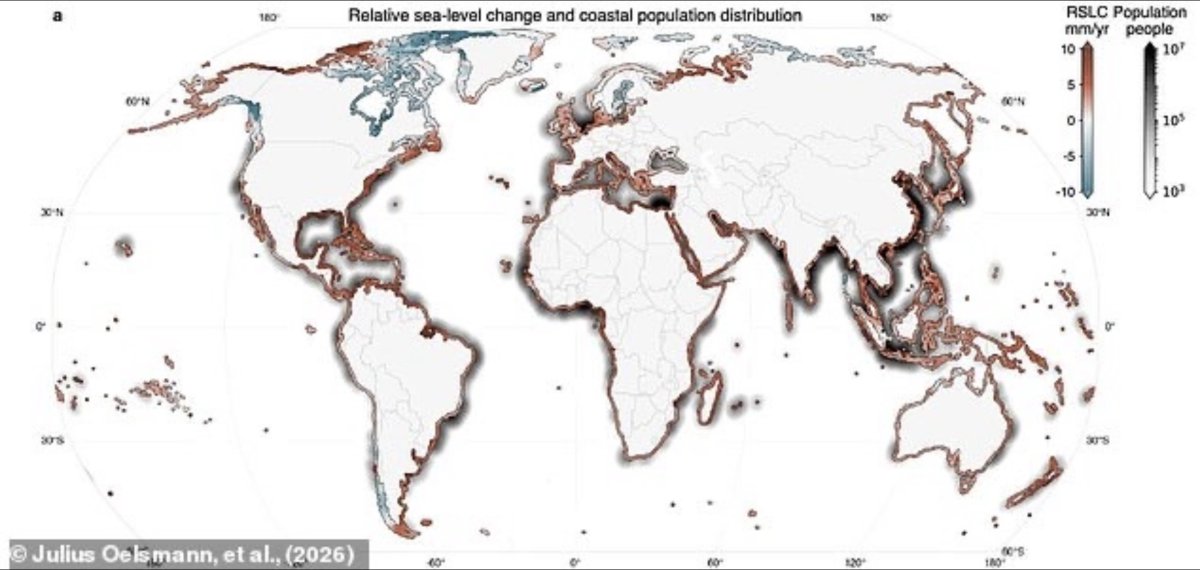
Picture courtesy of Daily Mail - Densely populated urban coastal regions are experiencing around 6mm of relative sea level increase per year (red regions)
Join the discussion? 
Already a member? 
 Adapted by ASEAN Now Dailymail 21 May 2026
Recommended Comments
Create an account or sign in to comment