



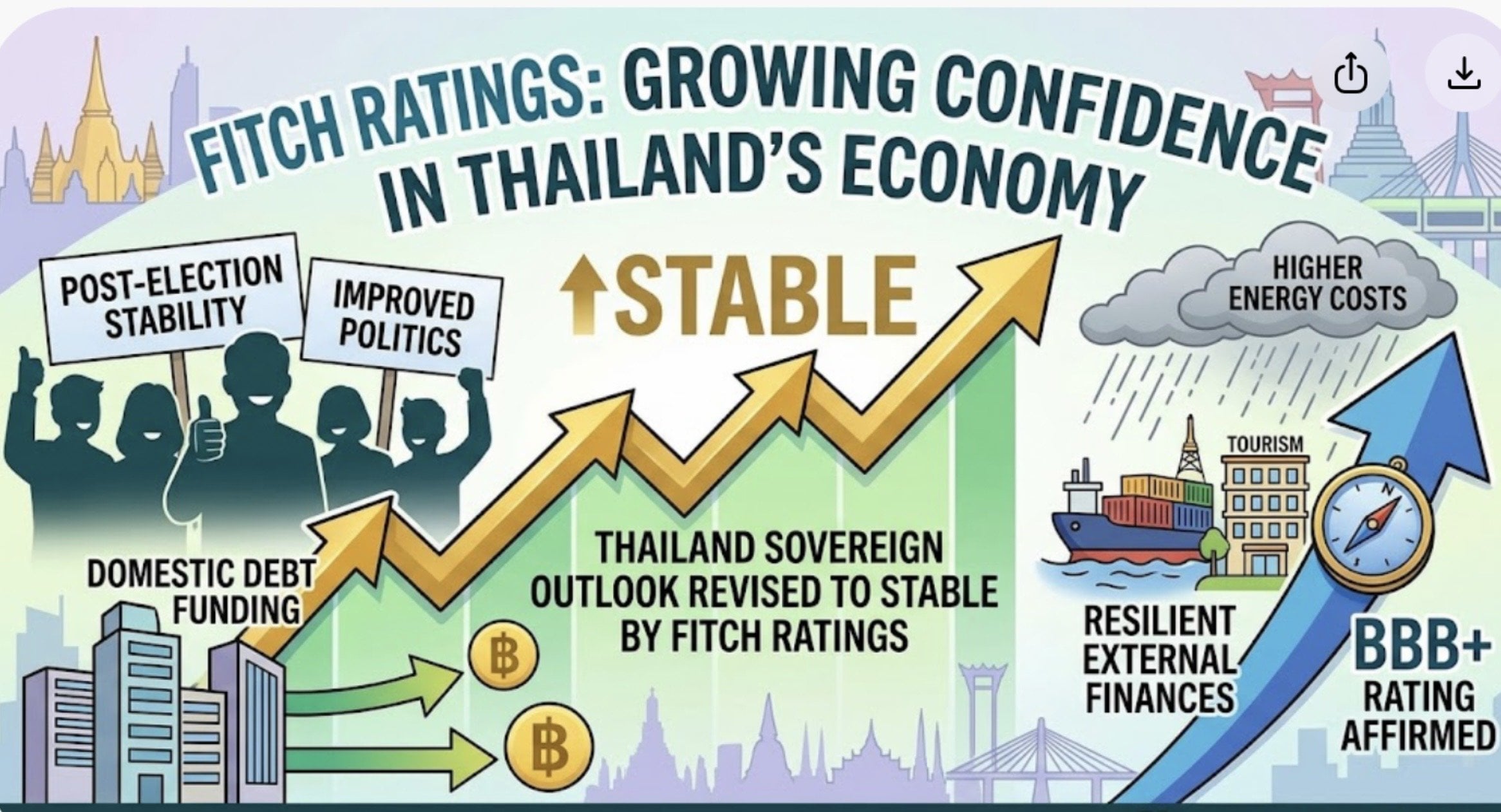

Fitch Ratings has revised Thailand's sovereign outlook to stable from negative, saying it has greater confidence that government debt will broadly level off over the medium term and that politics will improve after this year's general election.
The agency also affirmed Thailand's BBB+ sovereign credit rating. Its decision reverses a warning issued last year, when rising debt and weak growth had weighed on the country's credit profile.
Debt forecast improves
Fitch said government debt was 59.3% of GDP in the 2025 fiscal year and is expected to remain below 63% by fiscal 2028. That is lower than its earlier forecast of 65% and remains beneath Thailand's statutory 70% ceiling.
The ratings agency said Thailand's strong external finances and its capacity to finance most government borrowing domestically continued to support its investment-grade rating, despite relatively high debt and modest long-term growth prospects.
It expects Thailand's current account to return to a surplus equivalent to 1.5% of GDP in 2027, after a temporary deficit of 0.5% in 2026. Fitch attributed the expected deficit to high oil prices and capital-goods imports linked to data-centre construction.
Election eases policy concerns
Fitch's decision follows February's general election and what it described as a smooth political transition. Prime Minister Anutin Charnvirakul's coalition secured a working majority, reducing concern about policy uncertainty.
Thailand's economy has remained resilient despite higher energy prices and softer tourism demand following tensions in the Middle East, according to the report. Investment in technology and data centres has helped support growth.
The move comes after Moody's revised Thailand's outlook to stable in April, citing lower downside risks from US tariffs.
Deputy Prime Minister and Finance Minister Ekniti Nitithanprapas said Fitch's decision demonstrated "growing confidence in the government's policy direction".
"The government will accelerate the concrete implementation of policies aimed at promoting investment in new industries, expediting the transition to green energy ... and prioritising the maintenance of fiscal discipline to enhance potential and lay the foundation for the country's sustainable growth," he said.
Join the discussion? 

22 September 2026
Recommended Comments
Create an account or sign in to comment