





Israel's ambassador to Thailand, Alona Fisher-Kamm, has again urged Israeli visitors to respect Thai laws and culture after protests and a series of disputes involving tourists.
Speaking to AFP at the Israeli embassy in Bangkok on Tuesday 15 September 2026, Fisher-Kamm said both countries needed to ensure the Middle East conflict was not brought into Thailand. She nevertheless pushed back against describing recent protests as antisemitic.
"We have to work together to make sure that the conflict in the Middle East is not imported here to Thailand," she said.
"It's still very hard for me to use the word antisemitic here in Thailand," Fisher-Kamm added. "It's really, really far from their mentality, from their tolerance, from what they think."
Protests and tourist disputes
Demonstrators have gathered outside the embassy several times in recent weeks to protest against Israelis. At a rally last week led by Sondhi Limthongkul, leader of the ultra-royalist Yellow Shirt movement, some protesters held signs saying "Jews Out" and "You Jewish folks don't understand Thai culture, so get out".
There were also protests in Phuket, where a Rosh Hashanah dinner was cancelled at the last minute because of fears of violence. Rabbi Yehuda Kaploun, a US State Department special envoy on antisemitism, said on X that he was "deeply concerned by rising anti-Semitic rhetoric in Thailand".
The protests have mainly centred on allegations that some Israeli tourists have behaved rudely or failed to observe local customs. Fisher-Kamm accepted there was a "culture gap" between Israelis and Thais, including some cases of "disrespect" and "misbehaviour".
But she said there was a tendency to amplify incidents or take them out of proportion, adding that social media was driving a campaign to divide Israelis and Thais.
Embassy issues visitor guidance
The embassy has produced Hebrew-language guidance on standards of conduct for tourists, distributing it through social media, airlines and travel agencies.
Fisher-Kamm met Foreign Minister Sihasak Phuangketkeow last week to discuss the issue and "to see what can be done to minimise this".
Sihasak said Thailand's welcome did not mean visitors of any nationality could do anything they wanted in the country. He warned that inaction could affect relations between Thailand and Israel, which has a bilateral arrangement allowing tens of thousands of Thais to work there, particularly in agriculture.
Recent cases reported by Thai media included an allegedly illegal school on Koh Phangan, known as "Little Tel Aviv" because of its Israeli population, and a Jewish cemetery where bodies were allegedly buried after its licence expired. On Koh Samui, authorities ordered the deportation of a French zoo owner who had barred Israeli tourists, citing several issues including the risk of religious division.
More than 420,000 Israelis visited Thailand last year. Fisher-Kamm said Thailand remained attractive because its people were tolerant, welcoming and friendly, while Europe had become less appealing for Israeli travellers seeking distance from the conflict.
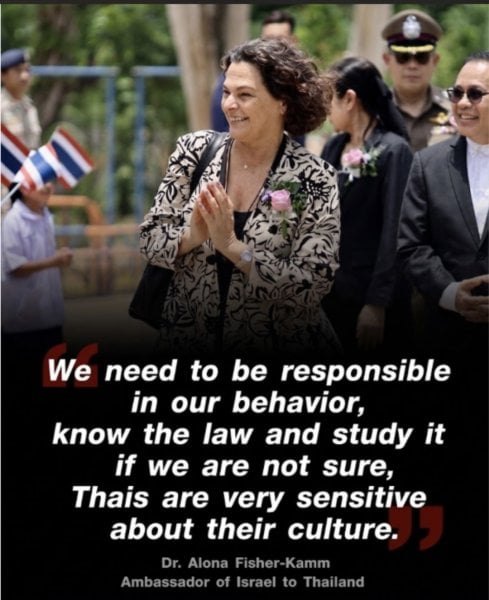
Picture courtesy of Khoasod
Join the discussion? 

17 September 2026
Recommended Comments
Create an account or sign in to comment