





Assistant Professor Dr Noppadol Kannika, a member of Thailand’s National Police Policy Committee, has called for new national security laws to tackle modern threats including foreign influence operations, cyber attacks and economic espionage. Speaking on May 13, he suggested Thailand should begin debating whether severe offences involving threats to national sovereignty and national security should carry the death penalty under strict legal safeguards.
Get today's headlines by email 
Noppadol warned that modern conflicts no longer begin with tanks or missiles but through information warfare, online influence campaigns, financial networks and covert interference. He said Thailand faced growing risks from cyber operations, disinformation campaigns, lobbying networks, strategic land acquisitions and attempts to shape public opinion through digital platforms and social divisions.
He argued that countries without strong laws against espionage and foreign interference could gradually lose sovereignty from within. According to Noppadol, threats could emerge through the manipulation of data, media, social narratives and economic influence, eventually weakening public trust, damaging state institutions and creating divisions in society.
The academic and former adviser to the Ombudsman also raised concerns about state officials allegedly abusing their authority to issue land rights, citizenship documents and permits that enable foreign-linked nominee structures. He warned that strategic areas including border zones, tourist destinations, special economic zones and areas near critical infrastructure could become vulnerable to money laundering, transnational influence networks and economic domination if left unchecked.
Noppadol stressed that Thailand should focus on identifying suspicious patterns rather than targeting foreigners as a whole. He cited examples such as unusual land ownership structures through Thai nominees, rapid demographic changes, closed business communities linked to foreign capital and opaque financial transactions.
He pointed to countries including the United States, China and the United Kingdom, which have introduced laws addressing foreign influence operations, cybersecurity threats, economic espionage and strategic sabotage. Noppadol said Thailand should study democratic legal frameworks abroad and adapt them to suit the Thai context while protecting civil liberties and the rule of law.
The proposal also highlighted the growing importance of combating hybrid threats and influence operations in the digital era. Noppadol said modern warfare increasingly focused on controlling ideas and public perception rather than territory, warning that societies could be destabilised without citizens realising they were being targeted.
He emphasised that any future legislation must remain under judicial oversight and respect human rights to avoid being misused for political purposes. Despite raising the possibility of capital punishment for severe acts against national security, he acknowledged that many democratic countries preferred imprisonment and transparency measures over the death penalty.
The Daily News reported that Thailand is now expected to face further public debate over how to balance national security, sovereignty and civil freedoms as concerns grow over foreign influence and strategic economic control.
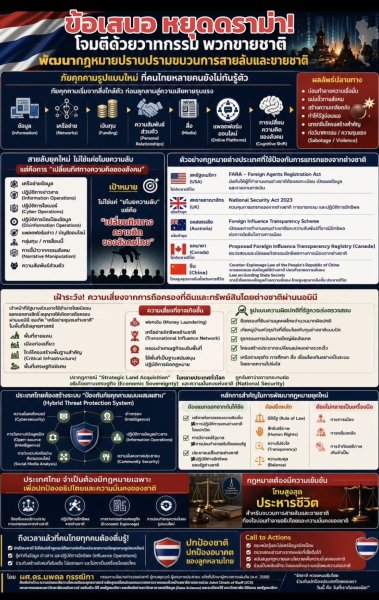
Picture courtesy of Daily News
Join the discussion? 
Already a member? 
 Adapted by ASEAN Now Dailynews 14 May 2026
Recommended Comments
Create an account or sign in to comment