



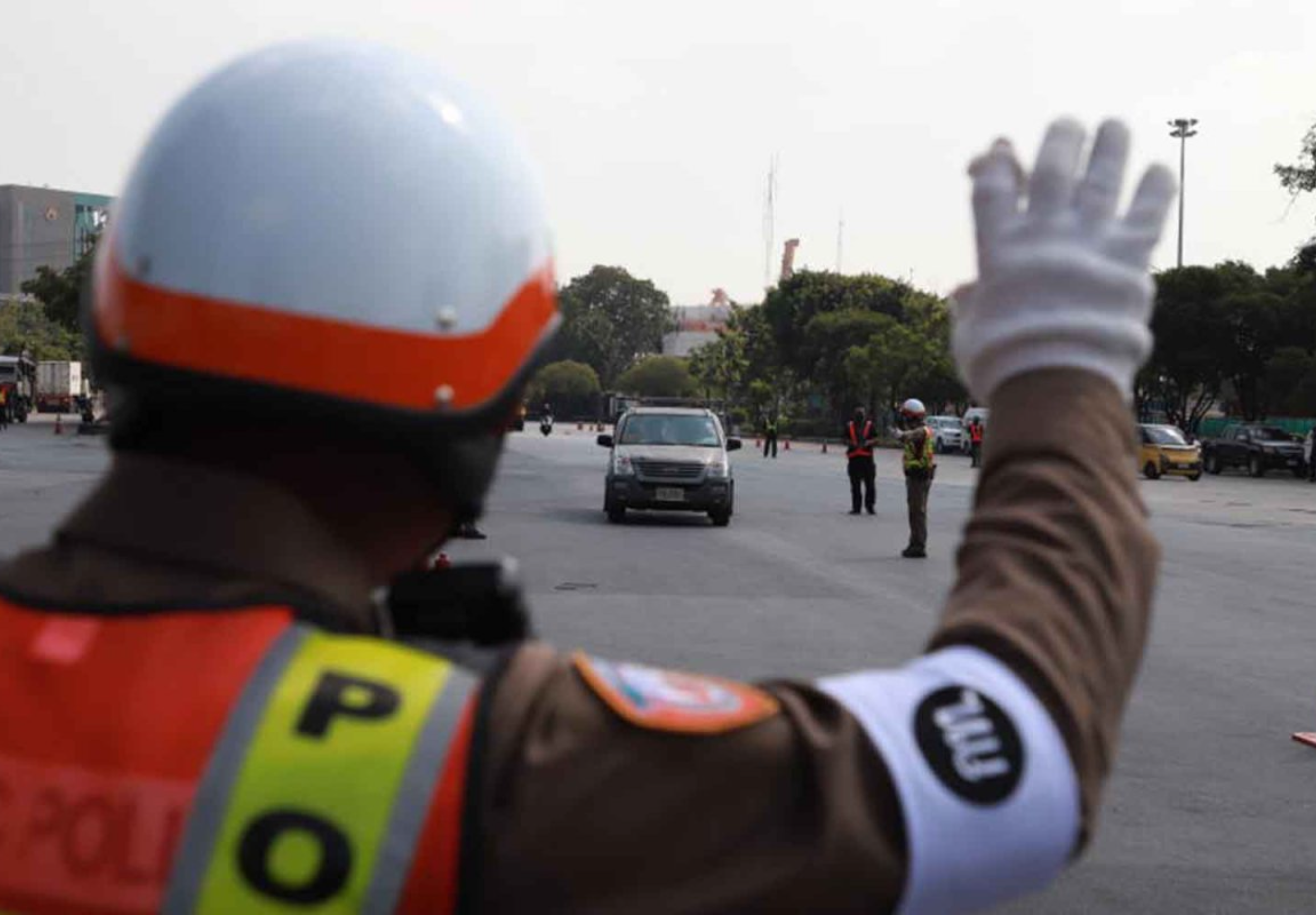

Most people in Thailand support stricter penalties for key traffic offences, but a majority oppose the current fine for speeding, according to a survey by the National Institute of Development Administration (Nida). The findings reflect public backing for tougher enforcement measures introduced from April 1, aimed at improving road safety.
Get today's headlines by email 
Nida polled 1,310 respondents nationwide by telephone on April 7 and 8, asking for views on newly enforced penalties. The survey followed the implementation of harsher punishments for multiple traffic violations, including reckless driving, drink-driving, and failing to comply with basic road safety laws.
Support was strongest for penalties targeting dangerous behaviour. On reckless driving, 74.66% agreed with fines ranging from 5,000 to 20,000 baht and/or up to one year in prison, while 12.67% said the penalties were too lenient and 11.60% too harsh. For drink-driving, 70.38% supported similar penalties, with 20.38% viewing them as too soft and 8.86% too severe.
Other offences also received majority backing, though with more mixed views. A fine of up to 2,000 baht for not wearing a seat belt was supported by 60.15% of respondents, while 35.04% thought it too high. Failure to stop for pedestrians at zebra crossings, punishable by a 4,000 baht fine, was supported by 60.08%, with 28.09% calling it too high and 11.68% too low.
Penalties for driving against traffic, failing to produce a driving licence and not wearing a helmet all received support from more than half of respondents, though significant minorities considered them too harsh. Similarly, fines for using a mobile phone without a hands-free device and running red lights were backed by just over half of those surveyed.
Speeding stood out as the only offence where most respondents disagreed with the penalty. A total of 54.43% said the fine of up to 4,000 baht was too high, while 40.69% supported it and 4.58% felt it was too low.
The results suggest broad public approval for stricter road safety enforcement, particularly for high-risk behaviours, but indicate resistance to penalties perceived as excessive for more common offences such as speeding. Authorities may face pressure to review or better justify the fine structure for speeding violations.
The Bangkokpost reported that enforcement of the new penalties is expected to continue nationwide, with officials likely monitoring public response and road safety outcomes. The survey may inform future adjustments to traffic laws as Thailand seeks to reduce accidents and improve compliance.
Join the discussion? 
Already a member? 
 Adapted by ASEAN Now Bangkokpost 20 Apr 2026
Recommended Comments
Create an account or sign in to comment