



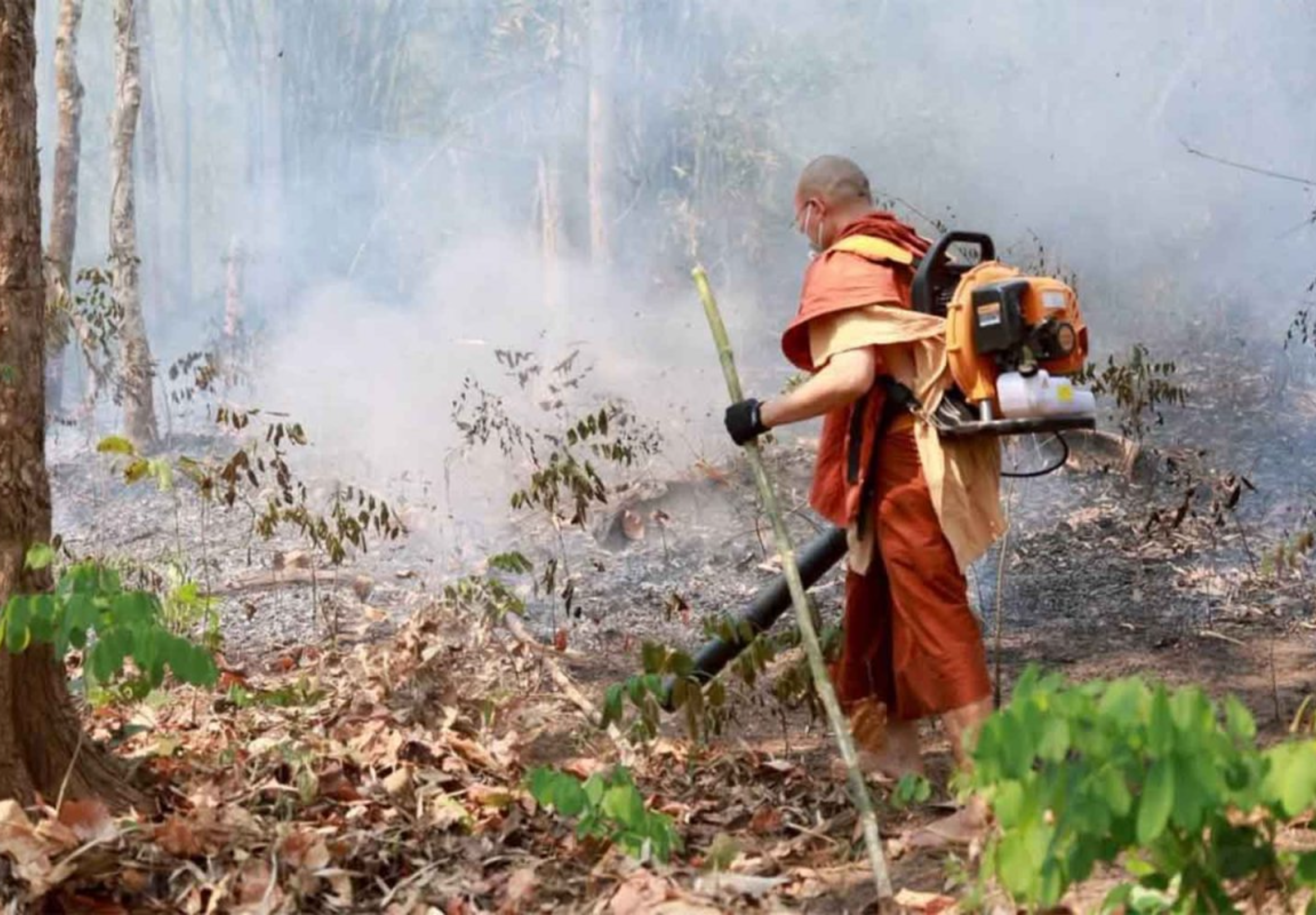

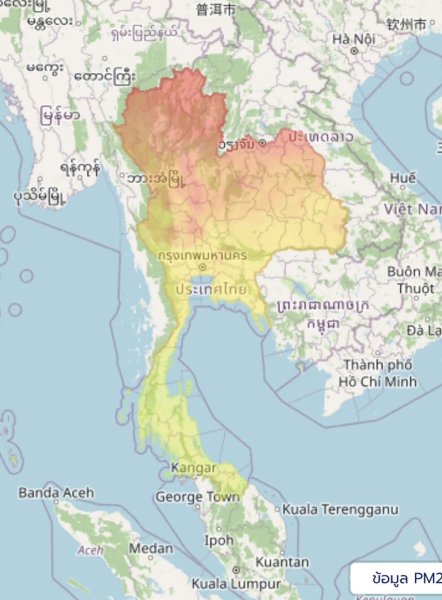
Hazardous levels of ultrafine dust covered Bangkok and 58 of Thailand’s 76 provinces on Sunday afternoon, 5 April, with air quality reaching levels considered harmful to health. The Geo-Informatics and Space Technology Development Agency (Gistda) reported at 3pm that particulate matter (PM2.5) ranged from 38.2 to 96.2 microgrammes per cubic metre (µg/m3), exceeding the government’s safe threshold of 37.5µg/m3. Ten provinces in the North and Northeast recorded red-level pollution, indicating conditions that are seriously harmful.
Get today's headlines by email 
The highest PM2.5 reading of 96.2µg/m3 was recorded in Chiang Rai. Other northern provinces with red levels included Phayao (92.1), Nan (85.8), Phrae (83.8), Lampang (83.5), Chiang Mai (81.7) and Mae Hong Son (78.6), while Bueng Kan (77.9) and Nong Khai (77.7) in the Northeast, and Uttaradit (75.7), also recorded severe pollution levels.
Bangkok and 48 provinces across the North, Northeast and Central Plain experienced orange-level pollution, indicating air quality that is starting to affect health. PM2.5 levels in these areas ranged from 38.2 to 73.3µg/m3, affecting provinces including Phichit, Lamphun, Loei, Sukhothai, Udon Thani, Nakhon Phanom, Khon Kaen, Nakhon Ratchasima and Chon Buri, among others.
By contrast, moderate air quality was recorded in five coastal provinces, with yellow-level readings: Chanthaburi (37.5), Prachuap Khiri Khan (36.6), Trat (36.2), Rayong (34) and Pattani (25.1). Thirteen southern provinces reported good air quality, with green-level PM2.5 readings ranging from 21.8 to 24.7µg/m3, including Phuket, Narathiwat, Krabi and Surat Thani.
The widespread smog reflects ongoing seasonal air pollution, often linked to agricultural burning, forest fires and weather conditions that trap pollutants. Authorities have continued to monitor air quality closely as levels fluctuate across regions.
Health experts warn that prolonged exposure to high PM2.5 levels can increase the risk of respiratory and cardiovascular conditions, particularly among vulnerable groups. Residents in affected areas have been advised to limit outdoor activities and use protective measures where possible.
The Bangkokpost reported that conditions are expected to remain under close observation, with authorities likely to issue further advisories if pollution levels persist or worsen in the coming days.
Picture courtesy of Bangkokpost
Join the discussion? 
Already a member? 
 Adapted by ASEAN Now Bangkokpost 6 Apr 2026
-
 1
1
Recommended Comments
Create an account or sign in to comment