
Skip to content
View in the app

A better way to browse. Learn more.

ASEAN NOW

A full-screen app on your home screen with push notifications, badges and more.

To install this app on iOS and iPadOS
  1. Tap the Share icon in Safari
  2. Scroll the menu and tap Add to Home Screen.
  3. Tap Add in the top-right corner.
To install this app on Android
  1. Tap the 3-dot menu (⋮) in the top-right corner of the browser.
  2. Tap Add to Home screen or Install app.
  3. Confirm by tapping Install.

Thailand warned tourist growth is straining destinations

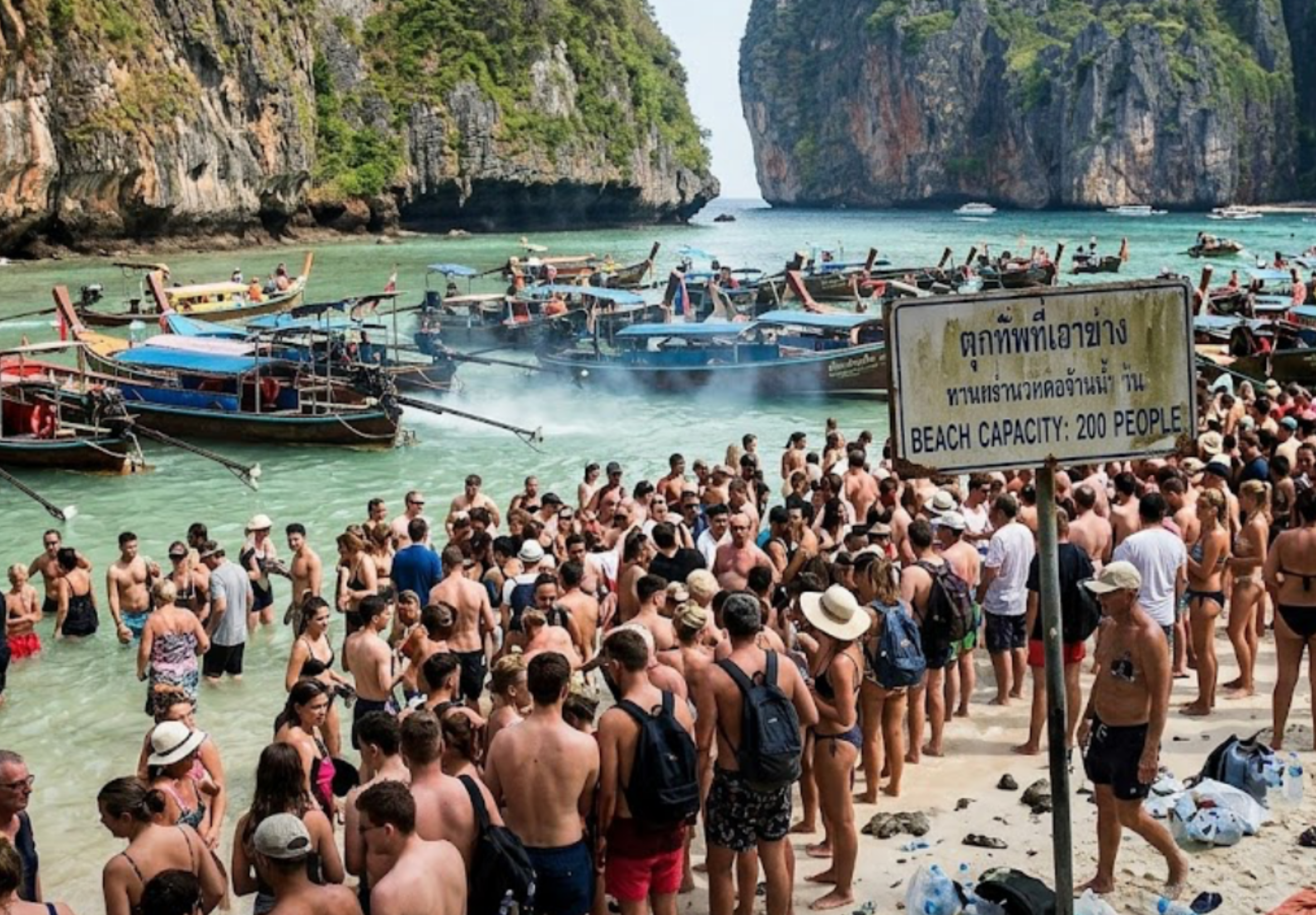
Thailand must stop measuring tourism success simply by visitor numbers and build a system that protects destinations, local communities and infrastructure, according to two researchers at the Thailand Development Research Institute (TDRI).

Nopparuj Chindasombatcharoen and Wirin Khowrat said tourism remains one of Thailand's largest income sources, but rising arrivals can also place severe pressure on natural resources, public services and the industry's future competitiveness.

Their warning comes as the government plans to reduce the visa-free stay from 60 days to 30 days, a proposal they say reflects the difficult balance between attracting visitors and managing the effects of overtourism.

For foreigners living in Thailand, as well as tourists, the issue is practical. Overcrowding, inadequate waste and wastewater systems, strained transport and public infrastructure, and safety concerns can directly affect daily life and the visitor experience in major destinations.

Sustainability schemes lack a common direction

Thailand has introduced several measures intended to support lower-carbon and more sustainable tourism. These include the Green Hotel Plus programme, Green Destination Standards for attractions, communities and small businesses, and carbon-accounting tools for hotels and low-carbon tourism routes.

However, the researchers said the schemes remain fragmented and largely voluntary. Green Hotel Plus, Green Destinations Standard, Green Health Hotel, Green Leaf Certification and carbon-measurement systems operate without a shared roadmap for the sector's transition.

They said there is also no clear common pathway setting baseline standards for tourism operators, financial incentives or government support. That leaves businesses to work out the requirements themselves rather than moving together.

Large operators generally have the money, specialist staff and management systems to meet sustainability standards, while smaller firms may lack funding, technical knowledge and operational capacity. Without changes, the researchers warned, sustainability policies could widen the gap between major companies and smaller tourism businesses.

Phuket illustrates the pressure

The authors said existing policies have not sufficiently targeted the biggest sources of tourism emissions: transport and energy use across the tourism supply chain. Many current measures instead focus on hotel standards, certification, carbon offsets and pilot projects.

They also stressed that sustainability involves more than emissions. Tourism income remains concentrated in a limited number of provinces, while many other areas have not turned visitor spending into meaningful local development.

Phuket demonstrates the risks, they said. As visitor numbers and tourism businesses have expanded, waste disposal, wastewater treatment and public infrastructure have come under growing strain, with local systems in some places struggling to cope.

Accidents and other incidents involving foreign visitors also continue to receive international attention, affecting confidence in Thailand as a destination.

Climate risks need local responses

Drought, flooding, extreme heat, coastal erosion and deteriorating marine ecosystems, including coral reefs and beaches, threaten the natural assets that draw travellers to Thailand, the researchers said.

They argued that destinations need locally tailored responses, rather than a single nationwide solution. Government should provide dependable information, improve infrastructure, coordinate agencies and help communities and tourism businesses prepare for climate impacts.

Thailand can continue growing tourist numbers, they concluded, but each additional visitor will add strain unless standards, incentives, safety, infrastructure, income distribution and climate adaptation are brought into one framework.

Join the discussion? Create account. orange.png


image.png

31 July 2026

User Feedback

Recommended Comments

L- Lifeline Silver Member

L- Lifeline

Advanced Member
15 hours ago, Jim Waldron said:

One only has to look at the water problem on Koh Samui to see why the TDRI researchers are right. As reported only yesterday, Samui's water infrastructure simply cannot supply enough to meet the demand from tourists, and rationing is now happening.

High-volume tourism places unsustainable strain on local infrastructure because visitor resource demand can often exceed local capacity. This, in turn creates shortages for local communities, further highlighting the environmental costs of simply chasing raw arrival numbers.

Beyond water, tourists also require far more energy and services than locals. High electricity consumption for air conditioning, and increased transport use raise emissions. Worse still, surging visitor numbers can overwhelm local waste management, polluting land and marine ecosystems.

The bottom line is that too many tourists lead to shortages of water and electricity, congested roads, failing sewage systems, and pressure on local housing rents.

It is clear that Thailand needs to shift away from its fixation on "headcounts" in order to preserve popular destinations and maintain the lifestyle of its citizens.

15 hours ago, Jim Waldron said:

One only has to look at the water problem on Koh Samui to see why the TDRI researchers are right. As reported only yesterday, Samui's water infrastructure simply cannot supply enough to meet the demand from tourists, and rationing is now happening.

High-volume tourism places unsustainable strain on local infrastructure because visitor resource demand can often exceed local capacity. This, in turn creates shortages for local communities, further highlighting the environmental costs of simply chasing raw arrival numbers.

Beyond water, tourists also require far more energy and services than locals. High electricity consumption for air conditioning, and increased transport use raise emissions. Worse still, surging visitor numbers can overwhelm local waste management, polluting land and marine ecosystems.

The bottom line is that too many tourists lead to shortages of water and electricity, congested roads, failing sewage systems, and pressure on local housing rents.

It is clear that Thailand needs to shift away from its fixation on "headcounts" in order to preserve popular destinations and maintain the lifestyle of its citizens.

15 hours ago, Jim Waldron said:

One only has to look at the water problem on Koh Samui to see why the TDRI researchers are right. As reported only yesterday, Samui's water infrastructure simply cannot supply enough to meet the demand from tourists, and rationing is now happening.

High-volume tourism places unsustainable strain on local infrastructure because visitor resource demand can often exceed local capacity. This, in turn creates shortages for local communities, further highlighting the environmental costs of simply chasing raw arrival numbers.

Beyond water, tourists also require far more energy and services than locals. High electricity consumption for air conditioning, and increased transport use raise emissions. Worse still, surging visitor numbers can overwhelm local waste management, polluting land and marine ecosystems.

The bottom line is that too many tourists lead to shortages of water and electricity, congested roads, failing sewage systems, and pressure on local housing rents.

It is clear that Thailand needs to shift away from its fixation on "headcounts" in order to preserve popular destinations and maintain the lifestyle of its citizens.

I agree- simply chasing a big number of tourists does not mean success per se

Quality of life for all is paramount

It is clear the volume of tourists is too much for an infrastructure that at times is fragile and always strained

khunPer Diamond Member

khunPer

Advanced Member
5 hours ago, emptypockets said:

Not residents at all. Non immigrants can't be residents, says that on your initial visa. You have a 12 month temporary permission of stay that may be extendable. Or not. Circumstances can change, agree unlikely, but not impossible. Only takes a very nationalistic government and everyone goes back home.

Yes, you are resident when it's your primary home — just like being tax resident — but you are not a permanent resident.

Geoff914 Gold Member

Geoff914

Advanced Member
16 hours ago, Jim Waldron said:

One only has to look at the water problem on Koh Samui

Very much the same in the uk and not just from the shift in the jet stream affecting all of Europe. Seems every summer now water levels are critical but they just can't stop building data centres. Google want to build a data centre close to where I live. Now the fact that it is almost next to a reservoir supplying drinking water is sheer coincidence I suppose. So the tech companies paying minimal tax will presumably demand priority when calling on water supplies.

Jim Blue Platinum Member

Jim Blue

Advanced Member
14 hours ago, SiSePuede419 said:

Thailand can continue growing tourist numbers, they concluded, but each additional visitor will add strain unless standards, incentives, safety, infrastructure, income distribution and climate adaptation are brought into one framework.

Not all tourists are equal.

IMHO Thailand wants the more educated, sensitive tourists with higher levels of consciousness.

Maybe give a test before granting the visa...

Have them use "your" and "you're" in a sentence.

Filter out the layabout scroungers. 😄

You mean ....ban backpacks !

BritScot Gold Member

BritScot

Advanced Member
19 hours ago, Hotchilli123 said:

Thailand tourism office gave up on quality years ago, since Covid only numbers mean anything...

it's as if it's some measure of success.

Sorry your so wrong! This rubbish about quality tourists has been going on since the military coup that usurped Thaksin...... I never liked him but unlike most expats I remember his premiership and the coup! Life for common Thai people and expats was so much better..... they used to track Europe and American visitors as their scale to success. Note: English skills were so much higher in schools as well....

Hotchilli123 Explorer Member

Hotchilli123

Member
5 hours ago, BritScot said:

Sorry your so wrong! This rubbish about quality tourists has been going on since the military coup that usurped Thaksin...... I never liked him but unlike most expats I remember his premiership and the coup! Life for common Thai people and expats was so much better..... they used to track Europe and American visitors as their scale to success. Note: English skills were so much higher in schools as well....

I'm not wrong, I just happen too have a different opinion to you

Hotchilli123 Explorer Member

Hotchilli123

Member
16 hours ago, Reddavy said:

Wrong MONEY means everything to Thais and as long as that is flowing in nothing else matters.

Quality would mean more money... alas Thailand has nothing to offer to the quality tourist.

Bars, karaoke and street workers doesn't quite the bill

Create an account or sign in to comment

Account

Navigation

Search

Search

Configure browser push notifications

Chrome (Android)
  1. Tap the lock icon next to the address bar.
  2. Tap Permissions → Notifications.
  3. Adjust your preference.
Chrome (Desktop)
  1. Click the padlock icon in the address bar.
  2. Select Site settings.
  3. Find Notifications and adjust your preference.