



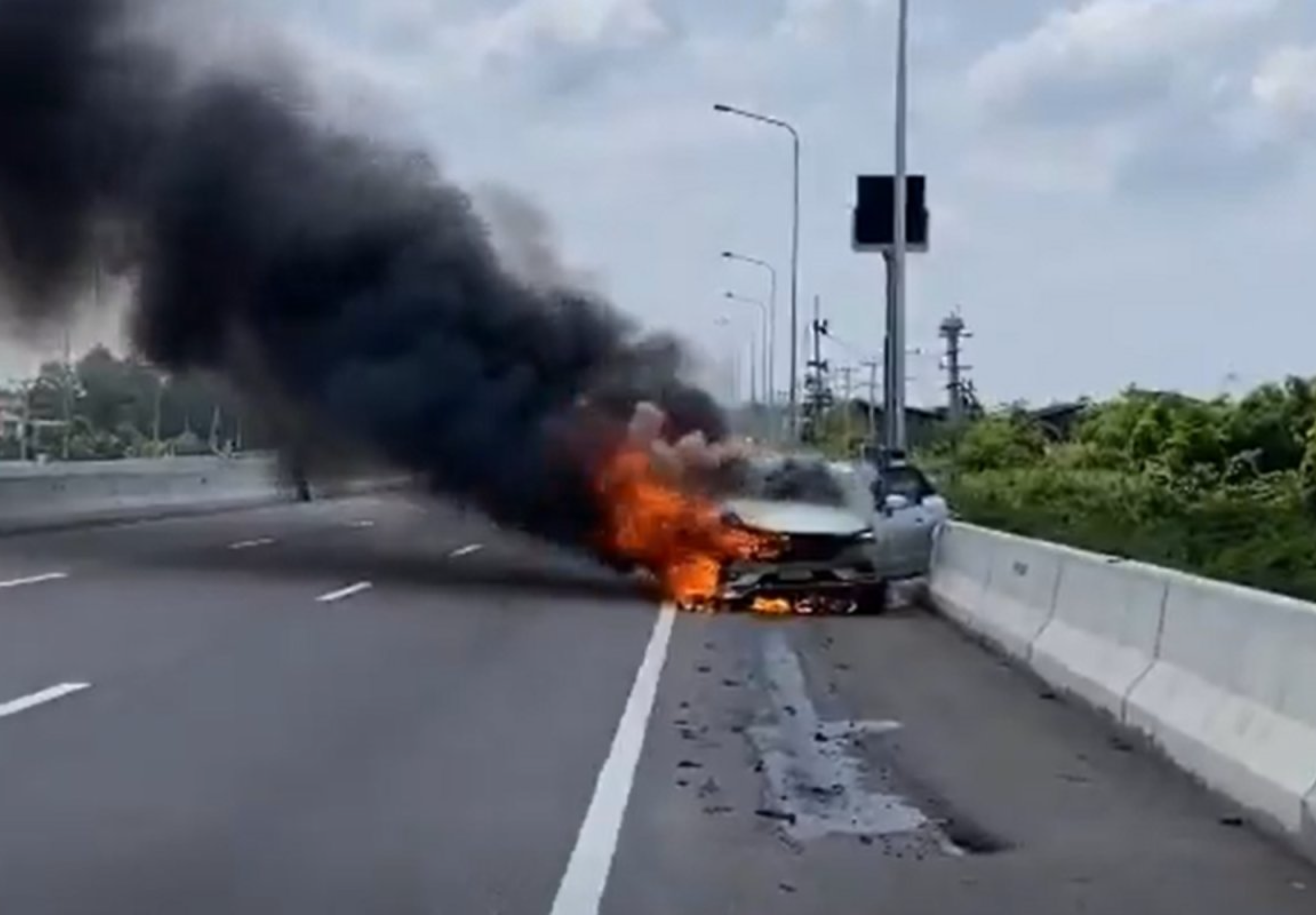

Volvo Car Thailand says an initial examination indicates that a fire involving a Volvo XC60 SUV on Motorway M81 in Nakhon Pathom did not originate from the vehicle’s high-voltage battery area. The fire occurred on Thursday in the outbound lane of the Nonthaburi-Kanchanaburi motorway, destroying much of the plug-in hybrid vehicle.
Get today's headlines by email 
The occupants, a couple and their two children, escaped safely before the fire spread through the SUV. According to the driver, a yellow warning light appeared on the dashboard shortly before smoke began coming from the hood. He then noticed a burning smell followed by flames emerging from underneath the vehicle.
The company issued a statement on Friday in response to growing public concern surrounding Volvo vehicles in Thailand. In its letter, Volvo Car Thailand said: “Based on a preliminary examination of images from the incident, together with information gathered from people at the scene, the company found that the source of the heat or fire did not originate from the high-voltage battery area.”
However, the exact cause of the fire has not yet been identified. Volvo said the investigation remains ongoing and that additional findings would be released once the full facts have been established.
The incident has attracted attention because it follows two separate fires involving Volvo EX30 electric vehicles in Thailand earlier this month. Those incidents prompted increased scrutiny from drivers and social media users concerned about the safety of electric and hybrid vehicles.
The XC60 involved in the motorway fire is a plug-in hybrid model that operates using both petrol and electric power. The EX30, which has also faced questions following recent fires, is a fully battery-electric vehicle.
Industry observers say fires involving electric and hybrid vehicles often draw heightened attention because of concerns about lithium-ion battery systems, even when investigations later point to other causes. Volvo’s statement appears aimed at addressing speculation that the battery system was responsible in the latest case.
The Bangkokpost reported that authorities and Volvo engineers are expected to continue examining the damaged vehicle to determine where the fire started and what triggered it. The company said any further developments from the investigation would be communicated publicly.
Related story
Volvo-faces-inquiry-over-ex30-battery-fires-in-Thailand
Join the discussion? 
Already a member? 
 Adapted by ASEAN Now Bangkokpost 24 May 2026
Recommended Comments
Create an account or sign in to comment