



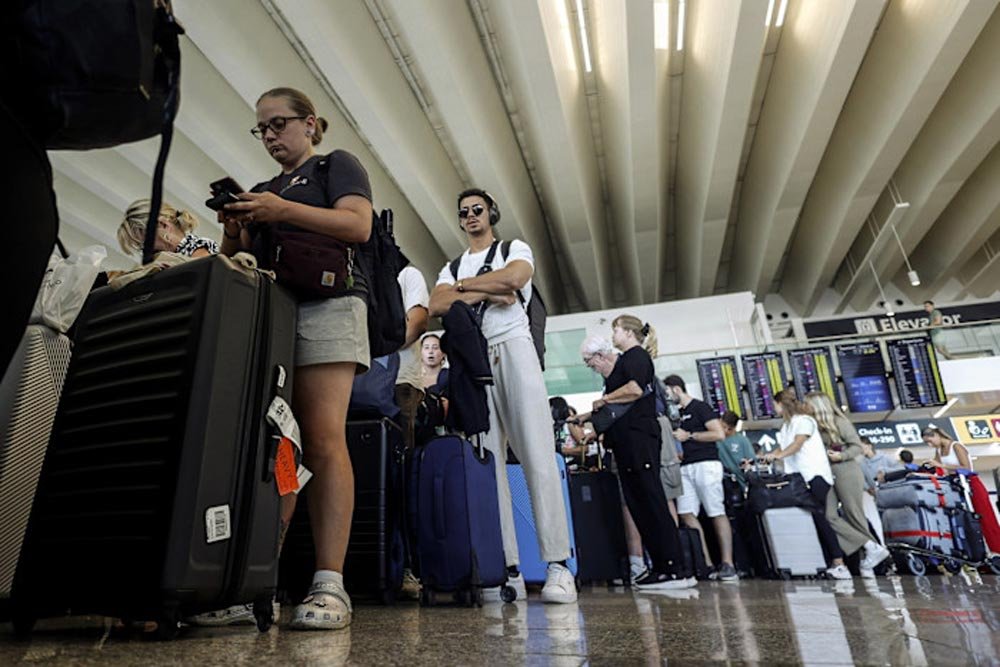

Rome’s airports have warned that the EU’s new digital border control system may need to be partially suspended during the busy summer travel season to prevent severe disruption for passengers.
Get today's headlines by email 
Airports seek flexibility over border checks
Marco Troncone, chief executive of Aeroporti di Roma, which operates Rome’s Fiumicino and Ciampino airports, said allowing some non-EU travellers to bypass the new Entry/Exit System (EES) would be the only practical way to avoid lengthy delays.
He told the Financial Times that airport operators were increasingly concerned about the system’s ability to cope with peak passenger numbers. Rating his level of concern as “eight or nine” out of 10, Troncone said the enrolment process was incompatible with the expected summer traffic and warned it would be impossible to process every eligible traveller through the system.
Biometric system faces ongoing problems
Under the EES, non-EU nationals, including British travellers, must provide fingerprints and facial images the first time they enter the European Union. The system is intended to strengthen border management by digitally recording entries and exits.
Although first introduced last October, the rollout was delayed several times because of technical problems before being fully implemented in mid-April.
The technology has continued to experience difficulties, resulting in long queues at border checkpoints. Some passengers have reportedly missed flights as a result, while even travellers who have already completed the biometric registration have sometimes been required to repeat the process instead of using the faster route.
Industry raises concerns over summer travel
Travel industry officials across Europe have echoed concerns about the system's performance.
Stefan Schulte, president of ACI Europe, the continent’s airports trade association, told the BBC that decisions to suspend or modify the system rest with individual EU governments rather than airport operators. He urged political leaders to acknowledge the problems, saying they should stop pretending the system was functioning properly.
Earlier in May, the European Commission said the EES included "built-in flexibility" that would allow certain functions to be suspended if necessary.
The International Air Transport Association (Iata) has also warned that waiting times at some airports could reach as long as six hours during the summer. According to the airline industry group, queues of up to three-and-a-half hours have already been recorded during busy periods.
In a statement released last week, Iata said the system had produced long lines, missed flights and growing concern throughout the travel sector only two months after its wider implementation.
Disruptions already affecting travellers
The new border procedures have already affected travellers in several countries.
British passengers have experienced significant delays at some EU border crossings. In May, French authorities temporarily suspended the additional EES checks at the Port of Dover to ease congestion, while Greece abandoned an earlier plan that would have exempted UK travellers from biometric checks until September.
Uku Särekanno, deputy executive director of the EU border agency Frontex, also cautioned this month that the system may take up to two years to stabilise fully.
Join the discussion? 
Already a member? 
 Adapted by ASEAN Now. Source 26 June 2026
Recommended Comments
Create an account or sign in to comment