



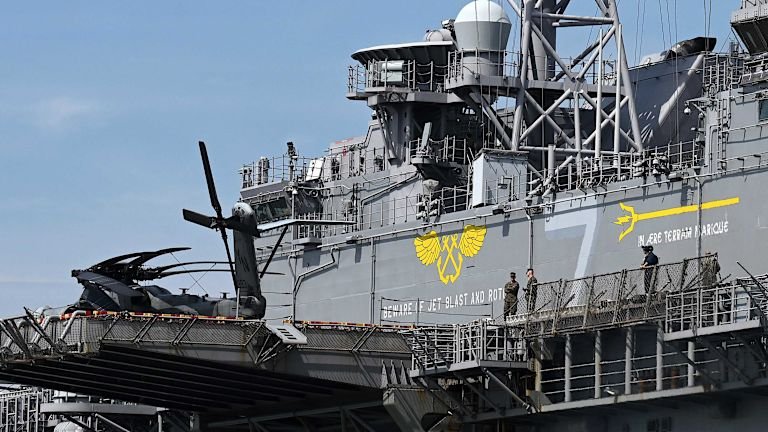

More than 3,500 US troops have reached the Middle East as fighting linked to the Iran war intensifies across the region. US Central Command said the amphibious assault ship USS Tripoli arrived with about 2,500 Marines as part of the Tripoli Amphibious Ready Group and the 31st Marine Expeditionary Unit.
Get today's headlines by email 
The vessel, previously stationed in Japan, sailed to the region roughly two weeks ago after receiving deployment orders. It is among the newest US amphibious warships and is designed to operate aircraft including F-35 stealth fighters and Osprey tilt-rotor aircraft.
New US forces arrive
Central Command said the ship also carries transport and strike aircraft as well as amphibious assault capabilities.
Additional naval forces are also heading to the region. The amphibious assault ship USS Boxer and two other vessels, along with another Marine Expeditionary Unit, have been ordered to deploy from San Diego.
Strikes and missile attacks
The reinforcement comes as military operations linked to the conflict expand. According to Central Command, more than 11,000 targets have been struck since Operation Epic Fury began on Feb. 28.
The deployment follows an Iranian attack that injured at least 10 US troops at Prince Sultan Air Base in Saudi Arabia.
Iran launched six ballistic missiles and 29 drones at the installation. Two US service members were seriously wounded in the strike.
US Secretary of State Marco Rubio said Washington believes it can meet its objectives without deploying ground forces. However, he said President Donald Trump must remain ready for multiple scenarios and retain military options.
Conflict widens across region
The conflict has disrupted global travel and energy markets. Iran’s control of the Strait of Hormuz has affected oil exports and pushed fuel prices higher.
Iran-aligned Houthi rebels in Yemen said they had joined the conflict. Houthi military spokesman Yahya Saree said the group launched missile attacks against Israel to coincide with operations by Iran and Hezbollah.
Israel said it intercepted at least one missile but did not immediately confirm further launches from Yemen.
Analysts warn the Houthis could again threaten shipping through the Bab el-Mandeb Strait, a key route linking the Red Sea with the Gulf of Aden.
The passage is vital for vessels travelling toward the Suez Canal. Around 12% of global trade moves through Bab el-Mandeb, while about 10% of maritime commerce — including 40% of container traffic — passes through the Suez Canal each year.
Saudi Arabia has already redirected millions of barrels of crude oil daily through Bab el-Mandeb as shipping through Hormuz remains effectively blocked.
Shipping risks grow
Renewed Houthi attacks could further destabilise maritime routes. Between November 2023 and January 2025, the group targeted more than 100 merchant vessels with missiles and drones, sinking two ships.
The growing tensions could also complicate the future deployment of the aircraft carrier USS Gerald R. Ford, which recently arrived in Croatia for repairs.
Sending the carrier to the Red Sea could expose it to attacks similar to those previously directed at the carriers USS Dwight D. Eisenhower in 2024 and USS Harry S. Truman in 2025.
Meanwhile, diplomatic efforts remain stalled. Trump has given Iran until April 6 to reopen the Strait of Hormuz, while Tehran says no negotiations are under way.
oin the discussion? 
Already a member? 
 Adapted by ASEAN Now. Source 29 March 2026