



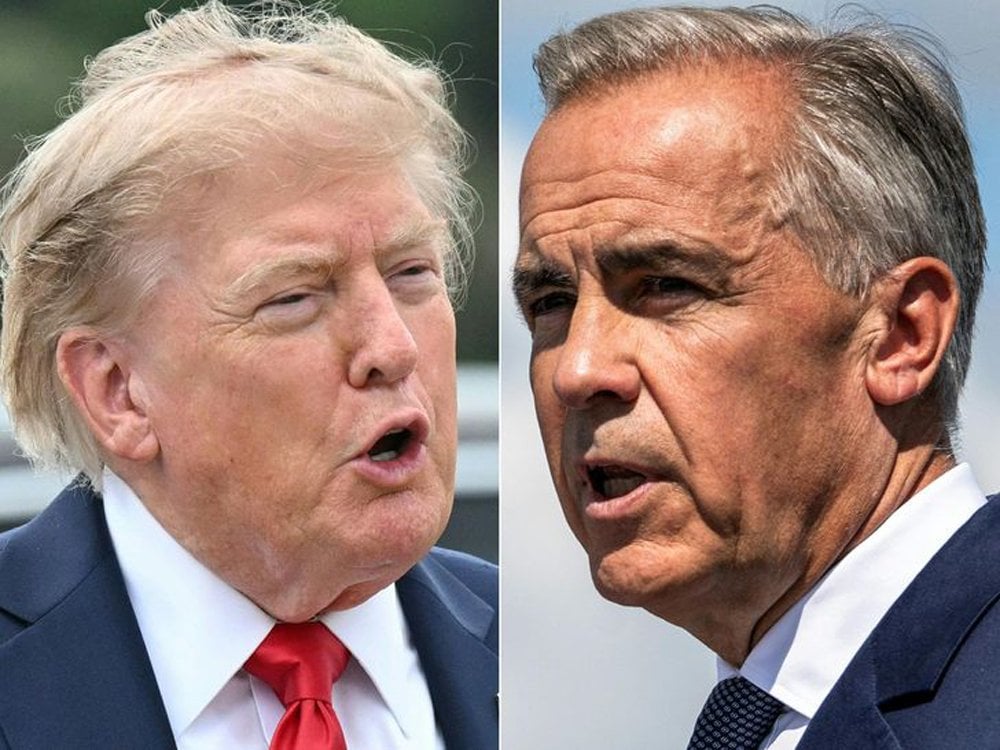

Canada’s escalating retaliation over trade is testing how far the Trump administration can push even a close ally, as a leaked account of Vice-President JD Vance’s remarks fuels tension ahead of tariff deadlines.
Leaked Comments Add Heat To Talks
Two days before US-Canada trade talks collapsed, Vance told an audience at a private fundraiser that Prime Minister Mark Carney was “a very sweet guy”. In an audio recording leaked to the Canadian Press, Vance reportedly added that Carney “comes in and puffs his chest out and says: ‘I’m going to, like, out-tough Donald Trump.’” The recording described the approach as “hilarious” because, Vance said, Canadians “climb down on a lot of issues”.
The comments attracted widespread attention in Canada, though they were not confirmed as the immediate trigger for Carney’s officials to end talks and leave over the weekend. What followed was a sharp break in negotiations for a new trade agreement and a new round of tariffs between neighbours whose two-way trade totals more than $872bn (£640bn) a year.
Why Trump Is Pressing Canada
Friction between Washington and Ottawa has long roots in Donald Trump’s first term and the negotiations that produced the USMCA, the deal that replaced NAFTA. The current conflict is also linked to personal clashes between Trump and Justin Trudeau, then Canada’s prime minister. Trump at the time derided Trudeau as “governor” and called Canada America’s “51st State”.
Behind the insults, administration officials also pursued a wider geopolitical view in which the United States was entitled to exert economic and political influence in its region. Officials said Canada was contributing too little to regional defence while benefiting disproportionately from trade with the United States.
Within that framework, Trump has repeatedly connected economic security and national security. “If you listen to really anybody in state, treasury, or commerce [departments], you will hear the phrase ‘economic security is national security’,” said Drew Delong, head of corporate statecraft at the Kearney Foresight think tank. As North American negotiations continued early this year, Trump’s focus shifted to military interventions in Venezuela and then the Middle East, but the approach to imposing pressure for national benefit has remained.
Power Limits, Retaliation, And The Chokepoint Test
The broader lesson, analysts say, is that power can be constrained when opponents still have ways to retaliate. The Trump administration is facing a comparable test in both military and economic settings, according to DeLong, despite differences between disputes over trade and conflicts in places such as Iran.
In Iran’s case, he said, leverage lies in threatening global commerce by targeting US partners and maritime chokepoints, including the Strait of Hormuz. With Canada, the mechanism is economic pain. Tuesday’s targeted tariffs were described as an initial step, with further measures possible, including restricting US access to Canadian energy and critical minerals and encouraging consumer boycotts of American goods.
DeLong said the underlying logic is spreading as governments shift toward “economic security” strategies, where countries look for “game of chokepoints and leverage angles” across supply chains.
At present, negotiators have limited clear off-ramps. Trump has accused Canada of “ripping off” the US, while Ontario Premier Doug Ford retaliated by telling the American president to “kiss my ass”. Imran Bayoumi, deputy director of the GeoStrategy Initiative at the Atlantic Council, said pushing allies and partners away can make them pursue new relationships instead of conceding.
The timing of escalation may also matter. Canada’s new tariffs are due to take effect in two weeks, while the main US response—an increase to 50% on Canadian-built vehicles and auto parts—is not scheduled until early 2027. Talks had shown progress until Friday night, offering a narrow window to restart negotiations before the next tranche of tariffs.
Deadlines Ahead Of US Midterms
A more immediate political deadline comes from November’s US midterm elections. Democratic gains could limit Trump’s room for manoeuvre, while unexpected Republican success could strengthen his position. Ottawa appears to be betting on the former, calculating that fear of a midterm blowout in industrial battlegrounds including Michigan and Ohio will pressure Trump to step back before ballots are cast.
Bayoumi said Canada does not face the kind of internal political divisions that the administration might have expected, and that Carney has “a lot of political runway” to secure a deal.
There is also another scenario: Canada could keep reducing reliance on the United States. Carney has said: “We cannot depend on traditional alliances when the rules of the game have fundamentally changed.”
Mexico, by contrast, appears to be pursuing deeper economic integration with the US. Other trading partners, including allies in Europe and Asia, are watching Canada’s resistance, DeLong said, adding that “ten years from now, this is going to be taught in classrooms” as North America may move toward “bifurcating paths” rather than reconverging.
Join the discussion? 

26 August 2026
Recommended Comments
Create an account or sign in to comment