



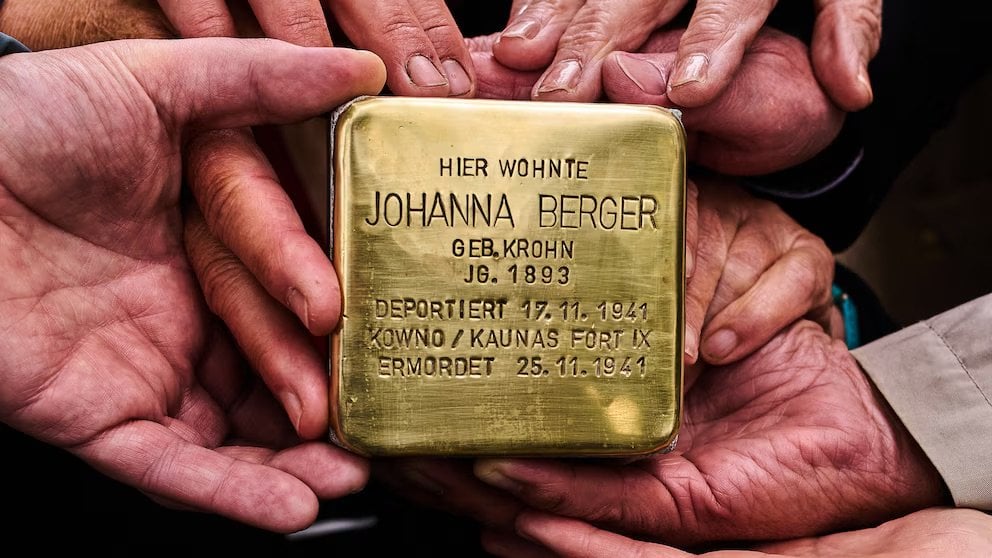

A city council in Heidenau, in eastern Germany near Dresden, has voted to end the installation of Stolpersteine memorial plaques honouring victims of Nazi persecution, a move that has prompted criticism and outrage.
City Vote in Heidenau
On Thursday, councillors in Heidenau decided to stop laying the small, engraved brass plaques on sidewalks, where they are typically set into pavements in place of cobblestones, often close to the homes where victims once lived.
The decision has drawn attention partly because members of some of Chancellor Friedrich Merz’s conservatives backed the plan alongside the far-right Alternative for Germany (AfD).
What the Plaques Mark
The Stolpersteine, created by German artist Gunter Demnig, are small memorial blocks bearing names and details about Jews and others persecuted by the Nazis. They are designed to be placed in public streets as a form of commemoration.
The first Stolpersteine were laid in Cologne in 1992. Since then, more than 126,000 have been installed across Europe, including in more than 30 countries, marking the fates of about 6 million Jews killed in the Holocaust and other victims of Nazi terror.
Backlash From Berlin and Jewish Figures
Israel’s ambassador to Germany, Ron Prosor, said he was “ashamed” about the decision. He added that some of the plaques in Berlin commemorate members of his own family and wrote on social media that a city council in 2026 had chosen not to install new Stolpersteine.
Many Jewish visitors travel to Germany for the plaque-laying ceremonies, often to remember people killed by Nazi gasings in concentration camps. Supporters of the plaques say the name-bearing memorial blocks function as the nearest equivalent to a grave.
Christian Meyer-Heidemann, the state commissioner for political education in Schleswig-Holstein, criticised the Heidenau vote as what he described to dpa as a deliberate attack on Germany’s culture of remembrance.
Wider Political Fallout
Munich has also limited Stolpersteine by not allowing them to be laid on land owned by the city, instead using alternative memorial approaches. Some Jewish leaders in Munich have objected to those substitutes, arguing that they can lead to victims’ names being stepped on.
The AfD, which is associated with anti-immigration politics and has a stronghold in eastern Germany, has gained momentum following recent electoral wins in two states. Polls suggest it is now the most popular party in Germany.
Merz, who leads the CDU, has ruled out cooperation with the AfD, which has been criticised for downplaying the Nazi past that continues to shape Germany’s politics and public thinking since the postwar years. Germany’s domestic intelligence agency has classified the AfD as extremist in some regional contexts.
Demnig, quoted by dpa, said that the Heidenau shift was not surprising after AfD electoral gains and accused the CDU of moving away from its Christian roots.
Join the discussion? 

28 September 2026
Recommended Comments
Create an account or sign in to comment