



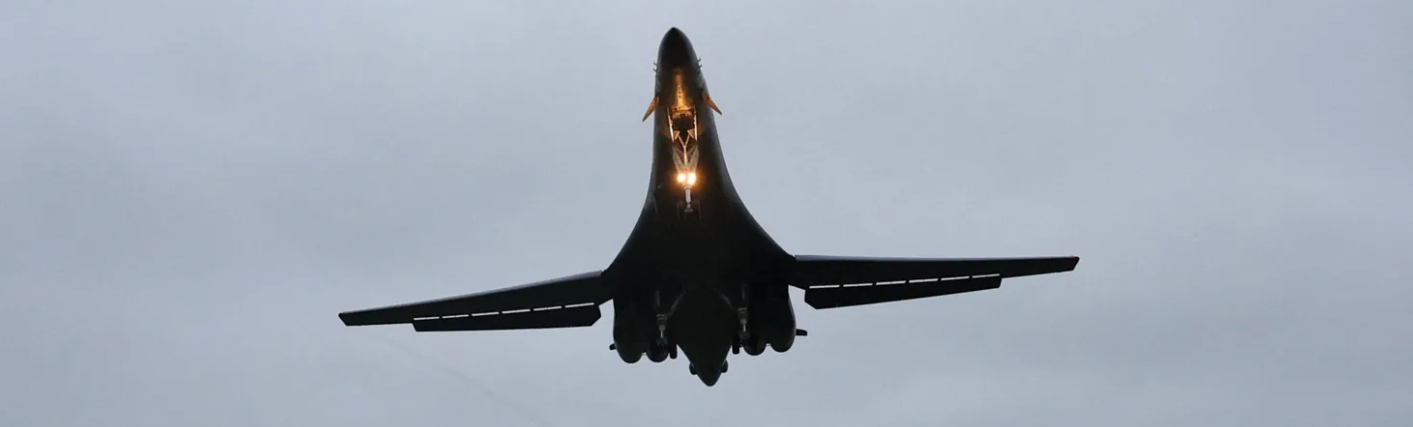

A long-range American bomber capable of carrying dozens of cruise missiles has arrived at a military base in the United Kingdom, underscoring Washington’s expanding military posture as tensions with Iran intensify.
The 146-foot B-1 Lancer landed at RAF Fairford in Gloucestershire on Friday after the British government authorised the United States to use certain UK bases for limited defensive operations connected to the conflict.
The aircraft’s arrival comes days after Prime Minister Keir Starmer agreed to allow American forces to operate from British facilities for strikes targeting Iranian missile capabilities. Officials have emphasised that the UK is not directly participating in attacks inside Iran but is supporting defensive measures to protect allied forces and regional partners.
Get the latest headlines in your email 
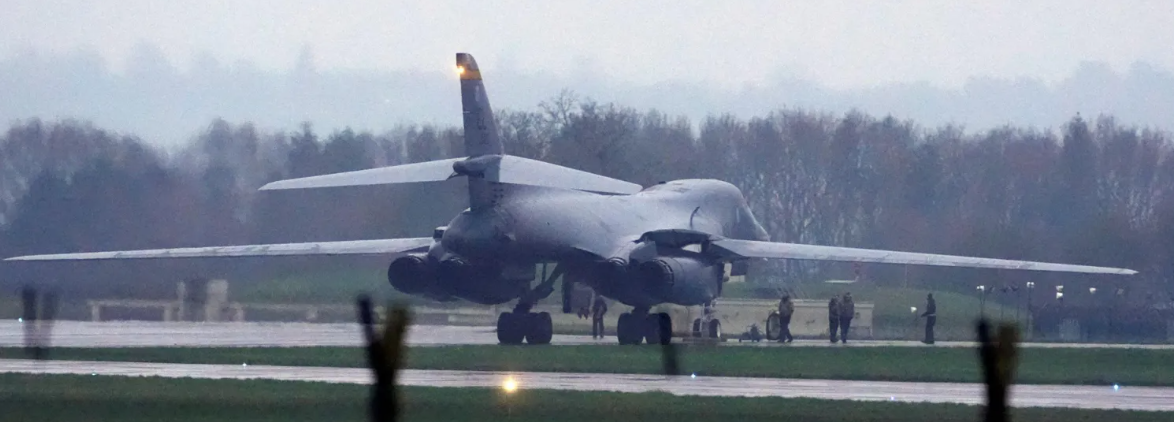
Strategic bomber deployed to RAF Fairford
The B-1 Lancer is among the most powerful aircraft in the U.S. Air Force’s long-range strike fleet. Piloted by a crew of four, the bomber has a wingspan of 137 feet and weighs about 86 tonnes.
According to manufacturer Boeing, it can reach speeds of more than 900 miles per hour, making it the fastest bomber currently in U.S. service.
The aircraft can carry up to 24 cruise missiles as well as a wide range of other precision weapons. Its systems include advanced radar and satellite-guided navigation designed to improve targeting accuracy over long distances.
To protect itself in hostile airspace, the bomber is equipped with electronic jammers, radar warning receivers and decoy systems intended to confuse enemy air defences.
Nicknamed “the Bone” by pilots and crews — derived from the aircraft’s designation B-One — the bomber has frequently been used for rapid strike deployments during international crises.
RAF Fairford’s long-standing US role
RAF Fairford, located on the border of Gloucestershire and Wiltshire, has historically served as a staging point for American heavy bombers operating in Europe and the Middle East.
The base has previously supported U.S. strategic aircraft during conflicts in Iraq and Afghanistan and regularly hosts visiting bombers during NATO exercises and rotational deployments.
Western officials said earlier this week that the UK was preparing to receive such aircraft and expected them to arrive within days as part of a broader reinforcement of American air capabilities in the region.
The bomber deployment forms part of a wider military buildup announced by U.S. Defence Secretary Pete Hegseth.
Speaking on Thursday, he indicated that American operations related to Iran were likely to intensify in the coming period.
“It’s more fighter squadrons, it’s more capabilities, it’s more defensive capabilities,” Hegseth said. “And it’s more bomber pulses more frequently.”
Britain emphasises defensive role
The British government has repeatedly stressed that its involvement in the crisis is focused on defensive actions rather than offensive strikes.
Royal Air Force aircraft have been deployed to intercept missiles and drones launched by Iran toward allied countries in the region, including those hosting Western military personnel.
Downing Street said the decision to allow the United States to operate from UK bases was aimed at preventing further attacks by targeting missile launch capabilities at their source.
A spokesperson for the prime minister told reporters on Friday that the arrangement allowed only “limited, specific and defensive use” of British facilities.
“We’ve been very clear that our response has been to allow the US limited, specific and defensive use of our bases to protect British lives, British interests and our allies in the region,” the spokesperson said.
Officials added that British forces were concentrating on air defence operations while U.S. forces targeted missile infrastructure believed to be responsible for attacks across the region.
The arrival of the B-1 bomber highlights how the conflict is drawing in additional Western military resources, even as governments continue to emphasise that their goal is to deter further escalation rather than widen the war.
Join the discussion? 
Already a member? 
 Adapted by ASEAN Now · Source · 05.03 2026
-
 1
1