



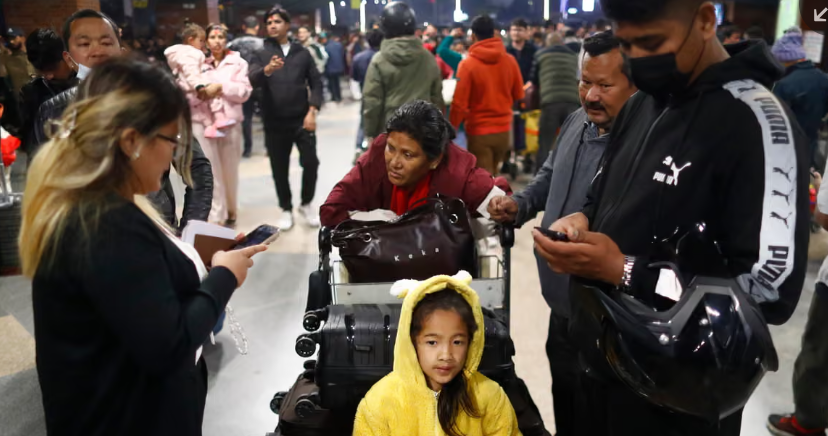

The US and Israeli attack on Iran triggered widespread airspace closures across the Middle East on Sunday, stranding or diverting hundreds of thousands of travellers and halting operations at key global aviation hubs.
Countries including Israel, Qatar, Syria, Iran, Iraq, Kuwait and Bahrain shut their airspace, while the United Arab Emirates announced a “temporary and partial closure”, according to the flight tracking website FlightRadar24. As a result, airports in Dubai, Abu Dhabi and Doha suspended operations, leading to thousands of cancellations by major international carriers, including British Airways and Virgin Atlantic.
Get the latest headlines in your email 
Dubai International – the world’s busiest airport for international passenger traffic – was among the worst affected.
UK evacuation planning
The UK government is preparing what could become one of the largest evacuations in its history. More than 76,000 British nationals have registered their presence in affected areas, with officials expecting that number to rise.
More than two-thirds of those are believed to be in the UAE, many of them tourists or business travellers rather than residents. The Foreign Office has advised against all travel to Iran, Israel and Palestine, and against all but essential travel to the UAE, Qatar, Kuwait and Bahrain.
Officials have urged British nationals to follow local safety instructions, including sheltering in place where advised. The government is examining options for potential evacuation routes, though any operation would pose significant logistical challenges.
Airports targeted and airlines suspend services
Major regional airports were also caught up in Iran’s retaliatory strikes. Dubai International Airport and the nearby Burj Al Arab hotel reportedly sustained damage, with injuries reported. In Abu Dhabi, an incident at Zayed International Airport was said to have resulted in casualties, though details remained unclear.
The three main Gulf carriers – Emirates, Qatar Airways and Etihad Airways – typically handle around 90,000 passengers a day through their hubs, according to aviation analytics firm Cirium. All three suspended flights.
More than 3,400 flights were cancelled across seven major Middle Eastern airports on Sunday. FlightRadar24 said a notice to airmen had extended the closure of Iranian airspace until at least Tuesday morning UK time.
Ongoing uncertainty for travellers
The closures are compounded by regional tensions elsewhere, including fighting between Pakistan and Afghanistan, which is narrowing alternative flight corridors and increasing congestion.
At Heathrow, 24 of 56 scheduled departures to Middle Eastern destinations were cancelled on Sunday, according to Cirium. Some airlines issued waivers allowing passengers to rebook without penalty.
Henry Harteveldt, president of Atmosphere Research Group, warned travellers to expect further disruption in the coming days. John Strickland, a UK-based aviation analyst, said the scale of the crisis lay not only in the number of passengers affected but also in displaced crews and aircraft.
Airlines have urged passengers to check flight statuses before travelling to airports, as the situation remains fast-moving and highly uncertain.
Join the discussion? 
Already a member? 
 Adapted by ASEAN Now · Source · 01.03 2026