




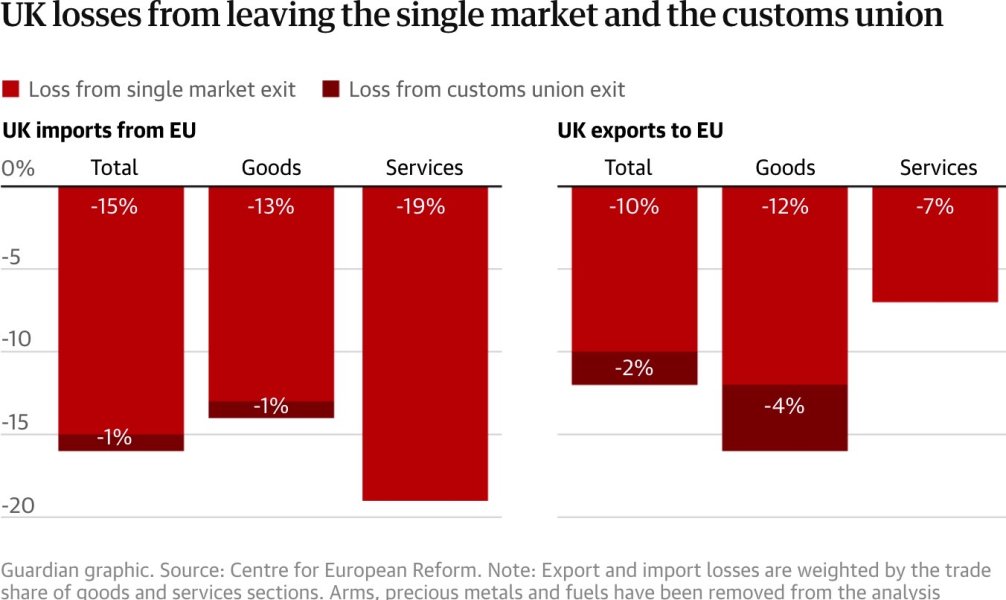
Brexit has reduced UK exports to the European Union by an estimated 12%, with most of the decline linked to the country's departure from the EU single market rather than its exit from the customs union, according to new research.
Get today's headlines by email 
The analysis, conducted by economists John Springford and Anton Spisak of the Centre for European Reform (CER), comes as debate over the UK's future relationship with the EU gains renewed political attention nearly a decade after the 2016 referendum.
Exports to EU Remain Below Pre-Brexit Expectations
Their findings indicate that UK services exports to the EU are around 7% lower than they would have been had Britain remained a member of the bloc, while goods exports are 16% lower.
Using trade data and economic modelling, the researchers conclude that around 10 percentage points of the overall 12% decline in exports can be attributed to leaving the single market.
They argue that regulatory barriers introduced after Brexit, including certification requirements and checks to ensure compliance with EU standards, have had a greater effect on trade than customs-related obstacles.
Single Market Departure Seen as Main Factor
According to the study, sectors experiencing the largest losses include travel, finance and insurance, chemicals and pharmaceuticals, and agrifood.
The researchers also suggest that previous estimates may have understated the impact on services exports. Their assessment takes into account a rise in services trade among EU member states following the Covid-19 pandemic, growth from which the UK has largely been excluded.
Political Debate Over Future EU Ties
The findings emerge as Prime Minister Keir Starmer and Chancellor Rachel Reeves continue to emphasise the importance of improving trade relations with the EU. A UK-EU summit is scheduled for next month.
However, the government has maintained its position that it will not seek to rejoin either the single market or the customs union, nor restore freedom of movement.
At the same time, potential future Labour leadership contenders Andy Burnham and Wes Streeting have both indicated support for eventual UK re-entry into the EU.
The Liberal Democrats have also shifted their stance. Party leader Ed Davey recently announced that the party would campaign for the UK to rejoin the single market, moving beyond its previous support for customs union membership alone.
Customs Union Benefits Viewed as Limited
The CER study argues that rejoining the customs union would provide only modest economic gains. While it would remove the need for businesses to comply with complex "rules of origin" requirements governing tariff-free trade, it would do little to address the challenges facing the services sector.
The researchers found that relatively few current exports are affected by those rules, suggesting the overall boost to trade would be limited.
They also note that customs union membership would restrict the UK's ability to negotiate independent trade agreements, since members must apply the EU's external tariff regime.
By contrast, regaining access to the single market could recover a much larger share of lost trade. However, the economists say such a move would involve significant political compromises, including accepting freedom of movement, contributing to the EU budget and aligning with EU regulations without direct influence over their creation.
The report also finds little evidence that stronger trade relationships with non-EU countries have compensated for reduced trade with Europe, contrary to arguments made by some Brexit supporters before the referendum.
Its conclusions are broadly in line with other studies estimating that Brexit has reduced UK economic output by between 4% and 8%.
Join the discussion? 
Already a member? 
 Adapted by ASEAN Now. Source 19 June 2026
-
 1
1
Recommended Comments
Create an account or sign in to comment