



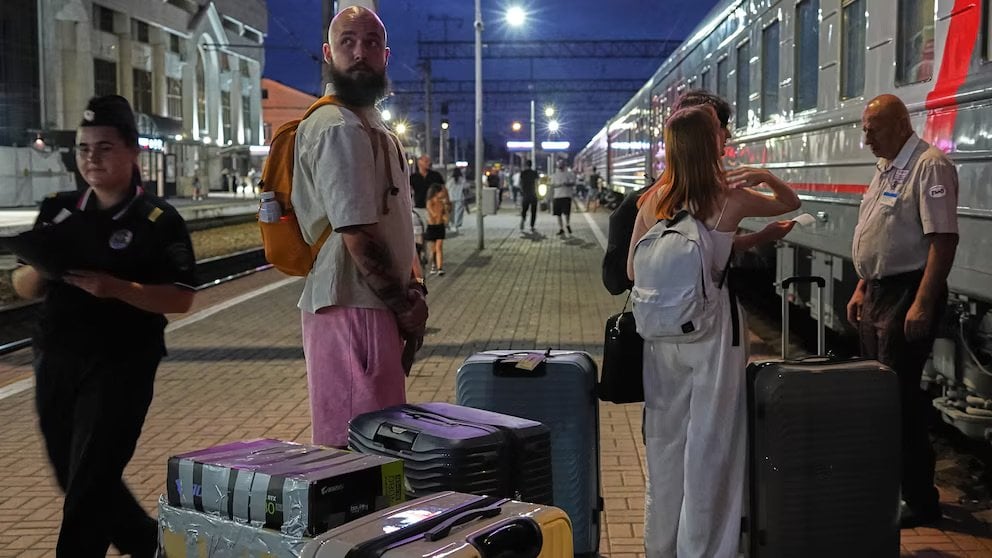

Some Russians have continued leaving the country this year, citing fears of another mobilisation for the war in Ukraine, alongside a crackdown on civil liberties and shrinking room for everyday life online.
This summer, a 28-year-old digital content marketer left Russia for Georgia after packing up in Krasnodar and travelling towards the border. Speaking to The Associated Press on condition of anonymity for security reasons, he said he was driven by “the political situation” and by problems caused by authorities restricting access to the internet. He said he would not have gone for more than a few months if not for the wider climate in Russia.
The departures come as parts of Ukraine have carried out drone attacks inside Russia, including this summer. The attacks triggered an unprecedented fuel crisis and hit the fast-growing e-commerce sector, and the government has since used the incidents to justify tightening controls on internet access.
Departure Wave Not Like 2022, Aid Group Says
The overall scale of the exodus appears smaller than in 2022, when hundreds of thousands fled following Russia’s full-scale invasion of Ukraine. A group that helps people move abroad, Kovcheg, said it received nearly eight times more enquiries in the past month than it did in May.
Anastasia Burakova, the founder of Kovcheg, said the figures did not necessarily point to a large crowd at borders, but suggested people were preparing to emigrate and exploring options. She said current numbers are difficult to verify because, unlike 2022, there were no visible scenes at border crossings and no clear shortages of flights to visa-free destinations such as Armenia, Georgia, Kazakhstan and Turkey.
AP also found numerous videos posted on social media from across Russia in which people said they had decided to leave for war-related reasons. Others cited worries about economic decline, uncertainty about the future, and reduced freedoms.
Ukrainian President Volodymyr Zelenskyy and other officials in Kyiv have said Russia plans another mobilisation after the State Duma election, which ends on Sunday. The Kremlin has repeatedly rejected such claims.
Kovcheg coordinator Yan Slovitsky said there had been “a panicked wave” of people leaving since mid-July, linking it to mobilisation fears as well as the fuel crisis and internet restrictions. A Moscow-based diplomat told AP there had been a “palpable rise in public anxiety” over the summer, and cited anecdotal evidence of more Russians appearing in Georgia and Armenia, possibly after concerns that another mobilisation could follow the Duma elections.
Armenia Signals Help, Moscow Rejects It
Armenia’s Security Council secretary Alen Simonyan told an independent Russian channel last month that Armenia “will not interfere in any way” and would help Russians who move there to avoid being drafted. The Russian Foreign Ministry responded with a rebuke, calling the remark “provocative”.
Russian lawmaker Viktor Sobolev, speaking on RTVI, said Russia did not need people who “leave because of rumours” and added that they should go.
Fears Behind Individual Decisions
The digital content marketer said he had tried to leave before. He moved abroad in 2022 to avoid the partial call-up of 300,000 new troops announced by President Vladimir Putin. He said he is not technically eligible for military service in peacetime due to a hip condition, but felt it was safer to leave because he did not know how authorities would act. In 2025, he returned to his hometown of Ulyanovsk and worked remotely for clients abroad, but said Russia’s ongoing clampdown on thousands of online platforms and services made his work harder, requiring him to switch virtual private network servers to maintain access.
From Tbilisi, he said the rumours of mobilisation also weighed on him because, as he put it, people cannot know what will happen next.
AP heard similar accounts from others. A 23-year-old Muscovite who left last month said mobilisation rumours and fears about her husband’s situation prompted her departure. She said her father narrowly avoided being drafted in 2022 by fleeing, and that this year her husband’s deferment ended after he finished a master’s degree. Another man, Ivan Nazarov, moved to Yerevan and said he was acting for “survival” after hearing reports that conscripts thought to be protected from deployment to Ukraine were being forced to sign contracts.
Queer activist Daniil Neonov said he left after a sequence of detentions and a 10-day jail term over charges related to an extremist symbol after he posted a photo of a rainbow-coloured T-shirt. He said Russian authorities treat the “international LGBT movement” as extremist, and that people carrying rainbow items have faced charges. He also said he knew others who left after being detained for supporting the opposition Yabloko party following a court decision to remove it from the election ballot.
A 35-year-old man preparing to leave told AP he wanted to avoid living without free speech, where he said the economy is sliding and where schoolchildren receive propaganda about the war.
Join the discussion? 

14 September 2026
Recommended Comments
Create an account or sign in to comment