



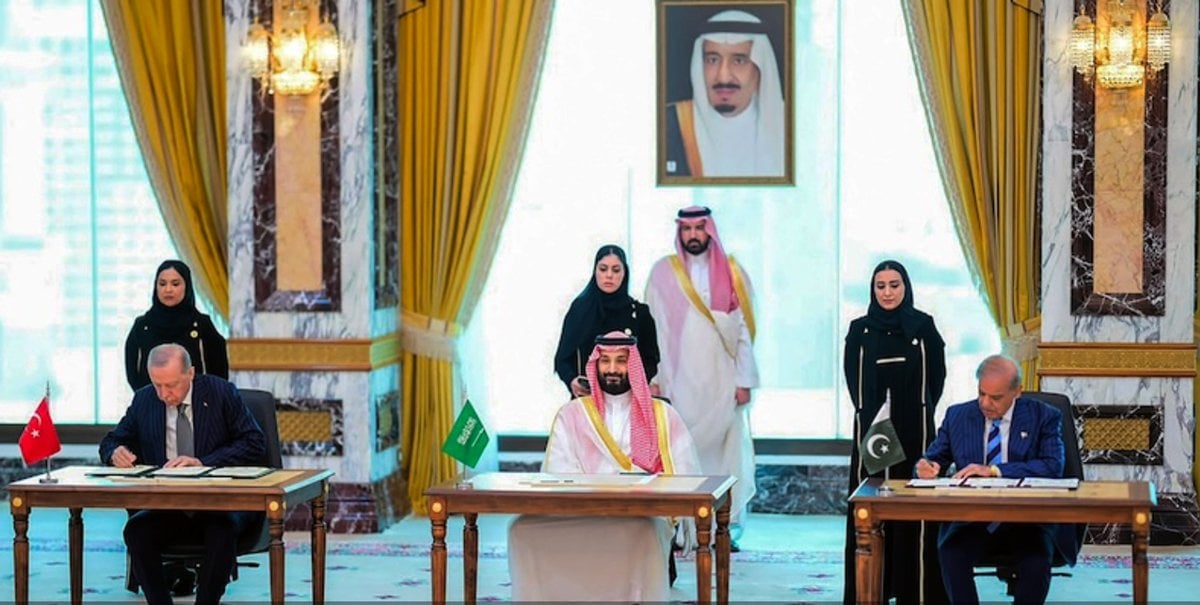

Saudi Arabia, Turkey and Pakistan have signed a joint defence agreement in Mecca that says an attack on any one of the three countries would be treated as an attack on all of them.
The pact was announced following a meeting between Saudi Crown Prince Mohammed bin Salman, Turkish President Recep Tayyip Erdogan and Pakistani Prime Minister Shehbaz Sharif in the Saudi city.
Defence Pledge Built Around Collective Deterrence
The “Mecca Joint Defence Agreement” says it is designed “to strengthen collective deterrence against any act of aggression”. It also stipulates that any armed attack against any one of the three states “shall be regarded as an attack against them all”, according to a joint statement.
The statement added that the agreement provides for closer defence co-operation across multiple areas.
While the pact commits the three countries to mutual support, it does not set out specific obligations for each party, including the practical steps that would follow an attack.
A Turkish official, quoted by Reuters, said the arrangement was “purely defensive in nature”.
Reaction From Tehran After Rising Tensions
The announcement comes amid heightened tensions across the Middle East linked to the conflict involving Iran.
After the US and Israel attacked Iran on 28 February, Tehran and its allies launched strikes on targets in Saudi Arabia and other Gulf states, and disrupted traffic through the Strait of Hormuz and the Red Sea, both major maritime routes for oil shipments.
The Mecca agreement drew criticism from Tehran. Ebrahim Rezaei, a senior member of Iran’s national security commission, wrote on X that a “paper agreement” between Saudi Arabia, Turkey and Pakistan would not improve security for Riyadh, adding that past efforts involving American support had not provided protection.
Saudi Arabia and Pakistan had already announced a joint defence pact last year.
Regional Security Shifts Driving New Calculations
Saudi Arabia’s decision to expand its defence alignments reflects concerns about how regional security has been reshaped by the war around Iran.
Last month, Yemen’s Iran-backed Houthi rebels, which control much of the north-west of the country, announced a “maritime embargo” against Saudi Arabia. They also targeted Saudi airports, oil facilities and tankers in the Red Sea.
Saudi planners were also influenced by last year’s Israeli strikes on Doha that targeted senior Hamas officials. A report by the Centre for Strategic and International Studies at the time said Gulf states “recalibrated their defence strategies”, with the Mecca pact presented as one of Saudi Arabia’s responses.
Benefits Viewed Differently by Each Partner
For Pakistan, the defence pact offers support at a time of renewed regional risk. In May 2025, long-standing tensions with India escalated into open conflict. Although an all-out war was avoided, analysts said the economic strength of Saudi Arabia and the military and industrial capabilities of Turkey could prove increasingly significant.
The agreement also coincides with Pakistan’s expanded role in diplomacy. Pakistan has acted as an intermediary between Iran and the US and hosted ceasefire negotiations, increasing its standing in the region, a factor that the pact further reinforces.
For Turkey, the deal is also seen through an industrial and operational lens. Burcu Ozcelik of the London-based Royal United Services Institute (Rusi) said it could open opportunities for Turkey’s defence sector through joint production, technology partnerships, procurement and greater military interoperability.
Unclear Triggers, But Deterrence Is Central
Although the agreement provides a framework for collective deterrence, the absence of detailed obligations leaves unanswered questions about when support would be activated and what form it would take.
Such scenarios could involve complex political choices and require careful diplomacy to avoid escalation. However, the central consequence the three countries appear to be relying on is deterrence: with two additional regional powers behind them, the potential cost of aggression would be higher.
Join the discussion? 

8 August 2026
Recommended Comments
Create an account or sign in to comment