



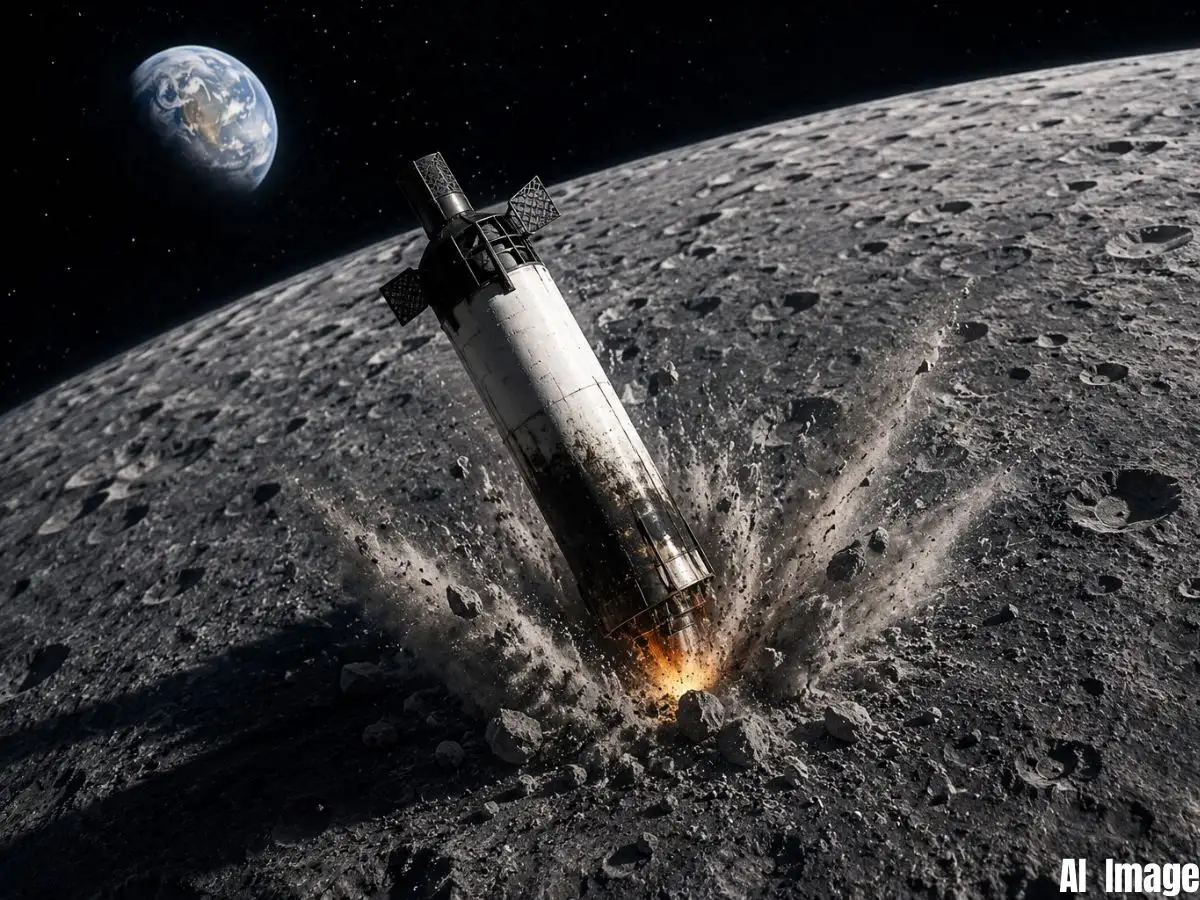

A four-tonne section of a SpaceX Falcon 9 rocket is due to hit the Moon on Wednesday in an unintentional collision, NASA said, creating a new crater and generating an opportunity for follow-up scientific observations.
The object, described as “school-bus-size”, is the second stage of a Falcon 9 launch that carried a lunar lander for Firefly Aerospace toward the Moon in January 2025. The stage has been travelling through space since last year, drifting among other tracked pieces of orbital debris.
Impact Details
NASA said the rocket body is expected to strike at about 06.35am GMT, crashing into the lunar surface at an estimated speed of 5,400 mph (8,690 km/h). The impact is expected to kick up a plume of lunar dust, likely illuminated by sunlight, though NASA said it would be difficult to observe from Earth with the naked eye.
The agency expects the collision to produce a crater about 60 ft (18 metres) wide and 12 ft (four metres) deep. It said dust and rock would be thrown outward as ejecta.
The stage is forecast to hit Einstein crater on the Moon’s western limb, a region that is often challenging to view from Earth.
Why The Stage Reached the Moon
Ordinarily, the stages of launch vehicles either re-enter Earth’s atmosphere and burn up or fall into the ocean after delivering a payload to a specific orbit. In this case, NASA said the January mission required more thrust than missions aimed at orbits closer to Earth, leaving the Falcon 9 second stage in space.
The stage had dumped its remaining fuel and cannot be controlled. NASA said it remained on an orbital path among thousands of pieces of debris, with active satellites needing to avoid such objects.
Julianna Scheiman, SpaceX director of NASA science and Dragon programmes, said on Monday that solar activity and gravity forces had combined to place the stage on a trajectory ending at the Moon.
What NASA Will Do
NASA said there is no danger to Earth from the planned impact. The agency and its partners plan to look for chances to image the site before and after the collision, with any collected data helping scientists “better understand artificial impacts and their exploration implications”.
Jimi Russell, speaking for NASA, said on Tuesday that researchers were planning to gather lunar data from the event and refine techniques for tracking objects in space.
Independent astronomer Bill Gray, whose widely used astronomy software was cited in connection with the report published in April, said the incident could have minor scientific interest and that it did not pose a danger to anyone.
Gray also said the episode highlights shortcomings in the way leftover hardware is disposed of after launches.
Past Moon Impacts And Recent SpaceX Results
Impacts with rocket stages on the Moon are rare. A Chinese rocket stage crashed into the lunar surface in March 2022 after completing a lunar test mission. In 2009, NASA intentionally sent a rocket stage into the Moon to study the plume of material kicked up by the impact.
Other spacecraft that aimed to land softly on the Moon in recent years have also crashed. Russia’s Luna-25 mission failed in 2023, while India’s Chandrayaan-2 lander crashed in 2019. Israel’s Beresheet lander also crashed that year; its payload included tardigrades, microscopic animals known for surviving radiation and other harsh conditions, which may still be present on the surface.
Scheiman said NASA and SpaceX are discussing ways to prevent similar lunar impacts in future.
The announcement comes after SpaceX reported on Tuesday a smaller-than-expected quarterly loss alongside a revenue increase in its first report as a public company. Even so, the company’s shares fell after investors expressed continued scepticism about its ability to deliver on long-term targets.
Join the discussion? 

5 August 2026
-
 1
1
-
 1
1
Recommended Comments
Create an account or sign in to comment