



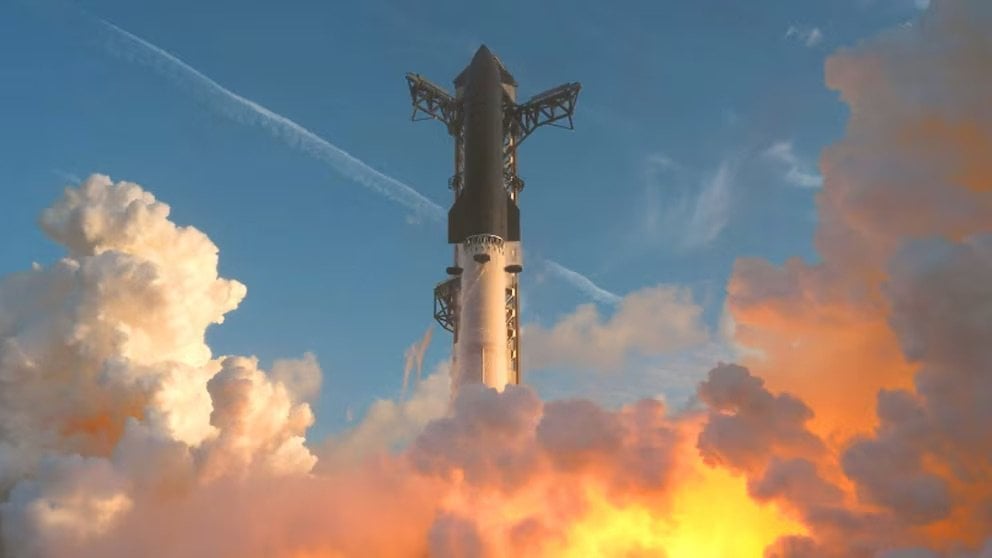

SpaceX launched Starship on Monday in its 14th test flight, aiming to put the spacecraft into orbit for the first time. The flight is also intended to support Starlink’s ongoing satellite internet service, with the company deploying operational satellites into space for use rather than for evaluation purposes.
Launch From Starbase
Starship lifted off at 8:50 a.m. ET from Starbase in Cameron County, Texas. SpaceX initially planned a 8:15 a.m. ET departure, but pushed the launch later to 8:48 a.m. ET. Flight controllers had a 75-minute window to get the spacecraft off the pad.
During the ascent, Starship lost one engine, a step SpaceX said was not required to reach orbit. The vehicle then carried out its orbital insertion burn successfully.
Starlink Deployments For Ongoing Use
Just over half an hour after liftoff, Starship began deploying 26 Starlink V3 satellites. SpaceX said it was the first time the Starlink satellites themselves had been placed into orbit for ongoing use. In earlier missions, Starlink payloads had included either simulators or satellites that burned up in the atmosphere.
The mission is scheduled to last just under 10 hours, with SpaceX targeting roughly six orbits. However, it also includes planned abort opportunities. If the flight encounters problems, SpaceX could end the mission early.
With a successful orbital insertion, Starship would travel at about 17,500 mph, more than 170 miles above Earth.
Video screenshot
Booster Return And Planned Abort Options
The launch used Starship’s Super Heavy booster. The booster separated from the spacecraft after liftoff and carried out a boostback burn to alter its trajectory for a return to Earth. After a landing burn, the booster splashed down in the Gulf.
Starship began the mission on what SpaceX describes as a “passively safe” suborbital and free-return trajectory. SpaceX said this route matches the approach used for previous flights. In the event of an early problem, the free-return path is designed to allow an abort without requiring additional manoeuvres, with re-entry occurring over the Indian Ocean before splashdown.
During the flight, SpaceX plans regular vehicle health checks. The company said Starship has more than 500 sensors monitoring parameters including temperature, pressure and acceleration, and that it transmits continuous telemetry to mission controllers. If issues develop later, Starship can deorbit early and splash down in the ocean.
At the end of the planned mission, Starship will perform a deorbit burn using a single Raptor sea-level engine in preparation for atmospheric re-entry. SpaceX said it expects to splash down in the Pacific Ocean to the west of Chile. If the flight terminates early due to a technical or mechanical issue, the splashdown location could change.
Join the discussion? 

28 September 2026
Recommended Comments
Create an account or sign in to comment