



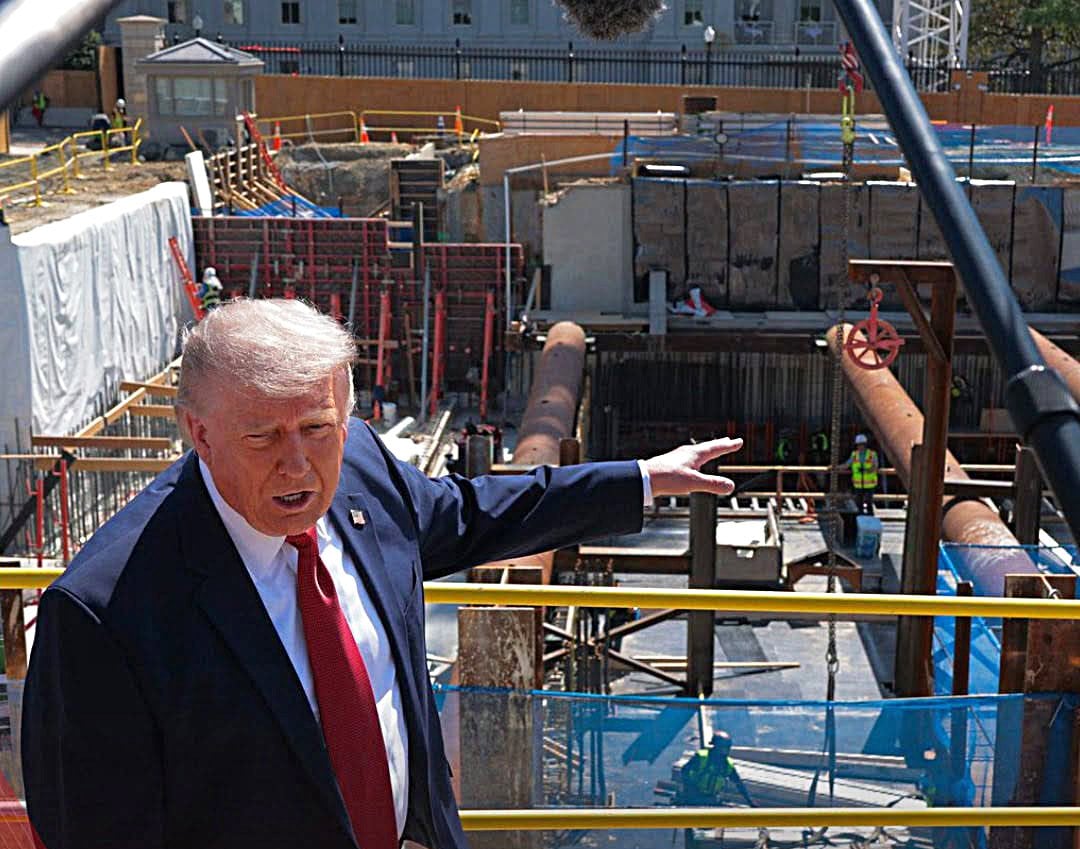

US President Donald Trump has asked the Supreme Court to allow him to continue building a $400m (£295m) ballroom at the White House without congressional permission, despite a court order that construction should stop until lawmakers approve.
Trump’s emergency application was submitted one week after a federal appeals court ruled that work must pause until Congress grants approval. The decision upheld a ruling won by the National Trust for Historic Preservation, which sued the administration last year.
Stop-Work Order Challenged
In the latest filing, US Solicitor General D John Sauer asked the Supreme Court to permit construction to continue while the government appeals the stop-work order. He described the order as “dangerous”.
Sauer said the project is about 65% complete and argued that halting the work would be unfair. He said refusing emergency relief would amount to “construction-by-injunction”, with restrictions effectively preventing the administration from completing work that had already begun.
He warned that the effects of the injunction would be especially inequitable after 21 August, when the appeals court ruling is due to take effect. The Supreme Court would need to grant the emergency request before then to prevent work from being stopped.
Sauer also argued that requiring the president to seek congressional approval would give the legislature “dangerous leverage”, and that insisting on such steps would risk undermining the purpose of the court intervention.
Supreme Court Chief Justice John Roberts ordered the National Trust for Historic Preservation to file a response by noon on Tuesday.
Security and Event Space Claims
Trump has previously said the White House does not have a suitable large event space and that creating one is vital for national security. The filing renews the administration’s position that the ballroom is needed for official purposes.
The appeals court decision is not currently in force, but under the timetable described in the dispute, construction will have to stop on 21 August unless the Supreme Court grants the emergency application.
The government’s argument extends beyond events, with the administration maintaining that the ballroom project also includes military facilities, including bomb shelters and centres for medical treatment.
Dispute Over Reviews and Funding
The legal battle dates to October, when the administration began demolishing the White House’s East Wing to start construction without congressional permission.
Soon after, the National Trust filed a lawsuit arguing that the project was unlawful because it started without a review process that includes public comment and approval by bodies such as the National Capital Planning Commission.
After Trump’s emergency application was filed on Friday, the National Trust accused the administration of “refusing to listen” and of accelerating construction in an attempt to move past the courts. It said the administration was actively seeking to evade judicial review and to limit the availability of meaningful relief.
The administration and its lawyers have argued that the ballroom work is not funded by taxpayer money and is instead paid for through private corporate donations, which they say removes the need for congressional approval. The president’s legal team also denies that it sidestepped required processes and says it has followed the law.
The White House ballroom project is part of a wider effort by Trump to change the look of parts of Washington, including the renovation of the Lincoln Memorial Reflecting Pool and a planned “Arc de Trump” modelled on the Arc de Triomphe in Paris. The administration has faced allegations in relation to those projects as well, with critics saying required review and public-comment procedures were avoided.
Join the discussion? 

15 August 2026
Recommended Comments
Create an account or sign in to comment