




U.S. President Donald Trump said he had called off planned military strikes against Iran on Thursday, hours after threatening further attacks and suggesting the United States could seize the Iranian oil export hub of Kharg Island.
Get today's headlines by email 
In a post on social media, Trump said planned strikes scheduled for later in the day had been cancelled after discussions with Iran reached the highest levels of the country's leadership and received approval.
“Based on the fact that discussions with the Islamic Republic of Iran have been brought to the highest level of Iranian leadership and approved, I have, as President of the United States of America, cancelled the scheduled strikes and bombings against Iran this evening,” Trump wrote.
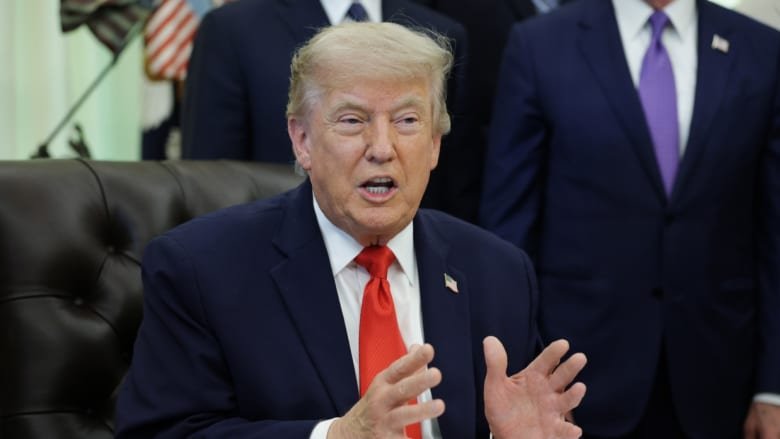
Speaking later in the Oval Office, Trump suggested an agreement to end the conflict was close, saying the Strait of Hormuz would reopen once a settlement was formally signed. He said he expected that to happen within days and indicated U.S. Vice-President JD Vance would attend a signing ceremony in Europe if one took place.
“We just made a great settlement of the war with Iran,” Trump told reporters, without providing details.
Trump also said discussions and final points had been approved by the United States, Iran, Israel, Saudi Arabia, the United Arab Emirates, Qatar, Turkey, Pakistan, Bahrain, Kuwait and Jordan, among others. He added that the U.S.-led naval blockade would remain in place until any agreement was finalized.
Earlier Threats Against Kharg Island
Earlier on Thursday, Trump had threatened to intensify military action against Iran and take control of key energy infrastructure, including Kharg Island, which handles about 90% of Iran’s oil exports.
Writing on Truth Social, he said the United States would eventually take control of Kharg Island and other oil facilities, comparing the move to U.S. actions involving Venezuela.
The comments came as U.S. and Iranian forces exchanged attacks and Washington continued operations aimed at enforcing a blockade of Iran-linked shipping near the Strait of Hormuz.
U.S. officials have previously indicated that any effort to control Kharg Island could require ground forces, although no such operation has been announced.
Iran responded sharply to Trump's remarks. Ebrahim Azizi, head of the national security committee in Iran’s parliament, said the United States would face a stronger and more painful response if it made what he described as an “uncalculated” move.
Shipping Tensions Continue
Despite Trump's suggestion that a settlement may be close, tensions at sea remained high.
India said three of its sailors were killed late Wednesday when a U.S. strike hit a tanker off Oman during operations linked to the blockade. New Delhi summoned a U.S. diplomat and called for such attacks to stop.
The U.S. military’s Central Command (CENTCOM) said an American aircraft carried out a precision strike on the engine room of the Palau-flagged tanker Settebello after its crew repeatedly failed to comply with instructions from U.S. forces. CENTCOM said the vessel was attempting to transport Iranian oil.
According to India’s Foreign Ministry, 21 Indian crew members were rescued after the strike. The Omani navy responded to the vessel’s distress call.
The deaths were the first reported since the blockade began on April 13. U.S. forces say they have disabled eight vessels and turned back more than 100 others during the operation.
CENTCOM also reported disabling another tanker, the Guinea-Bissau-flagged M/T Jalveer, in the Gulf of Oman on Thursday after its crew allegedly failed to comply with instructions. A third India-linked tanker was stopped earlier in the week.
“These attacks must cease,” Indian Foreign Ministry spokesperson Randhir Jaiswal said.
Conflict's Wider Impact
The conflict, which began on Feb. 28, has killed thousands of people, mainly in Iran and Lebanon, and contributed to higher global oil prices. The fighting has also become a political challenge for the White House as rising fuel costs have weighed on public support for Trump.
While Trump's latest comments raised expectations of a diplomatic breakthrough, details of any proposed agreement remain unclear and the naval blockade remains in force pending a formal settlement.
Join the discussion? 
Already a member? 
 Adapted by ASEAN Now. Source 12 June 2026
Recommended Comments
Create an account or sign in to comment