



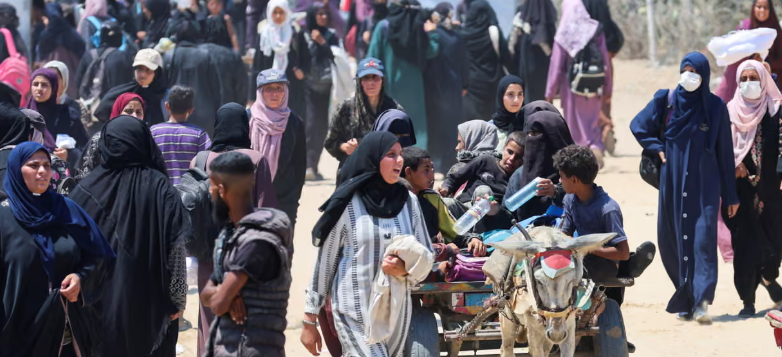

The United Arab Emirates is set to bankroll Gaza’s first “planned community” in the southern city of Rafah. This ambitious project promises essential services like education and healthcare, but at a cost: residents must submit biometric data and undergo security vetting, according to sources and documents reviewed during US-led talks in Israel.
This groundbreaking initiative marks the UAE's first foray into a postwar reconstruction project in parts of Gaza controlled by Israel. With over $1.8 billion in humanitarian aid contributed since October 2023, the UAE stands as Gaza's largest donor.
Blueprints for this community, described as a “case study,” outline the project's vision as a safe haven, free from Hamas influence. The construction of the compound will rise over the rubble left by Israel’s two-year offensive aimed at dismantling Hamas—an assault that has claimed over 70,000 lives and gutted much of Gaza's infrastructure.
Amid these plans, Jared Kushner and allies from the US-led Board of Peace have touched down in Abu Dhabi to mediate peace talks between Russia and Ukraine. Their presence underscores the UAE’s broader commitment to US-led efforts in the region and its role in funding Gaza’s reconstruction.
While the UAE remains publicly silent on its partnership with the Board of Peace, insiders suggest the plan could serve as a template for “alternative safe communities,” under joint US and Israeli guidance. The Rafah community could indeed set a precedent for future developments, with electronic shekel wallets and non-Hamas curriculum included to curb extremist influence.
The planned community promises freedom of movement with security measures in place to prevent the infiltration of weapons or hostile elements. However, details on who will conduct these security checks remain undisclosed.
Beyond immediate housing solutions, the project aligns with Trump’s ambitious peace initiative, which bifurcates Gaza into Israeli and Hamas-controlled zones, focusing initial efforts on the Israeli-held areas.
Kushner has challenged these divisions, instead proposing a comprehensive redevelopment of Gaza’s coastline, with plans depicting eight “residential areas,” including two in Rafah. The first of these, “New Rafah,” will feature 100,000 housing units, 200 education centers, and 75 healthcare facilities as part of a broader 20-point strategy.
Despite the lofty aims, the United Nations estimates that full reconstruction of Gaza could span eight decades, with upwards of $70 billion required to restore the heavily bombed infrastructure. Clearing debris and disarming explosives only add to the complexity and cost.
This initiative, while unprecedented in scale and aspiration, raises questions about the ethical implications of biometric data collection and the potential for increased surveillance and control. Critics argue it might pave the way toward a surveillance state rather than a community centered on trust and cooperation.
As discussions continue and the UAE begins laying foundations, the world watches to see if “New Rafah” will truly represent a fresh start for Gaza or if it will embody a new set of challenges amid the ongoing conflict.
Key Takeaways:
UAE funds Gaza’s first planned community with a focus on security and biometric data collection.
Kushner challenges existing territorial divisions, unveiling ambitious redevelopment plans.
Concerns rise about surveillance and control in exchange for basic services.


Adapted by ASEAN Now from source 2026-01-23

