



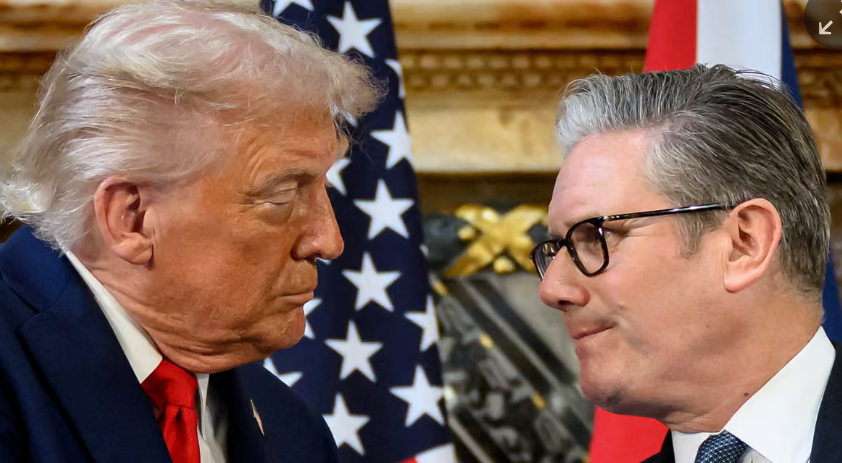

The United States did not provide the United Kingdom with exact operational details or timings before launching joint airstrikes with Israel on Iran, according to government sources, in a move that has exposed tensions between Washington and London over the widening Middle East conflict.
Get the latest headlines in your email 
The decision to withhold precise information came as British Prime Minister Keir Starmer initially declined a U.S. request to use British military bases for the offensive operation. Sources said that while the UK was aware action was likely, it was not formally briefed on the exact moment or scope of the strikes.
The airstrikes — carried out by the U.S. and Israel — killed Iran’s supreme leader, Ayatollah Ali Khamenei, along with dozens of senior military figures, dramatically escalating the conflict.
Intelligence but no tipoff
A Whitehall source said Britain knew military action was imminent because of the buildup of equipment moving through allied channels and intelligence shared “via the usual channels.” However, the UK was not given advance notice of the precise timing or operational details of the attack.
The British government evacuated its embassy staff from Tehran on Friday, signaling that it believed strikes were coming. Still, officials were not informed about when over the weekend the operation would unfold.
Government insiders said the UK is typically closely aligned with the U.S. on military matters, making it difficult to judge whether this level of limited notification was unusual. However, the absence of detailed coordination underscores strains in what is often described as the “special relationship.”
Trump criticizes Starmer
U.S. President Donald Trump has publicly criticized Starmer for refusing to allow American forces to use British bases for the initial strikes. Trump reportedly said the special relationship was “not what it was” and dismissed Starmer as “no Churchill.”
In the days following the attack, Starmer reversed course in part, granting permission for U.S. forces to use British bases for defensive strikes aimed at degrading Iran’s missile capabilities after Tehran retaliated against targets in the Gulf.
The shift reflects the delicate balance the British government is attempting to maintain: avoiding direct involvement in offensive operations while protecting British personnel and regional allies from retaliatory attacks.
Starmer defends “special relationship”
Facing criticism in Parliament, Starmer robustly defended his approach during Prime Minister’s Questions. Conservative MP Gareth Bacon challenged him on whether his handling of the crisis had strengthened or weakened ties with Washington.
Starmer responded that British military deployments had been under way for weeks and were coordinated with U.S. forces. He emphasized that British assets were actively protecting American personnel and interests in the region.
“The American planes are operating out of British bases,” Starmer told MPs. “That is the special relationship in action. British jets are shooting down drones and missiles to protect American lives in the Middle East on our joint bases. That is the special relationship in action.”
He added that intelligence sharing between the two countries continued daily, arguing that cooperation on defense and security — rather than rhetorical exchanges — defines the alliance.
Military deployments across the region
According to the prime minister, British deployments include radar systems, ground-based air defenses, counter-drone systems and fighter jets. Since the start of the escalation, multiple F-35 and Typhoon aircraft have been operating not only in the Middle East but also from Cyprus.
Further missions were flown overnight, with Typhoon jets defending Qatar and F-35s protecting other regional partners. The UK government framed these deployments as defensive in nature and focused on protecting lives and regional stability rather than conducting offensive strikes.
A spokesperson for the prime minister reiterated that Starmer would only authorize actions deemed in Britain’s national interest and necessary to keep British citizens safe.
Strains but continued cooperation
Despite the lack of detailed advance notice, officials stressed that U.S.-UK military coordination remains extensive. American aircraft continue to operate from British bases, and intelligence cooperation has not been suspended.
However, the episode highlights a moment of friction in the transatlantic alliance at a time of heightened global instability. While both governments maintain that the special relationship endures, differences over operational decisions and political messaging have revealed a more complicated dynamic behind the scenes.
Join the discussion? 
Already a member? 
 Adapted by ASEAN Now · Source · 04.03 2026