



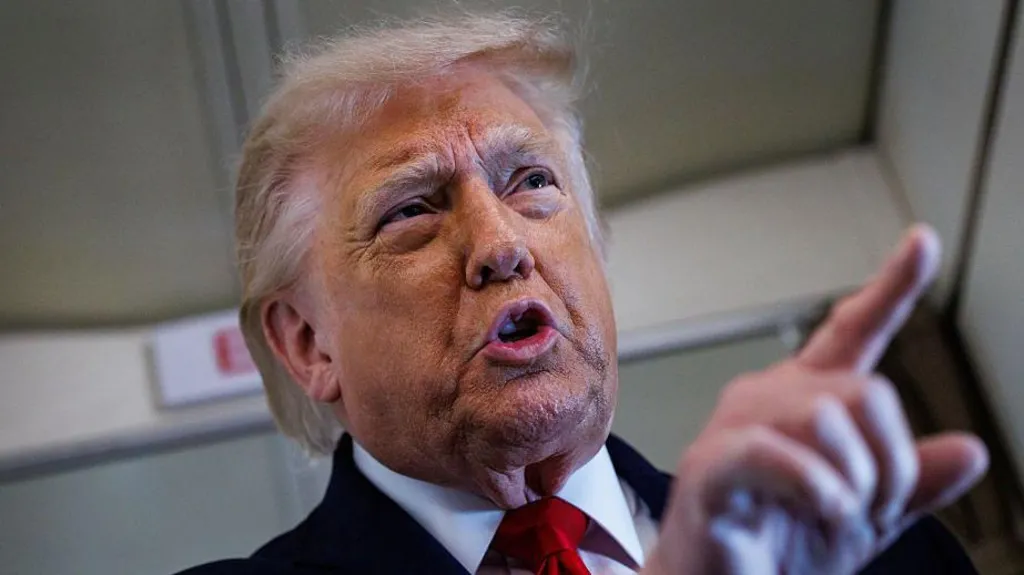

US President Donald Trump said the United States would launch further strikes against Iran on Wednesday, a day after American forces targeted Iranian military sites and Tehran responded with attacks on US bases across the region.
Get today's headlines by email 
Speaking to reporters in the Oval Office, Trump said the US had struck Iran hard on Tuesday and would do so again. He also renewed calls for Tehran to agree to a deal, warning that Iran was paying the price for delaying negotiations.
Iranian President Masoud Pezeshkian responded in a post on X, saying the country would remain steadfast in the face of pressure and threats.
Renewed Military Exchange
The latest escalation followed US strikes launched on Tuesday after Trump said Iran had downed a US Army Apache helicopter. According to the US military, the attacks targeted Iranian defence systems, radar installations and ground control facilities near the Strait of Hormuz.
Iran's Islamic Revolutionary Guard Corps (IRGC) said it retaliated by launching attacks on American military facilities in the region. Iranian officials said 21 targets were struck, including bases in Bahrain and Jordan, while Kuwait reported intercepting incoming projectiles.
A US official cited by Reuters said nearly all Iranian missiles and drones were intercepted and no casualties had been reported.
Trump described the US action as a justified response to the helicopter incident. He later said an Iranian drone had struck the aircraft while it was flying at low altitude, though the helicopter did not explode and both crew members were rescued by an American sea drone. Iranian media reported that Tehran had not claimed responsibility for the incident.
Diplomatic Tensions Deepen
Despite continued negotiations, relations between Washington and Tehran remain strained.
Iranian foreign ministry spokesman Esmaeil Baqai accused the United States of undermining diplomatic efforts through inconsistent messaging, shifting demands and repeated ceasefire violations. He said Iran needed to reassess the situation and stressed that diplomacy required a degree of stability.
Trump maintained that the proposed agreement would permanently prevent Iran from obtaining nuclear weapons.
Separately, the International Atomic Energy Agency (IAEA) approved a US-backed resolution calling on Iran to provide further information about its uranium stockpile and nuclear production facilities. Iran's mission to the United Nations in Vienna criticised the measure, arguing that support for diplomacy was being contradicted by continued military action against Iranian infrastructure.
Shipping Incident in Gulf of Oman
The US military also announced that it had struck an oil tanker in the Gulf of Oman, alleging the vessel had violated a blockade by attempting to transport Iranian oil.
India said three of its nationals were missing after the attack on the tanker Settebello, while 21 crew members were rescued.
The United States has enforced a blockade of Iranian ports since the Strait of Hormuz was effectively closed by Iran following US and Israeli attacks on Tehran earlier this year. The Settebello was reported to be the eighth vessel targeted by US forces under the blockade.
Conflict Background
The current conflict began on 28 February when US and Israeli strikes killed Iran's supreme leader. Iran responded with attacks against Israel and Gulf states aligned with Washington, and fighting later spread across the region, including into Lebanon.
Although a ceasefire agreed in April reduced large-scale hostilities, both sides have continued exchanging intermittent fire while pursuing difficult negotiations aimed at securing a longer-term settlement.
Join the discussion? 
Already a member? 
 Adapted by ASEAN Now. Source 11 June 2026
-
 7
7
Recommended Comments
Create an account or sign in to comment