
oldcpu
Advanced Member
-
Joined
-
Last visited
Everything posted by oldcpu
-
I don't need to contact them. I am only trying to help with regards to pointing out what I believe is an error in your approach. But if you are happy to proceed with your approach - and if you are confident your research is correct, then by all means, do proceed with your action. I assume therefore, you have significantly researched this then - but your outright dismissal of Double Tax Agreements gives me pause as to whether you have. Honestly? It makes me think otherwise. I hope - for you- that I am wrong, and that you are right. So - regardless as to my doubts (as to your view) ... please ...all the very best in your approach.
-
I believe you need to pay more attention to exact wording of the relevant Double Tax Agreement. I could be wrong, on the NT code aspect but your Singapore example is IMHO not a good one. There is a VAST difference between the Singapore-UK DTA, and the Thailand-UK DTA. And DTAs are incredibly important here. To dismiss such is in my view not a good approach.
-
I am still going through your post ... but note the Singapore-UK DTA is very different from the Thailand-UK DTA. According to the Singapore-UK DTA, if i read it correctly for any UK pension that is not UK civil-service or military, then only Singapore can tax that UK pension. This is VERY different from the Thailand-UK DTA, where the UK can still tax those other pensions. Do you see the difference? It is significant. I still need to go through the remainder of your post.
-
lol ! Not necessarily. Royal Decree 743 would first need to be revoked. Further, many of us are still Thailand tax exempt due to the DTA between Thailand and our income source country. Case in point? All Canadian pensions and similar Canadian remunerations remitted to Thailand. Only Canada can tax those. Further, for almost all country civil-service/military pensions are not taxable by Thailand. Further , many of us (myself for example) are living off income brought into Thailand when not a Thai tax resident and such is (and has been for some time) Thai savings. and further, many of us (myself again for example) have kept our pre-1-Jan-2024 savings outside of Thaliand (we get better returns there) - and we can per Thai RD Ministerial directives paw.161.162 bring that principle (not the profit) into Thailand tax free. More than World wide income tax would be needed to affect that - instead paw.161.162 would need to be revoked. Also, many of us come from countries with a higher tax rate than Thailand, so Thailand (with its lower tax rate for us) going to world wide income tax will have no effect as DTAs typically ensure one pays tax to only one country on the income ... and if it is Thailand, for some of us the tax would be lower than our income source country. Further, as opposed to the speculation re: 'world wide income' - the opposite looks more likely in the near term, where the current Thailand government, before the recent election (that they won) was stating they planned to either have a Royal Decree or Ministerial directive announced and implemented so to make any global income, remitted to Thailand in the year of earning, Thailand tax exempt for ALL Thai tax residents. That has not happened yet, but I suspect it has just as much chance of happening (and likely more of a chance) than 'world wide income tax'.
-
From what i read, given the Thai-UK Double tax agreement, you don't qualify for a UK NT Tax code as a tax-resident of Thailand. Having an LTR-WP will not change that. You will still have to pay UK tax on UK pensions.
-
As far as UK savings interest is concerned, I read UK banks have paid interest gross since 2016, so there is normally no withholding tax to stop. Further I read Form R105 is used in limited cases to confirm non-UK residence for certain types of savings income, but for ordinary bank interest it is generally not required. If tax has been deducted in error, I also read a non-UK resident can usually reclaim it by filing a UK Self Assessment return (including the SA109 residence pages) or, if appropriate, using Form R43. Non-residents are generally not liable to UK income tax on ordinary UK savings interest, so any tax deducted can normally be reclaimed. Hence I struggle to understand why for an LTR you would want a UK NT (No Tax) code. Granted, I pulled the above from multiple sources, but do I have that incorrect? ... Your wanting a UK NT (No Tax) code puzzles me.
-
I do not receive UK income, but I have friends who do, so out of curiousity I did previously look at the UK-Thai tax agreement. To the best of my knowledge, there is no general UK tax rule that exempts a non-resident from UK tax on UK-source pension income. While non-residents to the UK are generally not taxed on UK bank interest, UK dividends, nor most capital gains (other than UK land and property), from what i read UK pensions are different and remain taxable in the UK under domestic law. Further, from what I read, there is typically no withholding tax on those that requires an NT (No Tax) code. UK Government service pensions (civil service, armed forces, certain state employment) are taxable only in the UK under the Thailand–UK DTA, so an NT code would not apply to them. UK State pensions and UK private/company pensions also remain taxable in the UK; the Thailand–UK DTA does not remove the UK’s taxing rights, and Thailand’s LTR-WP visa does not affect UK tax liability. Therefore, an NT (No Tax) code would not normally be applicable simply because someone is non-UK resident and holds an LTR visa
-
I don't know UK tax law, but looking at the Thai-UK DTA, and I struggle to know what pension you refer to. For a Thai tax resident, my understanding is both UK State pensions and UK Private & Occupational Pensions are not taxable in Thailand but are in the UK. So if I am correct there, this is not an LTR specific visa question you are asking. Is there some clause in UK tax law saying non-residents of the UK need not a pay UK tax on their UK pension? I have never heard of such. So from what country is this pension coming from where you may want a NT (no tax) code from the UK. Can you name a case where you know someone who was a Thai tax resident in receipt of UK pension benefited by having a Thai Tax Resident Certificate to get the NT (no tax) code in the UK that you refer to?
-
Years back when I needed to show a TM30 at Phuket immigration, a screen print (of the TM30 completed online by my wife) was perfectly acceptable to Phuket immigration.
-
That's fabulous. It does read like Phuket has massively improved. 👍 From 2019 to 2023 (before I obtained my LTR) on a Type-OA (marriage, later retirement), and later a Type-O (retirement), I typically would spend the better part of an entire day (a couple of times the entire day) at Phuket immigration . Given what you note, the skeptics should take note (where I tend to be a skeptic) - somethings DO improve, and it reads like a massive improvement in Phuket. 👍 ... One thing about Phuket Immigration that always impressed me - was the hard work ethic of the staff who worked there. Likely my timing was unlucky (when I went to Phuket immigration) as for me, the place was typically flooded with foreigners. The hassle at Phuket immigration due to the overcrowding was one factor that drove me to go for the LTR-WP. Again - I am glad to read of the improvement in Phuket.
-
The 'no need to file a Tax return on the LTR visa is generic'. I believe expats (with LTR visa) from many countries do not need such. i did not need such for Canada, nor for Germany. If one does need such, then I would speculate, even thou a tax return is NOT required by Thailand (if all your remitted funds to Thailand is from income outside of Thailand), that you may still need to file a Thai tax return - IF you need that Certificate. This (having to obtain a Thailand Tax Residency Certificate) is the exception, and not the rule. Most of us do not need such, and even if we had such, it would do us no good. We would still pay tax in our home country for some income (per the Thai-to-home-country-DTA), despite being a Thai tax resident and not a Tax resident of our home country.
-
Many thanks for sharing what you heard in the meeting. I confess to being pleased to read this, and at the same time scratching my head. Puzzled. Is this another reversal of how the Royal Decree is interpreted, or could this be tied into a new Ministerial Directive or new Royal Decree that is coming out real soon? If I may explain ... back when many if us in the 2022/2023 time frame applied for and obtained our LTR visa, we were told no Thai tax on any remitted income (even if current year income) for LTR-WP/WGC remitted income. There was internal forum debate on that - as the Royal Decree 743 reading suggested otherwise (for current year income - dependent on how one interpreted the wording). I recall back the User @Guavaman called the Thailand Help desk and confirmed that (if my memory serves me right) no Thai tax on current year foreign income remitted to Thailand. Further user @JohnnyBD contacted BoI and he was initially advised no Thai tax on any remitted foreign income for LTR-WP/WGC visa holders However .... this was to change .. However user @K2938 contacted BoI and was advised an LTR Visa holder could possibly be subject to Thai tax on any current year remitted income brought in a year in which it was earned (per recent RD guidance). So user JohnnyBD contacted BoI again and was also given this update (current year foreign income remitted to Thailand is potentially taxable). User @John207 also contacted BoI and they told him the same as the latest from JohnnyBD and K2938. ie income brought into Thailand in the current year of remitted income is potentially taxable (ie depends on DTAs with one's income source country and other factors). Now we hear from a BoI seminar with an RD official presenting, that all remitted foreign income for LTR-WP/WGC visa holders is tax exempt, consistent with what user Guavaman and JohnnyBD were initially told, but contrary to what K2938 and John207 (and later JohnnyBD subsequently) were told. Am I the only one who finds all this seems to be changing back and forth? Am I the only one scratching my head ? ... Having typed that, I wonder if the 'elephant' in the room, is the speculation (and maybe stronger than speculation) is the possibility for all Thai tax residents, that the current Thai government (freshly re-elected) may via the Thai RD have a ministerial directive, or possibly even a Royal Decree, promulgated sometime in the near future, to make all current year foreign income remitted into Thailand in the same year it is earned, Thailand tax exempt? That would be for all tax-residents and not just LTR. There was talk (news articles) before the election called, stating this was possibly in the works. Obviously speculation by me, but for myself that appears to be a logical reason why the different Aseannow users were to some extent, getting different answers and why the current RD official seminar answer. I guess, This Is Thailand and were are dealing with changing Thai RD assessments and approaches as they try to deal with the current fiscal situation in Thailand. So i am (1) puzzled (about the past), and (2) pleased re: what I read on this forum about the seminar with BoI/RD, and (3) puzzled as to why and if this will change again. I do like Thailand. If nothing else, life is never boring.
-
@DrJack54 .. For certain he likes travelling, so rather than be upset about only getting 60-days, he turned it into a positive thing and used it as a good reason to visit Vietnam. I need to take notes from him, so to learn his positive attitude. @BrandJT ... thanks also for your comment and reminder. He is debating whether he should (in a subsequent visit) open a bank account. In his 70s (like me) thou, the clock on our remaining years is ticking, so one does not want to over complicate one's estate too much. Reference staying in Thailand, like the OP of this thread, he typically stays 4 months in Thailand. He does have Thai family in Thailand via his Thai wife and they visit her family every year since living together (they have been living together since the start of COVID, were married 2 years ago, and they spend 3 to 4 months every year in Thailand during the cold Canadian winter months)). I will pass on to him more of my understanding as to his Visa options - such that he is better able to decide what he will do next year, from Nov-2026 to Feb-2027.
-
I have a college class mate (in his 70s like me) who (unlike me) lives in North American with his Thai wife, who came to Thailand with an intent to stay ~4months. He mistakenly went for an METV, and was disappointed to only get a 60-day stamp. Toward the end of his 60-days, he elected to go to Vietnam and re-enter Thailand again, although that would not have been his first choice. I am kicking myself for not recommending a Type-O visa to him. Putting 400,000 THB in a new Thai bank account would not have been an issue for him. He could have shown up on a 90-day Type-O visa (for marriage to Thai (he already has his marriage to his Thai wife registered in Thailand)), opened a Thai bank account, and deposited 400k THB in the account. Then he could saunder down to immigration and obtain an extension for reason of marriage to a Thai. Unfortunately, he showed up on an METV. Of course not wanting to put any money into a Thai bank, and stay in Thailand for months, is not something the Thai government are particularly keen on hearing. They want foreigners to help generate more money in Thailand. For certain as a foreigner, having disposable income presents many more solutions. Best wishes to the OP in your ultimate approach.
-
Vietnam is a great country, I have visited it a few times and greatly enjoyed my time there. However one aspect where Thailand always appealed to me, was the superior quality of Thailand medical care and hospitals. Thailand's hospitals generally offer higher medical quality and expertise compared to Vietnam's, particularly in international accreditations, equipment, and staff competency, although I concede that Vietnam's top facilities are rapidly improving. From what I recall having read, user surveys and rankings consistently rate Thailand superior overall in the medical field. Both countries have modern private hospitals suitable for medical tourism, but Thailand leads as a regional hub.
-
Two separate Asean Now members, forwarded what they received in the past year from BoI, advising them that the BoI recent clarification from the Thailand Revenue department, indicated that current year income of LTR-WP and LTR-WGC visa holders, remitted to Thailand in the year of income, was taxable (dependent on DTA exclusions). This is contrary to earlier BoI clarifications which previous claimed all tax years tax exempt, ... and understandably has created some confusion. I suspect thou, given the results of the recent Thailand election, where we see the previous Thailand government re-elected, that this may be a moot point (at least moot for a while). The Thailand finance ministery is purportedly planning on making current year foreign income, remitted to Thailand, tax exempt for all Thailand tax residents, and not only for LTR visa holders. A reference for that is this: https://vbapartners.com/income-tax-for-foreigners-in-thailand/ where note this statement in that article: ==== start of quote ==== Following a significant drop in tax revenue for 2024 and 2025 so far, the Thai tax authorities have announced a new Royal Decree to try and address this. The Revenue Department has acknowledged that the stricter tax rules introduced in 2024 may have had a significant negative effect on Thai and foreign residents, causing them to stop remitting overseas income into Thailand due to the increased tax exposure. .... The proposed decree will introduce a 12 month remittance period. This means that if foreign income earned on or after January 1, 2024 is brought into Thailand within 12 months of the calendar year it was earned, it will be exempt from Personal Income Tax. ==== end of quote ==== I note this is a proposal, and to the best of my knowledge, there is as of yet no-Royal Decree, nor Ministerial directive, implementing such yet. However the government has only just been re-elected so they will need some time. But it is quite possibly in the works, and as noted, could make the LTR visa discussion a moot point re: whether current year income, remitted to Thailand, is taxable. My view is to wait a bit and see.
-
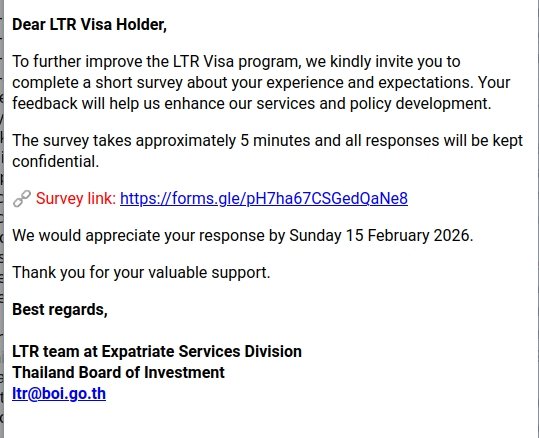
I received today a request to 'click on a link' and participate in a LTR visa poll. Frankly - i rarely click on any links from anyone in an email, no matter whom they are. So while I don't mind participating in a poll, I will not do so by clicking on some unknown link.
-
Interesting. I am most curious now to learn where I am 'behind the times' and when the 'u' turn was implemented per what legal government document? My understanding is Thai Tax law section-41, para-2 requires any foreigner residing in Thailand to pay tax on locally earned income and on remitted income if certain tax thresholds and certain other aspects are also met. ie Section 41, Paragraph 2 (Resident Rule): States something like: "A resident of Thailand who in the previous tax year derived assessable income under Section 40 from an employment or from business carried on abroad or from a property situated abroad shall, upon bringing such assessable income into Thailand, pay tax in accordance with the provisions of this Part." Royal Decree-18 (on Double Tax Agreement tax exemptions) and Royal Decree-743 (on LTR visa tax exemptions), Ministerial directives POR.161/162 on pre-1-Jan-2024 savings remited into Thailand and Thailand tax law on interest earned in Thailand banks (where there was already a withholding tax applied) are very relevant here, and legally they DO exclude many expats from needing to file a Thai tax return and exclude having to pay tax in Thailand (if such the only income). But that does not by any stretch of the imagination legally exclude each and every expat in Thailand from having to file a Tax return (although it does exclude many). Every expat's situation is different. Before the recent election the Thai government was talking of some new changes, but after the very very recent election there has been no ministerial directives on this yet. There may be soon, but I have as of yet read of nothing. But you note I am 'behind the times' ... so please provide your precise reference, as clearly, and with all due respect I am interested in learning. I would like to read of any new tax law change, or any new Royal Decree, or any new Ministerial Directive showing me to be behind the times. I think we are all keen to read if the re-elected government continues with their plans, but as I noted, I have yet to read of a formal new document. Is such already 'hot off the press', or are you anticipating? Until I read the tax law change, or new Royal Decree, or Ministerial Directive - well ... I am from Missouri on this. But I am very keen to read of the specific legal Thai government document which leads you to believe I am behind the times.
-
As noted above - If you are on a Type-O or OA visa, you nominally simply obtain a separate multiple re-entry permit, and you can come and go in/out of Thailand, as often as you like. No problem. Cost for the Multiple Rentry permit is 3,800 Thai baht.
-
You did not ask, but I assume you have thought through the taxation aspects, and that you plan on spending less than 180 days per year in Thailand. If you spend more than 180-days in Thailand, and if you remit the income to Thailand, then dependent on the money source and dependent on the Thai-Singapore DTA (or your Thai-income-source-country-DTA), the money you remit to Thailand could be taxable in Thailand. Hence if you spend more than 180-days in Thailand, you many wish to structure your finances in regards to your legal taxation exposure. Savings from outside of Thailand, saved from before 1-Jan-2024 are nominally not taxable in Thailand per Thai Revenue Department (RD) ministerial directives POR.16.1/162, One advantage of LTR, is if, for example, you are on the LTR Work from Thailand Professional, ... then you are, I believe, exempt Thailand income tax on your Singapore income when you remit that money to Thailand - even if it is remitted in the year in which you earned it. This, I believe, is different from the LTR-Wealth Pensioner (or LTR Wealthy Global Citizen) visa where the foreign money remitted to Thailand is Tax exempt only if remitted to Thailand in a year OTHER than which it was earned. I think the Type-O/OA (based on marriage) requires one to apply for a work permit in Thailand if one wishes to work in Thailand. But I suspect that applies to working for company's registered in Thailand (and not from a digital nomad style job) ... but I am unsure. In my view, the DTV and LTR visas give you the most solid legal grounds. With a Type-O you likely could slide under the RD radar, but one never knows what sort of enforcement the future may, or may not, bring. I have an LTR-WP visa. I took me a while to get it, but given most of the application process (for the Visa) was done from the comfort of my seaside condo balcony (with my laptop), sipping a glass of wine and over looking the sea, I did not find the application process that annoying, despite having a lot of back and forth with Thaland BoI.
-
With respect, your lawyer may not be an immigration lawyer, or perhaps they described things in details that were difficult for you to recollect/understand. Reference the first four of your questions: 1. Are those really my only two options? No. 2. Is the lawyer’s advice accurate? No. 3. Which visa are remote workers actually using in practice? DTV , and for some the LTR visa. If the overseas company has a branch office, subsidiary office, or representative office in Thailand, it may also open up a Type-B work visa option - but I am not knowledgeable on that. 4. Can you open a Thai bank account on these visas without too much trouble? You can on Type-0 for reason of retirement or also for reason of marriage to a Thai Others may be suited to answer your questions, especially in regard to the DTV visa and the Type-B visa. I note thou: Retirement visa: This actually is a bit ambiguous and inaccurate terminology. Typically this is understood to be a "non-immigrant Type-O (or Type-OA) visa" granted for reason of 'retirement', which is a far more accurate way to state to such. You do NOT have to depart the country every 180 days on a Type-O/OA. Rather it is more nuanced and better. Most of us (expats) prefer a Type-O visa, as a Type-OA visa nominally requires one buy health insurance from the Thai branch of a Health Insurance company, which a Type-O visa does not. I will describe below (under the 'final comment' how the permission to stay works with a Type-O visa. In your case thou, you may wish to work, in which case, nominally you are not allowed to work in Thailand (nor, I think, remotely < albeit i am unsure > ) if you are on a Type-O or a Type-OA visa for reason of retirement. If you have a Thai wife, there is another option. If you have a Thai wife, in both cases, if on a Type-O or on a Type-OA visa, if you obtain the Visa (or the subsequent visa 1 year extension) for 'reason of marriage' (to a Thail), and NOT for retirement, you can apply for a Thai work permit and be allowed to work in Thailand. Further, if you are on a Type-OA visa (which nominally I do not recommend), but on that visa for reason of 'marriage' (and not for reason of retirement) then you are not obligated to buy Thai Health Insurance. So lets consider a Type-O visa (or a Type-OA visa), but NOT for reason of retirement, but instead (if you have a Thai wife) for reason of marriage. In that case, being married to a Thai person on that visa, you are allowed to apply for a Thai work permit, and legally work in Thailand. LTR-Visa. As for the LTR-Visa, it has many categories - and some allow one to work in Thailand. (For example, I am on an LTR-Wealthy-Pensioner visa - but I did NOT apply for permission to work in Thailand). In general the LTR visa is an expensive visa in terms of financial requirements necessary to be met and proof shown, so to prove one's wealth. It has hefty health insurance requirements that puts many people off. If one has the wealth thou, then its a great visa. If thou you wish to work in Thailand (when on an LTR visa) you will have extra steps to go through to get that aspect of the LTR visa. Good approach. I think you are adopting the correct approach, asking on this forum. I am constantly impressed by the knowledgeable people here who share their advice. Yes there are some opinionated (possibly includes me) , but in the case of those, try to get the overall picture, narrow down to the visa that appears most appealing, and drill down to get the details to ensure this is the visa you like. One final comment - if you obtain a type-O visa from outside of Thailand, that will give you 90-days permission to stay in Thailand. With that visa you can IMMEDIATELY open a Thai bank account. Then immediately transfer ~800,000 Thai baht to that new Thai bank account. Then after about 60-days in Thailand (with 30-days left in your permission to stay in Thailand) go to the local Thailand immigration office, and apply for a 1-year extension on your permission to stay in Thailand (based on retirement). You can do that year-after-year-after-year. It does not thou, give you permission to work in Thailand. If you wanted to work AND have a Thai wife AND obtained a Type-O/OA visa for reason of marriage, you only need ~400,000 in that new Thai bank account. And you could then apply to work in Thailand since you are married to a Thai woman You do need a fair amount of paperwork when applying for the non-immigrant Type-O/OA visas, so check with the local embassy (assuming you are outside of Thailand) before hand, or ask on this forum, what paperwork is needed, when applying for the visas. Again, this forum has very knowledgeable people who can assist you.
-
It sounds like the Visa agent is getting him a 3-month type-O visa, ... and to save time at immigration, the visa agent has arranged to also get a 1-year permission to stay on that 3-month type-O visa. So 3 months + 12 months = 15 months. I have (err had - sadly he passed away) an elderly friend in Pattaya (in his late 80s) who obtained 15 months via getting the 90-day visa + 1 year extension "in one shot" using an agent to assist his visa application at immigration. And frankly - given his frail health, using the agent was a smart move! I was applying for a type-O in Phuket at that time (having entered visa exempt) and I was envious. I suggest you recommend to your friend to be certain to get a re-entry permit for his Visa else he will invalidate it the second he leaves Thailand, if he has not done so. EDIT: Re: getting the Bank account. If he is on a visa exempt status then that reads like he is doing ok. Its very hard to open a Thai Bank account if one is visa exempt, even with an agent's help.
-
For a balance of 320 baht (as of January 2025) ... AND as you note, you are paying 400 baht to keep that convenience. So per your question - why keep Bangkok bank account? You may be the ONLY person who can answer that as it depends on your finances. I would NOT keep Bangkok bank for the purpose of proving to Thai immigration you have adequate funds in Thailand (ie via 800k THB (retirement reason) or 400k THB (marriage reason)). One might wish to keep Bangkok Bank if one gets monthy deposits into the account to meet immigration requirements ( ie 40k THB/month (for marriage reason) or 65k THB/month (for retirement reason). But typically Bangkok Bank is IMHO a PIA to quickly obtain the immigration paperwork. So i would not keep BKK bank for that. Years back (when on either a type-O or type-OA visa - I can't recall which) i switched from using Bangkok bank to Krungsri as Krungsri was much faster and less painful to get the paperwork immigration required. So I would say, NO - do NOT keep a Bangkok Bank account for that. I am on an LTR-WP visa, and I have a Bangkok Bank account and some others. Why? Two reasons which are specific to me ... and before I give you the reasons, let me qualify by saying most of my money is kept outside of Thailand ... and despite what i say next , believe me. I prefer to spread my money (that is in Thailand) into a number of different Thailand banks, so to spread the risk in case one goes under. This is likely NOT applicable to you. I transferred a bunch of money into Thailand about a decade ago when I was not a Thai tax resident (ergo it was Thai tax exempt) and I have mostly , when in Thailand, been living off of that money ... which is not to say I have not brought small amounts more in since, but such was not needed. (I note when outside Thailand I typically (not always) do not use my Thai funds). I prefer Bangkok Bank over some others for exchanging currency (when I want to do so within Thailand, which is not all that often) as I have different currency accounts with Bangkok Bank. Also Bangkok Bank is better than some (not all) Thai banks for receipt of Wise transfers. There are some Thai banks that Wise won't transfer money too (at least that was the case a couple of months back). Also, i was able to buy Thai government savings bonds via Bangkok bank. Two other Thai banks (SCB & Krungsri) would not let me buy Thai government bonds though them. I needed the bonds for my LTR visa application. Bangkok Bank would ONLY let me buy bonds thru them if I had an account with them. But if one does not have my situation ... and if you only have 320 Thai baht in Bangkok Bank, and if you don't have millions of Thai baht that you plan to transfer to Bangkok bank, and if you have other accounts , and if Bangkok bank is not massively more convenient in regards to location from where you live, then ... ... then yes - I would say, close the account.
-
I live in Phuket , but its been some years since i was on a Type-O visa. I assume based on the Phuket Immigration Volunteer link you provided you plan to apply for a 1 year extension of your permission to stay in Thailand (on that 90-day Type-O visa) for reason of 'retirement'? My recollection, if all items are in order, that Phuket immigration is relatively quick to provide an extension based on retirement and 3 weeks is adequate. But if you are applying for the one-year extension for reason of marriage, then some years back, when I was on a non-immigrant visa for reason of marriage (it was actually a type-OA) it was VERY slow to get the extension. Back then, my understanding, is Phuket province was granted in province approval authority for extension of Visas based on retirement, but not marriage - and all the paperwork (for a marriage extension application) had to be sent out of province. Hence IMHO if one is applying for a 1-year extension in Phuket, based on marriage, one should apply as soon as one is allowed to apply (ie if possibly apply 45 days in advance in that case - if 45-day in advance application still allowed). But I believe if applying for the 1 year extension, for reason of retirement, on your existing type-O visa's permission to stay in Thailand, your 3 weeks time should be adequate. It don't think it would hurt to apply 30 to 45 days before if you have the finances in place - if that is still allowed. However i could be out of date, so listen to the view of others here.
-
Since the same time last year, I believe that there are no changes in Thai tax law ... nor any new ministerial directives relevant to tax applicable to the average expat, ... nor any new Royal decrees relevant to the average expat in regards to tax. But re: changes: I think one of the Thai tax forms (PID.90) was updated, with a spot for entering foreign tax credits (for cases where there was double taxation). I believe that was not there (in such an obvious manner) in previous tax forms. https://www.rd.go.th/fileadmin/tax_pdf/pit/2568/241268PIT90.pdf My having typed that, LTR-visa holders (ie LTR-WP and LTR-WGC) need to take note of a (not well advertised) BoI clarification that came last year on tax exemption relevant to those Visa holders. BoI recently advised a couple of LTR-WP visa holders, that only foreign income remitted to Thailand in a year OTHER than which the income was earned, is treated as tax exempt by the Thai RD. Previous, BoI did not place this caveat about remitted income needing to be from 'OTHER' year than which income earned. So some of us see that as a change ... or at least a change in what BoI are saying. I suspect most are not in the situation of an LTR visa holder - so clearly such the BoI change is not relevant to most. But this brings me to a point ... there is no general answer that fits everyone, as we are all often different, in terms of where we obtain our income and how much is our income. That can be important as to whether one needs to file a Thailand tax return or not file a Thailand tax return. However in general, as i noted, the only difference between this time last year and now is what I noted re: BoI advising about remitted income for LTR visa holders and the PID 90 tax return form changing with a spot for foreign tax credits to be entered. If I have this wrong - I hope someone will chime in and correct me. Given Thai government election, I think many of speculate that any of RD new rules were put on hold until after the election. What to do? It really depends on the specifics of your taxation exposure. .