



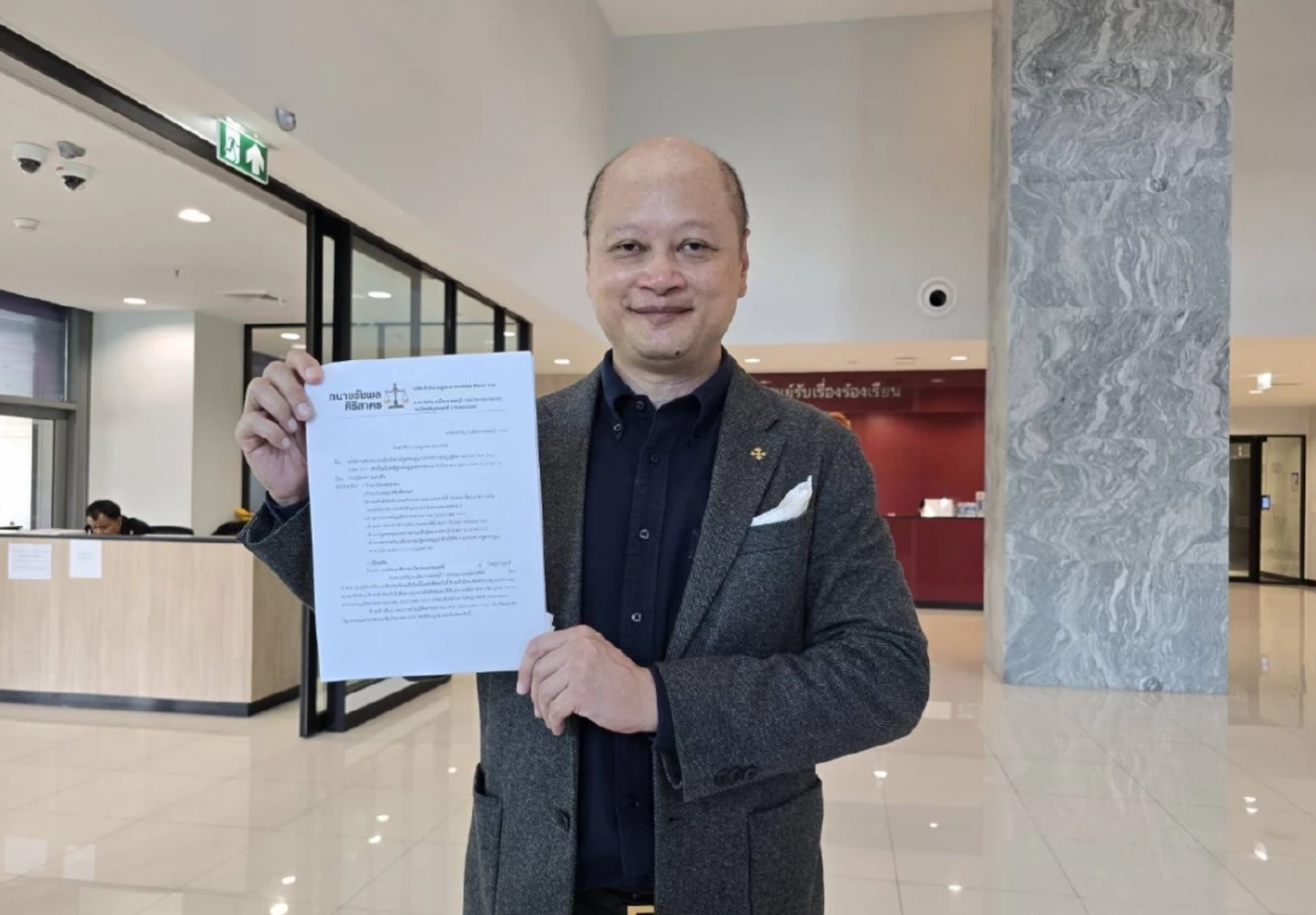

Thai lawyer Ratchaphon Sirisakorn has asked the Office of the Ombudsman to seek a Constitutional Court ruling on a measure that would withhold annual vehicle tax stickers from motorists with unpaid traffic-ticket fines.
He submitted the request at the Ombudsman's Office at the Government Complex on Chaeng Watthana Road on 31 July 2026, also urging the Ombudsman to recommend delaying a memorandum of understanding, or MOU, involving the Transport Ministry, Royal Thai Police and Department of Land Transport.
Challenge over car tax and traffic fines
Ratchaphon said the arrangement stems from an amendment to Section 141/1 of the Road Traffic Act, announced in 2017 and in force since 21 June that year. Its principle is that people who do not pay ticket fines will not receive a vehicle tax sticker.
He argued that a motorist who has paid the annual vehicle tax should receive the sticker, while traffic fines should be dealt with separately. In his view, police already have the power to bring unpaid-fine cases before a court rather than use the car tax process as leverage.
"Officials must take the case to court, not force the withholding of a tax sticker," he said, describing the measure as akin to "hitting below the belt".
Ratchaphon said the approach could conflict with Section 26 of the Constitution, which requires laws to respect the rule of law and restricts the removal of public rights. He warned against a wider expansion of such measures, suggesting it could lead to people being denied welfare cards, driving licences or identity cards.
He stressed that his complaint was not intended to help people avoid legitimate fines. Changing the law would require action at Act level, he said, and could not be done simply by the minister, police or Land Transport Department.
Ratchaphon noted that motorists can submit written objections to a ticket. If officials maintain that action should proceed after an objection, he said the person must pay the fine.
He said he had 60 days to submit the matter through the Ombudsman before it could go to the Constitutional Court. If the court finds the provision unconstitutional, it could no longer be enforced; if the MOU is not delayed, he said, authorities would continue enforcing it under the law.
Lawyer urges drivers to settle valid tickets
Ratchaphon urged people with tickets to consider whether they had actually committed the offence. He cited camera-issued tickets for speeding and crossing solid road lines as cases where the evidence can be clear.
Some motorists have 40 to 50 outstanding tickets, he said. Those who have genuinely broken traffic rules should pay, he added, because violations can inconvenience or endanger others.
He questioned why the tax sticker measure was needed when prosecutors can already take non-payment cases to court. He also said previous schemes allowing motorists with large fine debts to clear them at reduced rates, combined with training, had been a constructive approach.
Related story
hailand-links-traffic-fines-to-annual-tax-discs-from-August
Join the discussion? 

2 August 2026
Recommended Comments
Create an account or sign in to comment