





Thailand has published new regulations setting out how foreign nationals can be deported for immigration, employment and other offences, as well as conduct considered contrary to public order, morality or public wellbeing.
The Prime Minister's Office Regulation on Deportation BE 2569 (2026) was published in the Royal Gazette on 27 August and takes effect on 28 August.
The regulations say Thailand remains open to foreigners entering to travel, live, work and do business, provided they obey the law and uphold public order and good morals. However, they cite cases involving people who entered legally but later breached laws for personal gain, or behaved in ways considered disruptive to public order or morality.
Who can face deportation
Under the new rules, the Interior Ministry's permanent secretary, or a delegated official, must report cases to the Interior Minister where a foreigner is deemed to have acted against public order, good morals or the wellbeing of the public. The minister can then order deportation.
The provision also applies to anyone who instigates or supports such conduct.
Foreigners may also be deported after they have fully served a final court sentence and been released from prison for offences including illegal entry or stay, working without permission, unlawfully operating a business, forging or using forged official documents, or crimes carrying a prison term of five years or more.
Those who organise, encourage or assist such offences can also be subject to deportation.
Prison releases and possible re-entry bans
The Corrections Department must provide the foreigner's name, nationality, case file and relevant evidence to the Interior Ministry at least 15 days before release from prison.
Where a court gives a suspended prison sentence or imposes a fine, the Office of the Judiciary must urgently send relevant information to the Interior Ministry for consideration.
Once informed, the permanent secretary or delegate must quickly refer the matter to the minister. A deportation order may also specify a period during which the person is barred from re-entering Thailand.
The rules state that deportation decisions must take account of Thai laws, regulations, Cabinet resolutions and Thailand's obligations under relevant international law.
Return to home country or third country
Unless the Prime Minister revokes a deportation order or directs that removal should not proceed, an authorised official will send the person to their country of nationality through channels and methods set by the Interior Ministry. A person without confirmed nationality will be sent to the country where they said they last lived before entering Thailand.
A third country or international organisation can request that a deportee be transferred elsewhere, through diplomatic channels, within seven days of the deportation order. This may apply where the request seeks to prevent torture, cruel, inhuman or degrading treatment, or enforced disappearance.
The requesting party must accept all care and transfer costs, while the deportee must provide written consent. Such transfers should be completed within 30 days, with the minister able to grant up to two extensions of no more than 30 days each.
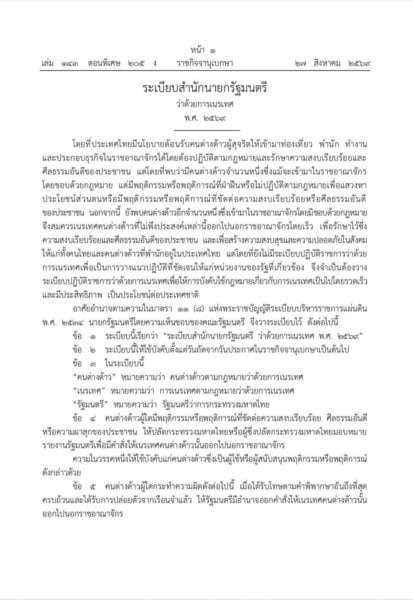
Picture courtesy of Royal Gazette
Related story
Thailand-approves-first-deportation-rules-for-foreigners
Join the discussion? 

28 August 2026
-
 2
2
-
 4
4
-
 1
1
Recommended Comments
Create an account or sign in to comment