



Skip to content
View in the app

A better way to browse. Learn more.

ASEAN NOW

A full-screen app on your home screen with push notifications, badges and more.

To install this app on iOS and iPadOS
  1. Tap the Share icon in Safari
  2. Scroll the menu and tap Add to Home Screen.
  3. Tap Add in the top-right corner.
To install this app on Android
  1. Tap the 3-dot menu (⋮) in the top-right corner of the browser.
  2. Tap Add to Home screen or Install app.
  3. Confirm by tapping Install.

Thailand GDP claims questioned as households cut spending

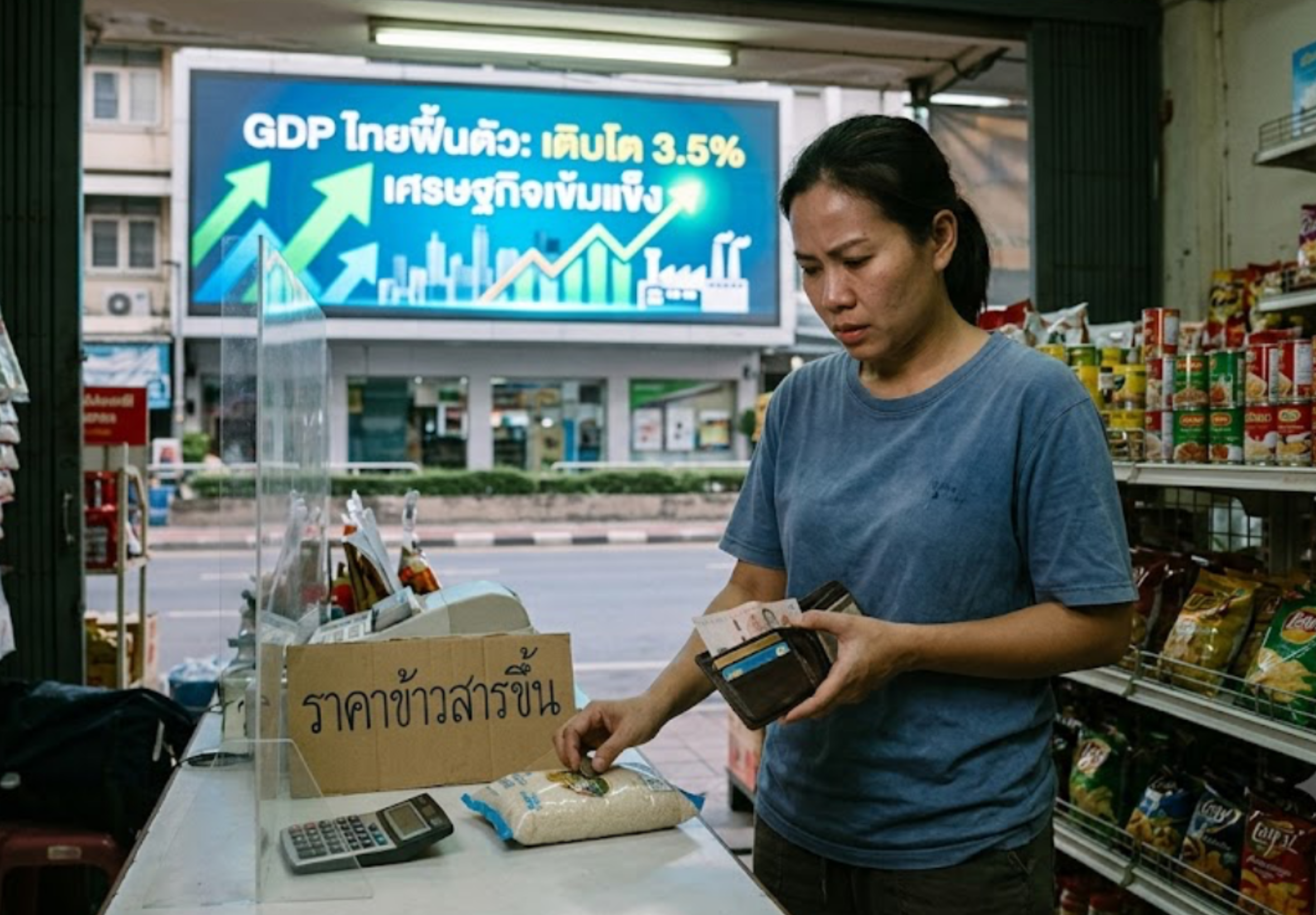
A Thai analysis published on 2 August 2026 has challenged government claims of a strong GDP recovery, arguing that headline growth is failing to reach ordinary households and small businesses.

The analysis says the gap between positive official economic reports and daily financial pressures has become increasingly stark. It cites polls and public sentiment suggesting that nearly 90% of people feel financially vulnerable, with many cutting spending, including on food.

A widening gap between GDP and daily life

The analysis argues that ministers and state agencies use macroeconomic figures to reassure investors and financial markets that Thailand's economy remains stable.

However, the commentary says this contrasts sharply with the experience of people facing rising living costs and household debt that have outpaced their ability to earn.

It describes Thailand as a "K-shaped economy", where major corporations and platform businesses continue to prosper while SMEs and lower-income households fall behind. In this view, tourism and export income is concentrated among a small number of large businesses controlling much of the country's supply chain.

The result, the analysis argues, is that purchasing power among ordinary consumers has not recovered, even where national growth indicators improve.

Short-term stimulus criticised

The commentary also questions short-term economic stimulus measures and cash-distribution policies, comparing them to temporary pain relief rather than treatment for deeper problems.

Such measures may briefly boost economic activity, it says, but do not address structural issues including inequality, corporate concentration and long-term workforce skills.

The analysis warns that weak household purchasing power could eventually slow the wider economy, as small businesses depend heavily on domestic consumers. It also suggests that public distrust of economic management could grow if gains from GDP expansion do not reach household budgets.

The analysis from SiamRath concludes that GDP growth alone cannot demonstrate national prosperity unless its benefits are more widely distributed, including at household level.

Join the discussion? Create account. orange.png


image.png

4 August 2026

User Feedback

Recommended Comments

ikke1959 Diamond Member

ikke1959

Advanced Member

The greed by the companies and a failing government are debit to this. Thai people hardly have enough money to spend, wages are not being raised and although the opposite is said, prices are rising and the inflation is huge. A simple example is for example Chabaa fruitjuice, that cost a few year back hardly 60 THB for a pack and no it is 85THB. It is said the price went up because the sugar got more expensive, but there is not so much sugar more in the pack. Same for the price of eggs, palm oil, rice, and many other things and than I don't even talk about the imported products. But the for the Tai people, wages are being the same, so how can you buy things if prices are going up and the wage is the same/ You only can buy less and less and even the 40/60 scheme is not helping. 1000THB a month max 200THB a day and for 4 months will relieve a bit, but it is far too less.

And I know businesses will claim that they can't pay more, but they forget when the people have more money, they will spend more and that will increase the sales of the businesses and give more profits. Now because of the greed, they will have less profits and will raise the prices as they need money, which results in even less sales... Money and greed have blinded them

Enzian Gold Member

Enzian

Advanced Member

I always wonder what it will take to ever end the de facto feudalism which is behind all this.

worgeordie Star Member

worgeordie

Advanced Member

Debt ,lots of it , Prices of the basics of living through the roof, Bank interest for

anyone with money less than 1% , and economists wonder why folks aren't

spending , at the moment the Government is running a scheme to help people

survive ,I think it's a 40 % -60% people pay 40 % and government pays 60%

regards worgeordie

Jim Waldron Gold Member

Jim Waldron

Advanced Member

While the government may well claim that Thailand’s GDP recovery looks good in official reports, the SiamRath analysis highlights a different story in which nearly 90% of households feel financially vulnerable, cutting even food spending.

The reality is that growth is concentrated in big corporates and tourism giants, while SMEs and ordinary families face rising debt.

Short‑term stimulus is dismissed as just painkillers. They are only temporary boosts that ignore structural issues like inequality and corporate concentration.

The warning is pretty blunt, without stronger household purchasing power, small businesses and domestic demand will continue to suffer, and GDP growth risks becoming a statistical mirage.

Cameroni Star Member

Cameroni

Advanced Member

Well, we know that China has lied about its own financial data, so that's a given that in Thailand we see similar issues. Not everyone is as honest as Americans.

If you believe government financial data you're a bit naive. It's not way off, but it's obviously massaged.

KhunHeineken Diamond Member

KhunHeineken

Advanced Member

Thailand's household debt to GDP ration is 85.9%.

Create an account or sign in to comment

Account

Navigation

Search

Search

Configure browser push notifications

Chrome (Android)
  1. Tap the lock icon next to the address bar.
  2. Tap Permissions → Notifications.
  3. Adjust your preference.
Chrome (Desktop)
  1. Click the padlock icon in the address bar.
  2. Select Site settings.
  3. Find Notifications and adjust your preference.
