



Skip to content
View in the app

A better way to browse. Learn more.

ASEAN NOW

A full-screen app on your home screen with push notifications, badges and more.

To install this app on iOS and iPadOS
  1. Tap the Share icon in Safari
  2. Scroll the menu and tap Add to Home Screen.
  3. Tap Add in the top-right corner.
To install this app on Android
  1. Tap the 3-dot menu (⋮) in the top-right corner of the browser.
  2. Tap Add to Home screen or Install app.
  3. Confirm by tapping Install.

Thailand says tsunami warning system remains operational

Thailand's tsunami warning system remains fully operational despite some monitoring buoys failing to transmit data, Deputy Interior Minister Jetsat Thaiset said on 16 August.

The reassurance followed social-media posts which raised public concern over the status of tsunami wave-monitoring buoys. Jetsat, who oversees the Department of Disaster Prevention and Mitigation (DDPM), said Thailand does not rely on buoys alone to decide whether to issue an alert.

Multiple sources used for warnings

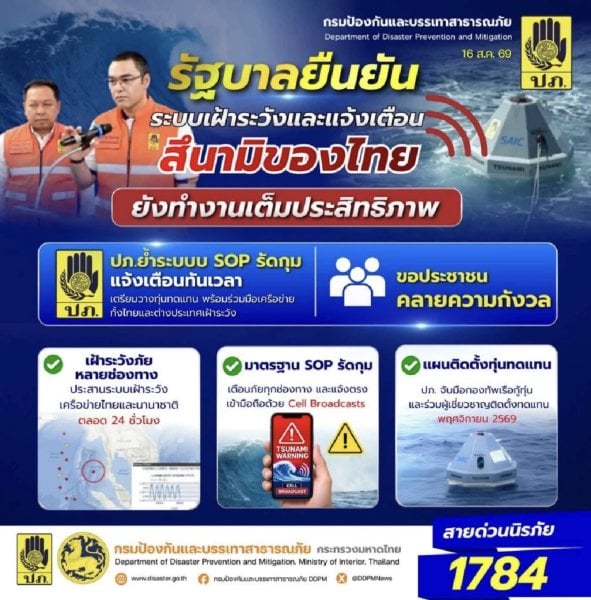
In a Facebook post, Jetsat said the government, Interior Ministry and DDPM continuously prioritise tsunami surveillance and warnings. The national system combines information from several sources and agencies, using standard operating procedures to assess a threat before warning the public.

Tsunami buoys are only one part of that network, he said. Other information includes earthquake data, sea-level monitoring stations, and data from international networks and agencies.

If an assessment identifies a risk requiring a public warning, authorities can use several channels, including Cell Broadcast messages sent rapidly to mobile phones in affected areas.

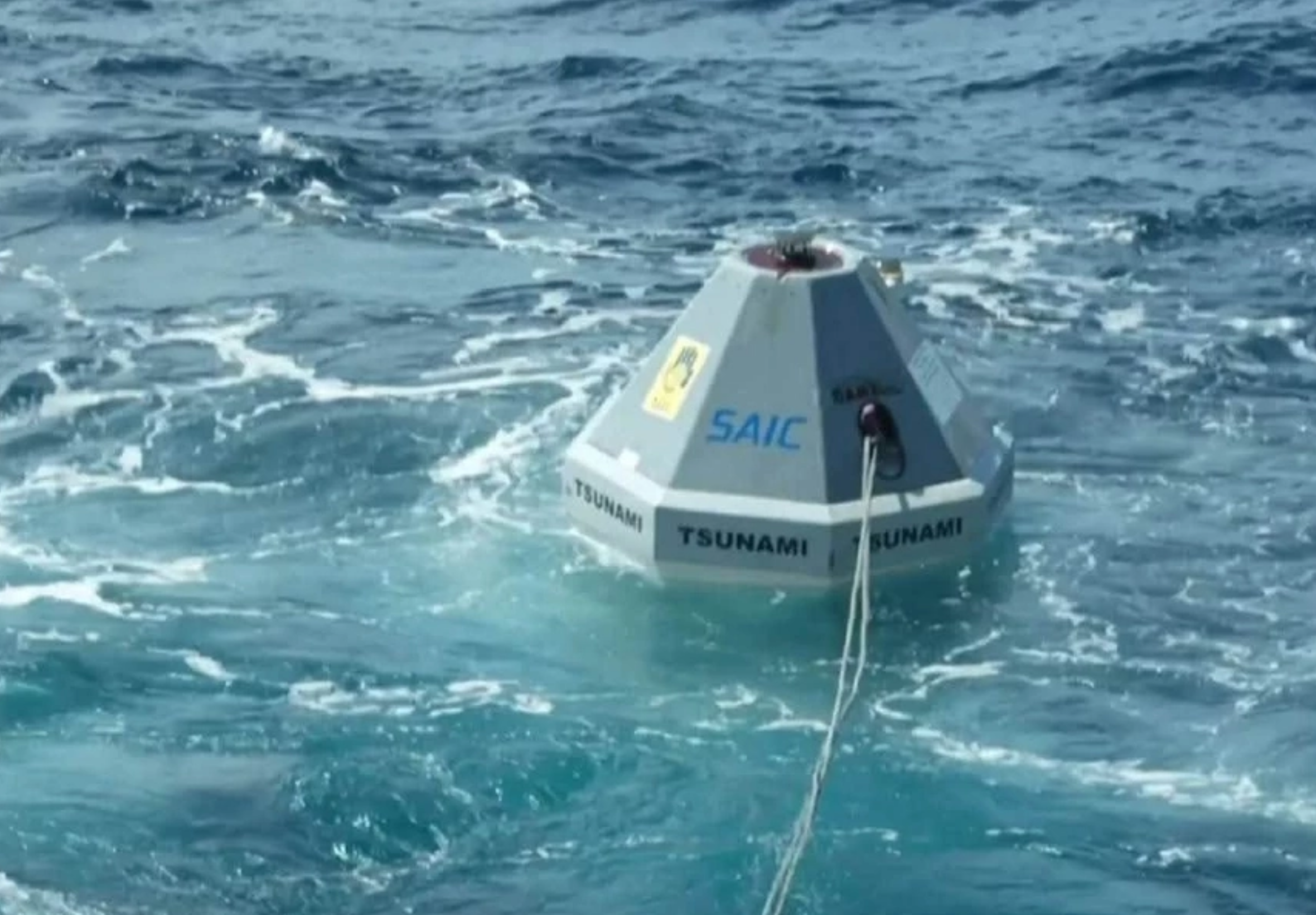
Buoy found off Ranong and Phang Nga

The DDPM's National Disaster Warning Centre has been continuously checking the buoy's technical condition and GPS signal, according to DDPM director-general Theerapat Kachamat.

Its latest position was about 111 kilometres from Koh Phayam in Mueang Ranong district, Ranong province, and around 44 kilometres from Mu Ko Surin National Park in Phang Nga province.
IMG_0466.jpeg

Officials believe strong waves and winds in the Andaman Sea during the south-west monsoon may be responsible. The DDPM and Royal Thai Navy have already planned to recover the buoy and install a replacement tsunami wave-monitoring buoy.

Installation is scheduled for November 2026, when sea conditions are expected to calm sufficiently for a large oceanographic research vessel to operate safely.

Public asked not to panic

Jetsat said the system was "100% accurate" and asked people not to panic, stressing that warnings are based on information from multiple sources, agencies and stages of assessment.

Prime Minister and Interior Minister Anutin Charnvirakul, along with Jetsat, had sent their concern to the public, the DDPM said. The department maintained that the current inability of the Andaman Sea buoy to send data would not affect Thailand's tsunami monitoring and warning effectiveness.

IMG_0465.png

Pictures courtesy of Komchadluek

Join the discussion? Create account. orange.png


image.png

18 August 2026

User Feedback

Recommended Comments

Jim Waldron Gold Member

Jim Waldron

Advanced Member

For those interested, the US government's National Data Buoy Center maintains a web site providing tsunami monitoring data from an international network of real‑time stations (https://www.ndbc.noaa.gov/).

Two of these stations are operated by Thailand:

Station ID 23401 - Bay of Bengal, 600 NM WNW of Phuket.

Currently operating.

Station ID 23461 - Andaman Sea, 180 NM NW of Phuket.

Currently not operating.

Jetsat’s reassurance that buoys are only one part of the warning system needs context.

While earthquake data, sea‑level stations, and international feeds are indeed part of the network, all of these sources were present in 2004, yet the Indian Ocean tsunami still claimed over 250,000 lives!

The point is simple: DART buoys (only introduced after the 2004 event) are now the most reliable real‑time confirmation tool. They measure and transmit deep‑ocean pressure changes before waves reach land.

Without them, authorities are left inferring risk rather than directly detecting it.

Consequently, it is vital that Thailand’s buoys are properly maintained and kept operational. Otherwise Jetsat's “multi‑source” reassurance means Thailand risks relying on inference when what is needed is direct, real‑time confirmation!

JimHuaHin Platinum Member

JimHuaHin

Advanced Member

"Thailand's tsunami warning system remains fully operational despite some monitoring buoys failing to transmit data, Deputy Interior Minister Jetsat Thaiset said on 16 August."

Is it just me, or is not this statement self-contradictory? How can a system be fully operational, if some components fail to transmit data?

Watawattana Platinum Member

Watawattana

Advanced Member
11 hours ago, JimHuaHin said:

"Thailand's tsunami warning system remains fully operational despite some monitoring buoys failing to transmit data, Deputy Interior Minister Jetsat Thaiset said on 16 August."

Is it just me, or is not this statement self-contradictory? How can a system be fully operational, if some components fail to transmit data?

I don't have access to the design and operational requirements for this system, but in non-related systems I have worked on it is common for a design to have built-in redundancy. So, if one thing fails the system's operational design requirements can still be met. So this person saying the system is still fully operational may very well be true, albeit with reduced redundancy - the service the system is providing is fully operational. But I do understand why people get concerned - it's understandable public perception.

One quick example. Most major airports have coverage from multiple radars; if one fails then others are already there to provide the coverage required for the airport to keep at full capacity (fully operational). Public perception example - there used to be a big radar in the middle of Heathrow in London. When the aerial was stopped for maintenance the airport used to get a lot of phone calls asking if the airport was still open. So much of a pain did that become that when that radar was being decommissioned they deliberately left the aerial turning!

Create an account or sign in to comment

Account

Navigation

Search

Search

Configure browser push notifications

Chrome (Android)
  1. Tap the lock icon next to the address bar.
  2. Tap Permissions → Notifications.
  3. Adjust your preference.
Chrome (Desktop)
  1. Click the padlock icon in the address bar.
  2. Select Site settings.
  3. Find Notifications and adjust your preference.
