



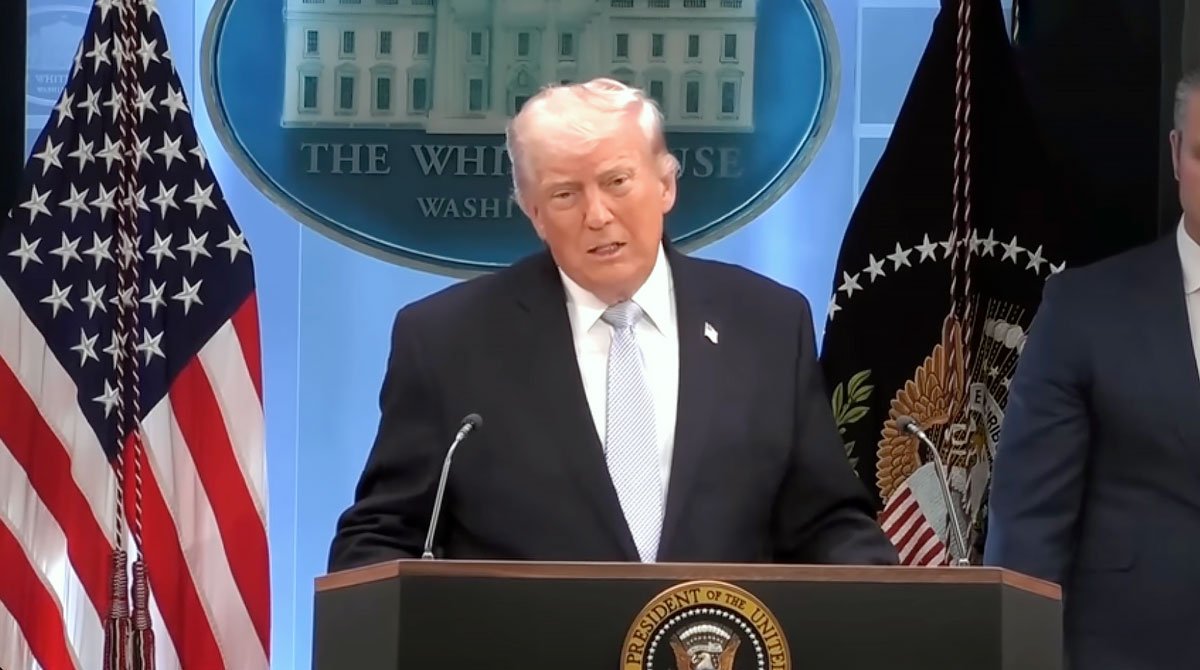

US President Donald Trump has warned that the United States could destroy key Iranian infrastructure “in one night” if Tehran fails to reach an agreement before a deadline he set for reopening the Strait of Hormuz.
Get today's headlines by email 
The ultimatum requires Iran to restore the free flow of energy shipments through the strategic Gulf route by 20:00 EDT (00:00 GMT) on Tuesday. The narrow waterway is one of the world’s most important oil transit corridors.
Speaking at the White House on Monday, Trump said the US was seeking what he described as an “acceptable” agreement that would ensure shipping could resume through the strait.
Deadline approaches amid uncertainty
At a news conference alongside Dan Caine and US Defence Secretary Pete Hegseth, Trump suggested that some Iranian officials appeared open to negotiations.
He said he believed “reasonable” leaders in Iran were negotiating in “good faith”, though he acknowledged the outcome remained unclear.
Iran has rejected proposals for a ceasefire and instead called for an immediate halt to hostilities, reconstruction following the conflict and the removal of sanctions imposed on the country.
Trump’s comments came days after US forces recovered two crew members from an F-15 fighter jet that had been shot down in southern Iran.
While praising what he called the “heroic” rescue operation, the president repeated his warning that the US could launch attacks on Iran’s energy and transport systems if the strait remained closed.
“The entire country can be taken out in one night — and that night might be tomorrow night,” Trump said.
Threats to infrastructure
Trump also said that if the deadline passed without agreement, Iran’s infrastructure could be severely damaged.
“They’re going to have no bridges,” he said. “They’re going to have no power plants.”
He added that Iran would be sent back to the “Stone Ages” if the US carried out such attacks.
Despite Tehran’s rejection of US demands so far, Trump maintained that negotiations might still produce results. He said the situation remained fluid following the deaths of several senior Iranian leaders in recent US and Israeli strikes.
“We’re going to find out,” he said.
Diplomatic efforts continue
A regional official familiar with the talks said significant progress was unlikely without a ceasefire first. The official, who spoke on condition of anonymity due to the sensitivity of the negotiations, said communication with Iranian officials had been slow because of a communications blackout in the country.
According to the official, relaying messages and receiving responses from Tehran can take about a day.
Several countries, including Pakistan, Turkey and Egypt, have been involved in mediation efforts.
Trump declined to provide details of the US strategy, saying only that he had “the best plan” but would not reveal it publicly.
Legal concerns and criticism of allies
Some legal experts have warned that deliberate attacks on civilian infrastructure could violate international law.
A former legal adviser to the National Security Council during the administration of Barack Obama told CBS News that sustained assaults on power plants and other civilian facilities could constitute war crimes.
Earlier in the day, Trump said he was not concerned by that possibility. He argued that the Iranian population would be prepared to endure hardship in pursuit of freedom, even though he said overthrowing Iran’s government was not the aim of US policy.
The president also criticised several US allies, including the NATO, the United Kingdom and South Korea, accusing them of failing to assist the United States during the conflict.
“That’s a mark on Nato that will never disappear,” he said, adding that the US does not “need” the UK.
According to the United States Central Command, American forces have carried out more than 13,000 strikes across Iran since the conflict began.
Join the discussion? 
Already a member? 
 Adapted by ASEAN Now. Source 7 April 2026
Recommended Comments
Create an account or sign in to comment