



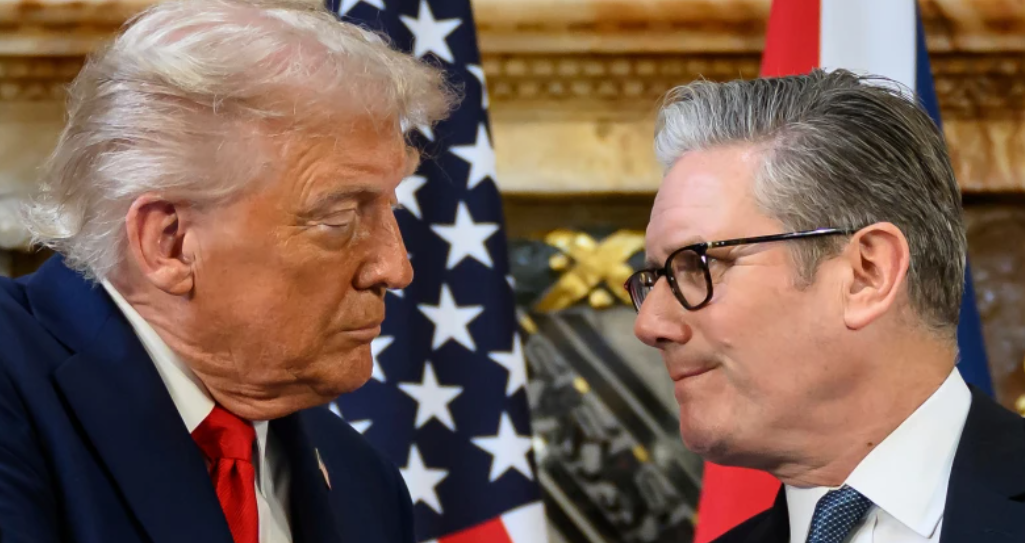

The war with Iran has exposed sharp tensions between Keir Starmer and Donald Trump, straining a trans-Atlantic relationship the British leader had worked carefully to cultivate.
Trump publicly criticised Starmer this week over Britain’s reluctance to join U.S.-Israeli strikes on Iran. Speaking at the White House, Trump said: “This is not Winston Churchill that we’re dealing with,” accusing the UK of hesitating to allow American warplanes to use British bases.
Get the latest headlines in your email 
In an interview with The Sun, Trump said the relationship with Britain was no longer as strong as before, adding: “It’s very sad to see that the relationship is obviously not what it was.”
Dispute over base access
Starmer initially blocked U.S. aircraft from operating out of British bases during the first wave of strikes. He later agreed to limited use of bases in England and on Diego Garcia in the Indian Ocean for what the UK described as defensive actions targeting Iranian missile sites — but not broader offensive operations.
Even after an Iran-made drone struck the British air base at Akrotiri in Cyprus, Starmer maintained that the UK “will not join offensive action.” He announced that the Royal Navy destroyer HMS Dragon and Wildcat helicopters equipped with counter-drone capabilities were being deployed for defensive purposes. British forces have also intercepted drones in Jordanian and Iraqi airspace.
In the House of Commons, Starmer offered a rare implicit rebuke of the U.S. approach, saying the UK does not believe in “regime change from the skies.”
“Any UK actions must always have a lawful basis and a viable, thought-through plan,” he told lawmakers, adding that while Trump disagreed with Britain’s position, it was his duty to act in the national interest.
Growing friction
The disagreement comes against a backdrop of mounting friction between the two leaders. Trump’s earlier comments about taking control of Greenland were criticised by European governments, including London. More recently, Trump has attacked Britain’s agreement to transfer sovereignty of the Chagos Islands — home to the strategically important Diego Garcia base — to Mauritius.
Peter Ricketts, a former head of the UK Foreign Office, said the U.S. under Trump had “effectively given up on any effort to be consistent with international law,” a stance likely to trouble Starmer, a former chief prosecutor.
Despite the tensions, UK officials insist the “special relationship” remains intact. Foreign Office Minister Stephen Doughty told Parliament that ties with Washington “have endured, continue to endure, and will endure into the future.”
However, the Iran conflict has highlighted differing approaches to military intervention and international law, raising questions about how closely London and Washington will align as the war continues.
Join the discussion? 
Already a member? 
 Adapted by ASEAN Now · Source · 03.03 2026