



Skip to content
View in the app

A better way to browse. Learn more.

Thailand News and Discussion Forum | ASEANNOW

A full-screen app on your home screen with push notifications, badges and more.

To install this app on iOS and iPadOS
  1. Tap the Share icon in Safari
  2. Scroll the menu and tap Add to Home Screen.
  3. Tap Add in the top-right corner.
To install this app on Android
  1. Tap the 3-dot menu (⋮) in the top-right corner of the browser.
  2. Tap Add to Home screen or Install app.
  3. Confirm by tapping Install.

Asok Rail Crossing Crash Exposes Bangkok Planning Failures

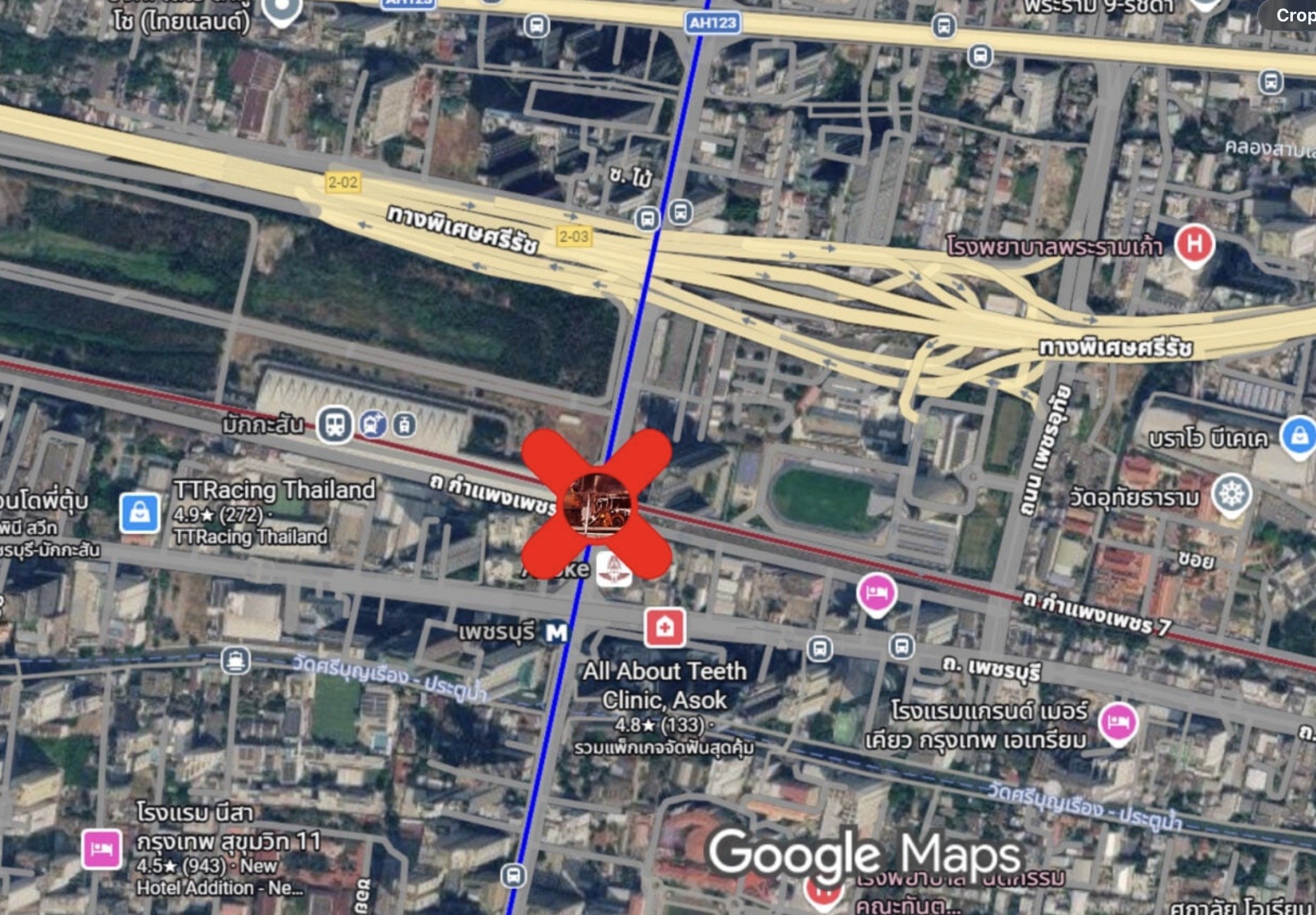
A fatal crash between a train and a public bus at the Asok-Din Daeng rail crossing in Bangkok has renewed scrutiny of one of the capital’s most dangerous transport bottlenecks. The collision, involving an eastern rail line train and a bus stranded on the tracks, has sparked debate over whether the disaster reflects deeper failures in urban planning rather than individual driver error.

Get today's headlines by email image.png

The crossing sits on Asok Montri Road, where traffic from Rama 9 junction and Asok-Phetchaburi junction converges before passing over a level railway crossing. According to data from the Bangkok Metropolitan Administration’s Traffic and Transportation Department, more than 100,000 vehicles pass through Rama 9 junction daily, while over 60,000 use the Asok-Phetchaburi junction.

The eastern railway line was built long before Bangkok expanded into a dense commercial district. However, critics argue that allowing heavy road traffic and rail operations to continue sharing the same ground-level crossing has created a long-standing safety hazard in the centre of the city.

Traffic congestion in the area frequently leaves vehicles trapped on the tracks as queues build up from nearby junctions. Vehicles approaching the crossing are often unable to move forward or reverse once warning signals activate and barriers lower, effectively turning stranded cars and buses into stationary obstacles directly in the train’s path.

The danger is heightened by the nearby Asok railway halt, where large numbers of passengers gather during rush hour close to the crossing. Concerns have been raised that any derailment or severe collision in the area could potentially lead to mass casualties.

Urban transport analysts say the problem stems from the physical design of the area rather than isolated mistakes by drivers or crossing staff. The combination of narrow road capacity, merging traffic from Kamphaeng Phet 7 Road and extremely high vehicle volumes has created what experts describe as a chronic choke point.

Comparisons have been drawn with major international cities, where dangerous inner-city level crossings have largely been eliminated through grade separation projects. Proposed solutions for the Asok crossing include elevating the railway line, constructing underground tunnels for road traffic, or creating bypass routes to reduce congestion through the central business district.

Daily News reported that authorities are now facing renewed calls to permanently separate rail and road traffic at the site. Critics argue that as long as trains and vehicles continue sharing the same level crossing in an area operating beyond traffic capacity, similar incidents remain likely in future.

Related stories

Bus-hit-by-train-near-Rama-9-bursts-into-flames

PM-visits-Makkasan-rail-crash-site

Join the discussion? image.png

Already a member? image.png

image.png Adapted by ASEAN Now Dailynews 17 May 2026

User Feedback

Recommended Comments

Geoff914 Gold Member

Geoff914

Advanced Member
1 minute ago, Geoff914 said:

You are putting all the blame on the railways. How many trains per day actually use this line? Re-routing is a possibility but you still have the problem of crossings so it will need to be elevated. Remind me how long high speed rail taking to build? I would have thought it would be easier to eliminate the major rail crossings by put the cars and buses on a bridge.

Of course the congestion could be eliminated by moving freight trains at night. Then just deal with the very few passengers trains each day.

josephbloggs Diamond Member

josephbloggs

Advanced Member
5 minutes ago, Geoff914 said:

Of course the congestion could be eliminated by moving freight trains at night. Then just deal with the very few passengers trains each day.


There are way more passenger trains on that line than freight trains.

TedG Ruby Member

TedG

Advanced Member
On 5/17/2026 at 8:33 AM, richard_smith237 said:

The issue therefore was not simply train speed. The issue was that multiple safety measures designed to prevent exactly this type of disaster appear not to have been properly executed.

  • Audiable warnings ignored: The bus driver - along with numerous other motorists - crossed the railway tracks while the audible warning had already been sounding for several minutes beforehand.

  • The train driver was radioed and instructed to stop, but failed to do so.

  • Crossing barriers were not lowered.

  • A signalman further up the track failed to properly “red-flag” the train.

This is a case study in the Swiss cheese model of errors.

Geoff914 Gold Member

Geoff914

Advanced Member
34 minutes ago, josephbloggs said:


There are way more passenger trains on that line than freight trains.

How many more?

I count 12 trains going Eastbound from 06.19 to 18.41at Makkasan and 12 Westbound 06.44 60 19.24. So two an hour roughly. They are stopping at Makkasan any way so going at low speed So let's tunnel the whole of the Eastern line for 24 trains a day plus a few freight trains that could run at night. That looks very cost effective.

richard_smith237 Star Member

richard_smith237

Advanced Member
21 minutes ago, TedG said:

This is a case study in the Swiss cheese model of errors.

James Reason would be proud of you...

But yes - exactly that....

richard_smith237 Star Member

richard_smith237

Advanced Member
6 minutes ago, Geoff914 said:

How many more?

I count 12 trains going Eastbound from 06.19 to 18.41at Makkasan and 12 Westbound 06.44 60 19.24. So two an hour roughly. They are stopping at Makkasan any way so going at low speed So let's tunnel the whole of the Eastern line for 24 trains a day plus a few freight trains that could run at night. That looks very cost effective.

Why 'run it' into Central Bangkok at all ????

Another fitting argument - why so many cars in central Bangkok that contribute to this extreme level of gridlock ?

josephbloggs Diamond Member

josephbloggs

Advanced Member
23 minutes ago, Geoff914 said:

How many more?

I count 12 trains going Eastbound from 06.19 to 18.41at Makkasan and 12 Westbound 06.44 60 19.24. So two an hour roughly. They are stopping at Makkasan any way so going at low speed So let's tunnel the whole of the Eastern line for 24 trains a day plus a few freight trains that could run at night. That looks very cost effective.


Eh? I never said tunnel the route - that would be totally impractical.

I just said there are way more passenger than freight trains so moving freight trains to night wouldn't make a massive difference, and I am pretty sure most freight trains do run at night anyway already.

I haven't counted the trains, just circumstantial evidence of living by that line for the last 15 years. I am often stopped at barriers for passenger trains, ocassionally for freight (in the day time).

Geoff914 Gold Member

Geoff914

Advanced Member
27 minutes ago, richard_smith237 said:

Why 'run it' into Central Bangkok at all ????

Another fitting argument - why so many cars in central Bangkok that contribute to this extreme level of gridlock ?

Yes even without the railway Asoke Petchaburi junction is a complete mess. Why run into Central Bangkok? My guess that is where people want to go to. And when the railway was built Makkasan was probably farm land.

Geoff914 Gold Member

Geoff914

Advanced Member
18 minutes ago, josephbloggs said:


Eh? I never said tunnel the route - that would be totally impractical.

I just said there are way more passenger than freight trains so moving freight trains to night wouldn't make a massive difference, and I am pretty sure most freight trains do run at night anyway already.

I haven't counted the trains, just circumstantial evidence of living by that line for the last 15 years. I am often stopped at barriers for passenger trains, ocassionally for freight (in the day time).

Some people have mentioned tunnelling. Only 2 passenger trains per hour and stopping a Makkasan anyway. So comparing the congestion cause by a train every 30 minutes to the volume of traffic for the remaining 29 minutes shows that it is not really the railway that is the problem.

The issue with the freight train as I see it is that they are not stopping where as the passenger train stops at Makkasan anyway. And of course the safety infringements that should have prevented this from happening.

richard_smith237 Star Member

richard_smith237

Advanced Member
11 minutes ago, Geoff914 said:

Yes even without the railway Asoke Petchaburi junction is a complete mess. Why run into Central Bangkok? My guess that is where people want to go to. And when the railway was built Makkasan was probably farm land.

Its freight - mostly, and this line comes in from lat-Krabang to Hualompong.

Although there are overland carriages / people carriages.

Yagoda Star Member

Yagoda

Advanced Member

I mentioned simple fixes yesterday.

richard_smith237 Star Member

richard_smith237

Advanced Member
7 minutes ago, Yagoda said:

I mentioned simple fixes yesterday.

What was Thailand Prime Minster's response ?

Yagoda Star Member

Yagoda

Advanced Member
48 minutes ago, richard_smith237 said:

What was Thailand Prime Minster's response ?

He agreed with all of them.

Selatan Advanced Member

Selatan

Advanced Member

Malaysia used to have accidents at level crossings, decades ago. But with the electrified double-tracking project from Johor Bahru to Padang Besar, all level crossings were eliminated by constructing flyovers over them.

I have always felt that my government prioritized highway building over railroads but it looks like that we are not that bad when compared to Thailand. A new, standard gauge railroad called the East Coast Rail Link is due for completion later this year. The ECRL is built by China.

Create an account or sign in to comment

Account

Navigation

Search

Search

Configure browser push notifications

Chrome (Android)
  1. Tap the lock icon next to the address bar.
  2. Tap Permissions → Notifications.
  3. Adjust your preference.
Chrome (Desktop)
  1. Click the padlock icon in the address bar.
  2. Select Site settings.
  3. Find Notifications and adjust your preference.

