

Skip to content
View in the app

A better way to browse. Learn more.

ASEAN NOW

A full-screen app on your home screen with push notifications, badges and more.

To install this app on iOS and iPadOS
  1. Tap the Share icon in Safari
  2. Scroll the menu and tap Add to Home Screen.
  3. Tap Add in the top-right corner.
To install this app on Android
  1. Tap the 3-dot menu (⋮) in the top-right corner of the browser.
  2. Tap Add to Home screen or Install app.
  3. Confirm by tapping Install.

Thailand Driving Out Foreigners It Once Courted

Thailand is pursuing two major policy directions that appear to conflict with one another: opening its economy to foreign business while intensifying enforcement against foreign-linked property ownership structures.

Get today's headlines by email image.png

The contrast has become increasingly visible following reforms to the Foreign Business Act. In April 2025, the Cabinet approved the most significant overhaul of the law in 25 years. In January 2026, it confirmed plans to remove ten business categories, including software development, from restricted lists, allowing foreign companies to operate without local partners or special licences. The reforms form part of the Thailand 4.0 strategy aimed at improving competitiveness and attracting investment.

Now authorities have launched an extensive crackdown on nominee company structures used by some foreigners to control land. New rules require Thai shareholders in foreign-linked companies to prove that invested funds genuinely belong to them. Authorities have also introduced data-sharing systems between agencies and analytical tools designed to identify suspicious ownership arrangements.
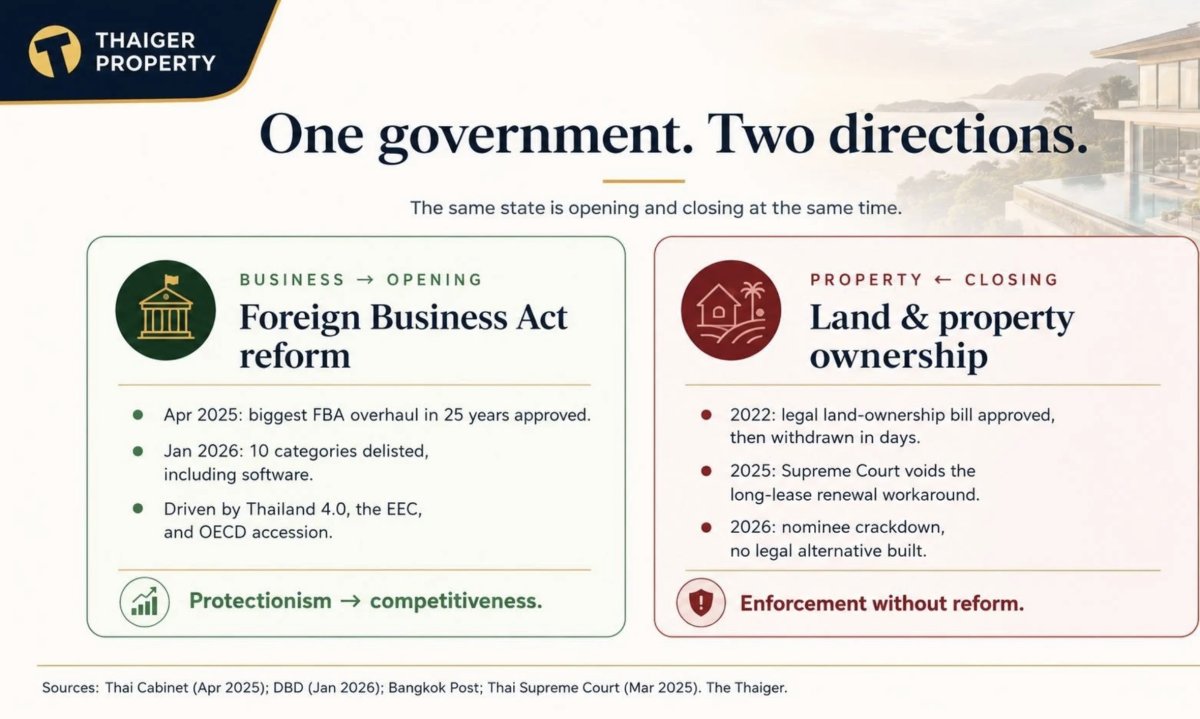
image.jpeg

Enforcement activity has increased significantly. In May 2026, a major operation on Koh Phangan resulted in 22 arrests and the seizure of more than 40 rai of land. Police are also using criminal procedures in investigations involving alleged nominee arrangements.

The crackdown targets structures where Thai shareholders act only as legal fronts while foreigners effectively control assets. Authorities argue such arrangements violate Thai law and amount to fraud. However, concerns have emerged that some long-term foreign residents who purchased property through company structures recommended by legal advisers years ago may also be affected.

The debate is rooted in previous attempts to reform foreign property ownership rules. In late 2022, Thailand’s Cabinet approved a proposal that would have allowed qualifying foreigners to legally own small residential land plots. Supporters argued that foreigners already gained access to property through leases, condominium ownership quotas and nominee companies, and that the proposal would provide a transparent legal alternative.

The proposal was withdrawn less than two weeks later following political opposition. In March 2025, the Supreme Court also ruled against a long-lease renewal structure that many foreign buyers had relied upon for additional security.

Supporters of reform argue that restrictive laws encourage the very workarounds now being targeted. They point to broader business reforms as evidence that Thailand has already accepted the principle of creating legal pathways while enforcing existing laws against abuse.

image.jpeg

Some observers believe the current crackdown may be part of a broader strategy to clear out unlawful structures before introducing new legal ownership frameworks. Others warn that enforcement without further reform could discourage investment and prompt foreign capital to move elsewhere.

Regional competition is increasing. Malaysia permits foreign freehold ownership subject to minimum-price requirements, while Indonesia offers foreigners registered property rights lasting up to 80 years. Other neighbouring countries have also introduced clearer frameworks for foreign property investment.

The Thaiger reported that the attention will now focus on whether Thailand introduces new legal routes for foreign property ownership or long-term leases. Proposals frequently discussed include reviving elements of the 2022 ownership framework, strengthening lease protections and updating condominium regulations.

The outcome could determine whether Thailand’s property policies ultimately align with its broader efforts to attract foreign investment and support economic modernisation.
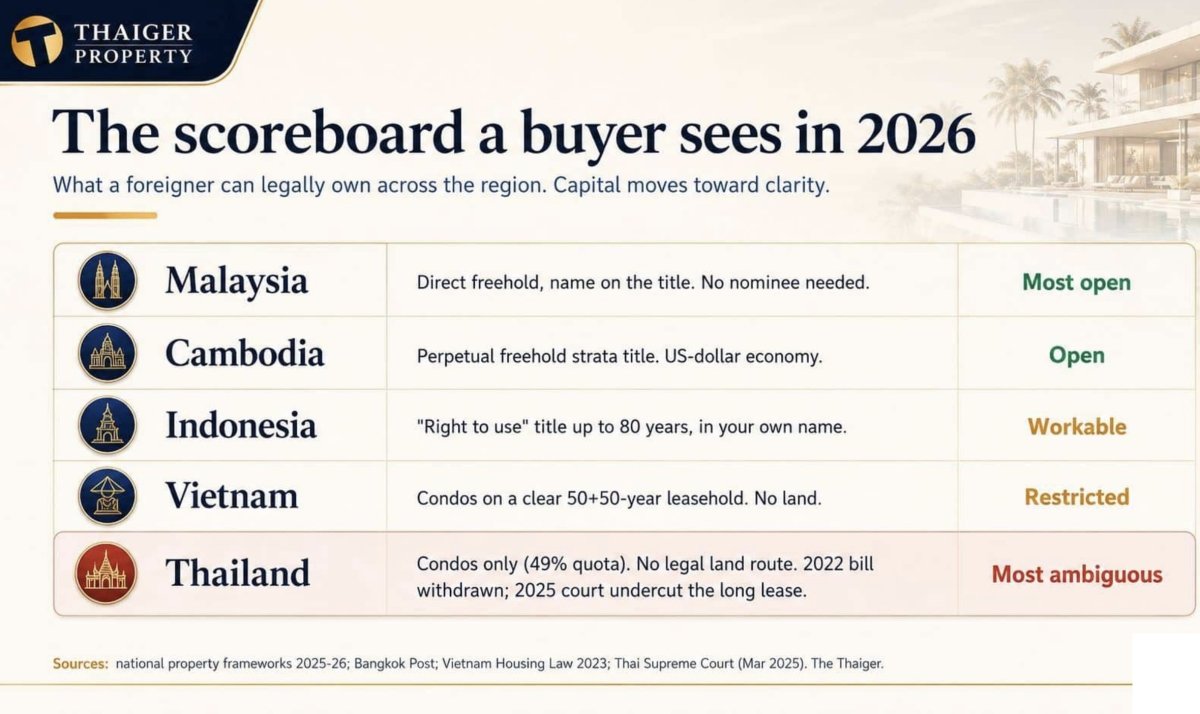
image.jpeg

Pictures courtesy of The Thaiger

Join the discussion? image.png

Already a member? image.png

image.png Adapted by ASEAN Now TheThaiger 22 June 2026

User Feedback

Recommended Comments

Yumthai Gold Member

Yumthai

Advanced Member
2 hours ago, steve187 said:

You may do it, but it could come back and bite you, as you know its wrong

What is right or wrong is in the eye of the beholder, specifically in Thailand.

JerryM Gold Member

JerryM

Advanced Member
2 hours ago, steve187 said:

You may do it, but it could come back and bite you, as you know its wrong

Waste of time dealing with the "When in Rome ... " contingent.

Yumthai Gold Member

Yumthai

Advanced Member
17 minutes ago, JerryM said:

Waste of time dealing with the "When in Rome ... " contingent.

Well it seems you have nothing better to do.

As pointed out in another thread you would have a better use of your time directly addressing the Thai authorities with your unenforced law bitter concerns.

JerryM Gold Member

JerryM

Advanced Member
(edited)
22 minutes ago, Yumthai said:

As pointed out in another thread you would have a better use of your time directly addressing the Thai authorities with your unenforced law bitter concerns.

Rainy day. To approach the authorities one needs to make a case as to what is wrong and you guys are a big help on that score.

Edited by JerryM

novacova Diamond Member

novacova

Advanced Member
4 hours ago, JerryM said:

Nobody who is paying bribes for their retirement extension needs to worry. Yet.

Just observations, no advice intended. The “yet” thing is an open door of unknowns. Complacency and denial is the result of the current happenings, as it will be for the next, whatever that may be. Though personally wouldn’t want to be one caught up in a iffy presumed visa situation especially if there was no where else to go at a decrepit old age.

JerryM Gold Member

JerryM

Advanced Member
(edited)
9 minutes ago, novacova said:

The “yet” thing is an open door of unknowns.

Absolutely. But then there is a topic heading this forum:

Thailand built the nominee scheme, but foreigners pay the price

Which may be the same as may happen if ever this immigration bribe via 'reputable' agent scheme collapses as the foreigner soliciting the bribe may be most exposed.

Edited by JerryM

wavodavo Gold Member

wavodavo

Advanced Member
On 6/22/2026 at 11:29 AM, Cabradelmar said:

It's not a conflict. The framework is the same as it ever was. Some things are legal and some are not. Fewer restricted job categories is good. Cracking down on existing laws against illegal accusation of land is not new, nor are the laws against such activities. If this surprises you you are thick in the head.

On 6/22/2026 at 11:29 AM, Cabradelmar said:

It's not a conflict. The framework is the same as it ever was. Some things are legal and some are not. Fewer restricted job categories is good. Cracking down on existing laws against illegal accusation of land is not new, nor are the laws against such activities. If this surprises you you are thick in the head.

On 6/22/2026 at 11:29 AM, Cabradelmar said:

It's not a conflict. The framework is the same as it ever was. Some things are legal and some are not. Fewer restricted job categories is good. Cracking down on existing laws against illegal accusation of land is not new, nor are the laws against such activities. If this surprises you you are thick in the head.

I don't know how a foreigner can ever work out what is legal or not not with the regular change of government and leaders and the constant policy changes .For example immigration and visa rules , 30 days then up to 90 days and then back to 30 days again. Airport taxes on then off and then on again.Not to mention pot laws firstly iillegal then legal and a shop on every street corner now they have been restricted to being like a doctors clinic.

JerryM Gold Member

JerryM

Advanced Member
On 7/29/2026 at 7:30 AM, steve187 said:

You may do it, but it could come back and bite you, as you know its wrong

One of the ways the experts on the VISA Forum claim the 15,000 baht agent provided no 800k baht in-the-bank extension is legal is that they re-write the regs.

The current police order on extension says: *

.. but (if) a competent officer ... is of the opinion that the alien has legitimate reason for staying in the Kingdom

This has been re-written as:

it's left up to the immigration officer's discretion to determine what legitimate means. So if the office determines 10,000 baht backhander means it's legitimate, then it is.

The ministerial regulation It's talking about the ALIEN'S legitimate reason which is nominally hardship or humanitarian.

This has now morphed to read: ANYTHING the IMM officer claims is legitimate is therefore legitimate.

* ORDER OF THE IMMIGRATION BUREAU

No. 327/2557

Subject: Criteria and Conditions for Consideration of an Alien’s Application

for a Temporary Stay in the Kingdom of Thailand at Clause 5.

Create an account or sign in to comment

Account

Navigation

Search

Search

Configure browser push notifications

Chrome (Android)
  1. Tap the lock icon next to the address bar.
  2. Tap Permissions → Notifications.
  3. Adjust your preference.
Chrome (Desktop)
  1. Click the padlock icon in the address bar.
  2. Select Site settings.
  3. Find Notifications and adjust your preference.