

Skip to content
View in the app

A better way to browse. Learn more.

Thailand News and Discussion Forum | ASEANNOW

A full-screen app on your home screen with push notifications, badges and more.

To install this app on iOS and iPadOS
  1. Tap the Share icon in Safari
  2. Scroll the menu and tap Add to Home Screen.
  3. Tap Add in the top-right corner.
To install this app on Android
  1. Tap the 3-dot menu (⋮) in the top-right corner of the browser.
  2. Tap Add to Home screen or Install app.
  3. Confirm by tapping Install.

Thailand Driving Out Foreigners It Once Courted

Thailand is pursuing two major policy directions that appear to conflict with one another: opening its economy to foreign business while intensifying enforcement against foreign-linked property ownership structures.

Get today's headlines by email image.png

The contrast has become increasingly visible following reforms to the Foreign Business Act. In April 2025, the Cabinet approved the most significant overhaul of the law in 25 years. In January 2026, it confirmed plans to remove ten business categories, including software development, from restricted lists, allowing foreign companies to operate without local partners or special licences. The reforms form part of the Thailand 4.0 strategy aimed at improving competitiveness and attracting investment.

Now authorities have launched an extensive crackdown on nominee company structures used by some foreigners to control land. New rules require Thai shareholders in foreign-linked companies to prove that invested funds genuinely belong to them. Authorities have also introduced data-sharing systems between agencies and analytical tools designed to identify suspicious ownership arrangements.
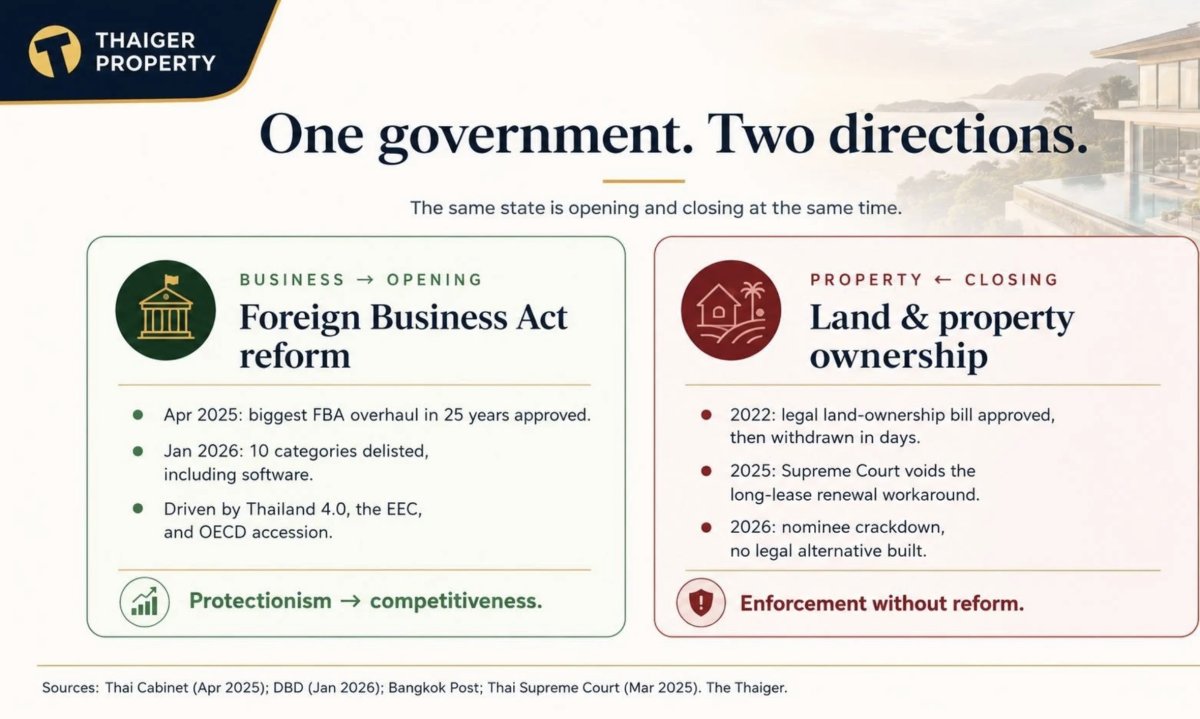
image.jpeg

Enforcement activity has increased significantly. In May 2026, a major operation on Koh Phangan resulted in 22 arrests and the seizure of more than 40 rai of land. Police are also using criminal procedures in investigations involving alleged nominee arrangements.

The crackdown targets structures where Thai shareholders act only as legal fronts while foreigners effectively control assets. Authorities argue such arrangements violate Thai law and amount to fraud. However, concerns have emerged that some long-term foreign residents who purchased property through company structures recommended by legal advisers years ago may also be affected.

The debate is rooted in previous attempts to reform foreign property ownership rules. In late 2022, Thailand’s Cabinet approved a proposal that would have allowed qualifying foreigners to legally own small residential land plots. Supporters argued that foreigners already gained access to property through leases, condominium ownership quotas and nominee companies, and that the proposal would provide a transparent legal alternative.

The proposal was withdrawn less than two weeks later following political opposition. In March 2025, the Supreme Court also ruled against a long-lease renewal structure that many foreign buyers had relied upon for additional security.

Supporters of reform argue that restrictive laws encourage the very workarounds now being targeted. They point to broader business reforms as evidence that Thailand has already accepted the principle of creating legal pathways while enforcing existing laws against abuse.
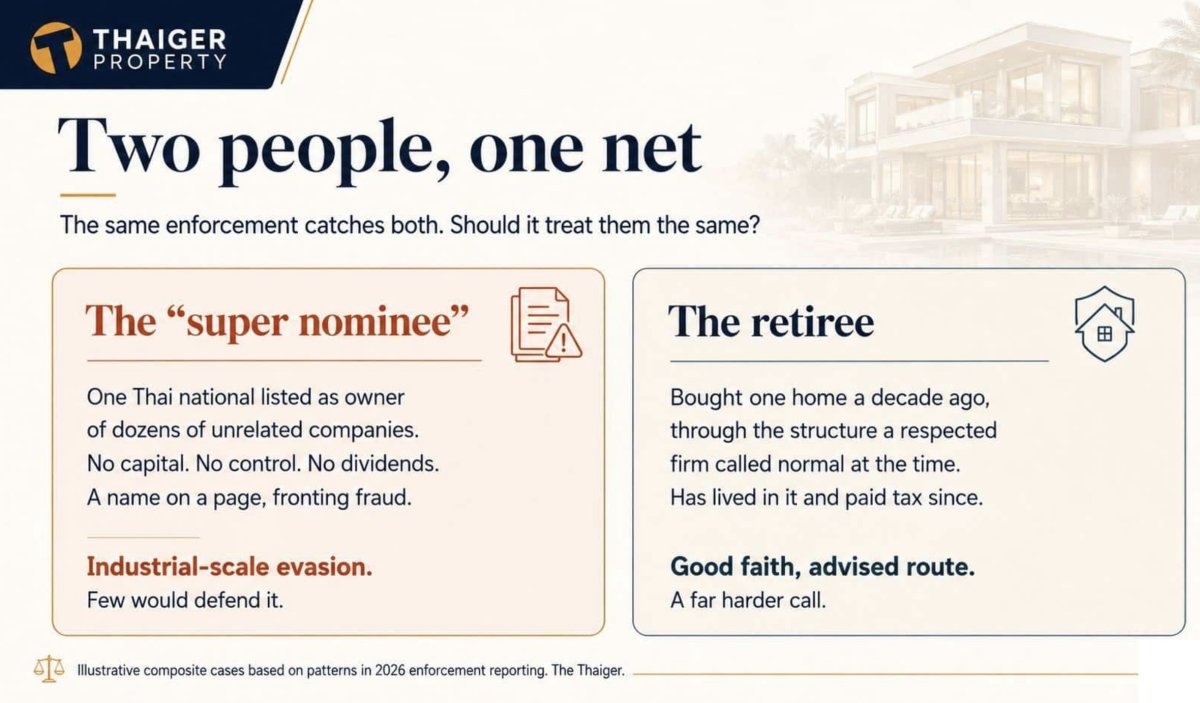
image.jpeg

Some observers believe the current crackdown may be part of a broader strategy to clear out unlawful structures before introducing new legal ownership frameworks. Others warn that enforcement without further reform could discourage investment and prompt foreign capital to move elsewhere.

Regional competition is increasing. Malaysia permits foreign freehold ownership subject to minimum-price requirements, while Indonesia offers foreigners registered property rights lasting up to 80 years. Other neighbouring countries have also introduced clearer frameworks for foreign property investment.

The Thaiger reported that the attention will now focus on whether Thailand introduces new legal routes for foreign property ownership or long-term leases. Proposals frequently discussed include reviving elements of the 2022 ownership framework, strengthening lease protections and updating condominium regulations.

The outcome could determine whether Thailand’s property policies ultimately align with its broader efforts to attract foreign investment and support economic modernisation.
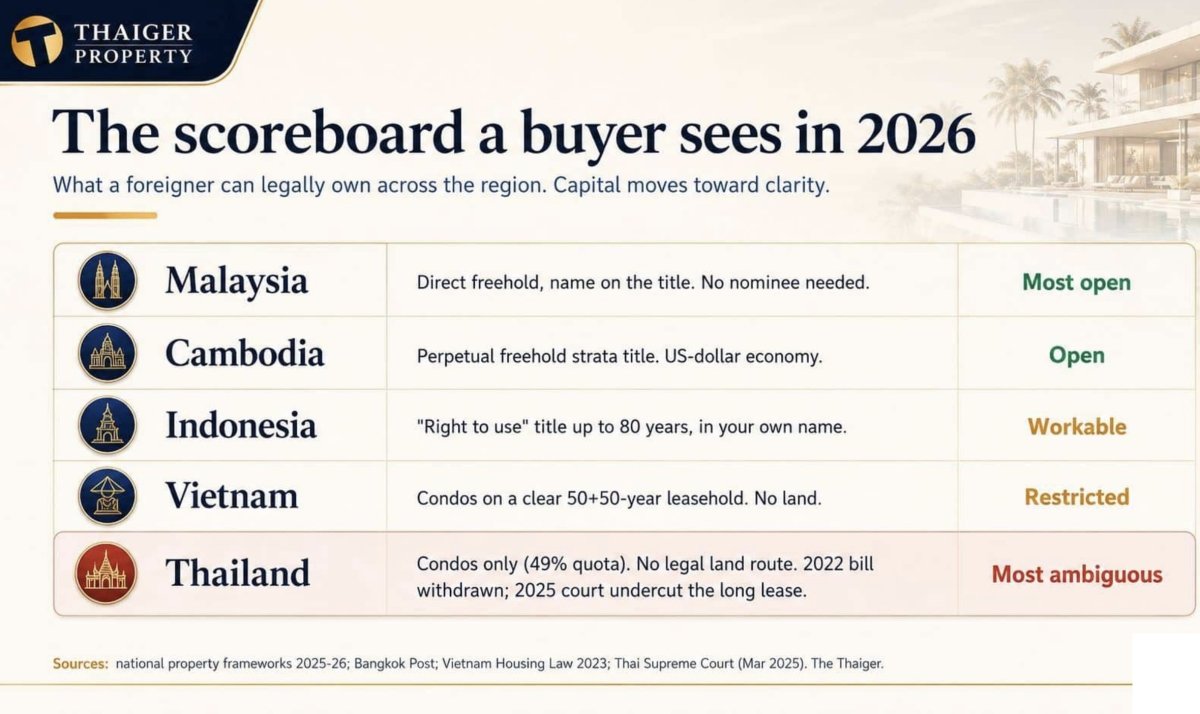
image.jpeg

Pictures courtesy of The Thaiger

Join the discussion? image.png

Already a member? image.png

image.png Adapted by ASEAN Now TheThaiger 22 June 2026

User Feedback

Recommended Comments

ChipButty Star Member

ChipButty

Advanced Member

Some guy here in Phuket want to Triple the Hotel tax on tourist, Thai logic!

henryford1958 Silver Member

henryford1958

Advanced Member

You mean driving out crooks who broke Thai law. Good riddance. They KNEW a foreigner buying land/property was illegal.

KhunLA Star Member

KhunLA

Advanced Member

Foreigners that break the law, BYE BYE, Cya, don't let the door hit you in the ass on the way out.

Good Riddance indeed.

ChipButty Star Member

ChipButty

Advanced Member

Buying property in Thailand whether it be leasehold or condo has and will remain 2nd only to Gaza as a bad investment.

rocketboy2 Gold Member

rocketboy2

Advanced Member

If they take the bad Thais down with the bad foreigners.

i'm ok with that. thumbsup

But anything that's one sided BS, No.

ChipButty Star Member

ChipButty

Advanced Member
3 minutes ago, jacko45k said:

How abut those who used an agent to falsely demonstrate a 800k bank balance to get a retirement extension, even just once in maybe a 20 year history, OUT, with a blacklist?

That was all about making money they all jumped on the bandwagon,

save the frogs Star Member

save the frogs

Advanced Member

Yeah right, Cambodia is "OPEN".

In 10-15 years, it will catch up to Thailand and tighten the noose too.

ChipButty Star Member

ChipButty

Advanced Member
3 minutes ago, rocketboy2 said:

If they take the bad Thais down with the bad foreigners.

i'm ok with that. thumbsup

But anything that's one sided BS, No.

They could start with the Land department,

rocketboy2 Gold Member

rocketboy2

Advanced Member
2 minutes ago, ChipButty said:

Buying property in Thailand whether it be leasehold or condo has and will remain 2nd only to Gaza as a bad investment.

Still have my first Condo I bought, 25 years ago, no company BS.

It's a nice holiday home now. thumbsup

jacko45k Star Member

jacko45k

Advanced Member
4 minutes ago, ChipButty said:

That was all about making money they all jumped on the bandwagon,

Yes, it usually (always) is.

Yumthai Gold Member

Yumthai

Advanced Member
13 minutes ago, KhunLA said:

If not using an agent just for convenience, but to skirt the financial requirements, then Hell Yea, as you shouldn't be here to begin with.

Skirting the financial requirements does not necessarily mean one is broke, but has just much better ways to make this amount profitable than wasting it at less than 1% yearly interest rate.

CecilM Silver Member

CecilM

Advanced Member

How's that the case?

Land ownership for foreigners was never part of the advertising.

That creative people find loopholes and abuse it, is not surprising. So now they face the consequences. Som nam naa.

ronnie50 Platinum Member

ronnie50

Advanced Member
4 hours ago, Georgealbert said:

The contrast has become increasingly visible following reforms to the Foreign Business Act. In April 2025, the Cabinet approved the most significant overhaul of the law in 25 years. In January 2026, it confirmed plans to remove ten business categories, including software development, from restricted lists, allowing foreign companies to operate without local partners or special licences. The reforms form part of the Thailand 4.0 strategy aimed at improving competitiveness and attracting investment.

Now authorities have launched an extensive crackdown on nominee company structures used by some foreigners to control land. New rules require Thai shareholders in foreign-linked companies to prove that invested funds genuinely belong to them.

While I understand the gist of the report that the right hand is undermining what the left hand is doing, I don't quite agree. The government is allowing some sectors as above to become entirely owned and operated by foreigners without any requirement for Thai partners. That's a big and positive step.

For sectors still under restriction (like property ownership as one example) the government is making Thai partners prove they have invested their own money in the 'business' and that they have operational control.

So two different things that are not contradictory IMO. However, It would be better if more sectors were allowed to operate without Thai partners ,and if private ownership of a principle residence by a foreigner was relaxed to end the need for Thai nominees.

mikebell Diamond Member

mikebell

Advanced Member

I think it is significant that this witch-hunt started when Anutin (millionaire) came to power. His oft quoted, 'dirty foreigners', show his distaste for us. As farangs desert his Kingdom, the poor will suffer the economic problems inherent in a possible drop of the 20% income associated with tourism. The shortened VOA will stop snowbirds from fleeing the Western winters; will curtail the tourist's time to decide whether to become an ex-pat, surely TAT's Holy Grail.

Ralf001 Star Member

Ralf001

Advanced Member
56 minutes ago, jacko45k said:

How abut those who used an agent to falsely demonstrate a 800k bank balance to get a retirement extension, even just once in maybe a 20 year history, OUT, with a blacklist?

What relevance does that have to the OP ?

JerryM Gold Member

JerryM

Advanced Member
6 minutes ago, Ralf001 said:

What relevance does that have to the OP ?

Right. Nobody tries to make the case that the nominee structure (when the Thai nominee has no investment) is legal.

But with the no-money-in-the-bank agent cover extension, people will swear up & down that, because the IMM officer has 'discretion', it is legal. You betcha,.

Ralf001 Star Member

Ralf001

Advanced Member
1 minute ago, JerryM said:

Right. Nobody tries to make the case that the nominee structure (when the Thai nominee has no investment) is legal.

But with the no-money-in-the-bank agent cover extension, people will swear up & down that, because the IMM officer has discretion, it is legal. You betcha,.

And another post that bares no relevance to the OP.

Yumthai Gold Member

Yumthai

Advanced Member
14 minutes ago, KhunLA said:

Why the requirements are in place. Being broke is an issue, but generating income illegally or against the rules is also an issue.

Nobody likes illegal aliens in their home country, don't be one here, TH. Is that too much to ask from guests ?

In other words, the only ones who should be able to blatantly break the rules are the ones holding a Thai ID. If you are Thai that makes perfect sense.

spidermike007 Star Member

spidermike007

Advanced Member

Thailand is extremely conflicted when it comes to foreign investment and the xenophobia and extreme fear continues to rear its ugly head.

They have absolutely no understanding of globalization and how the inherent ecosystems work, and they don't understand that they need foreign investment at this time in order for the economy to thrive. There are multiple reasons why the entire economy is in the doldrums and one of them is that they make it so difficult for foreigners to invest here.

They will eventually learn but it could be a generation or two from now, when the youth finally take over and start leading with wisdom, rather than paranoia.

Jimbolkb Senior Member

Jimbolkb

Member

it should be very easy

who allowed this illegal stuff ? local politicians that got cough cough paid

land department officials that agreed and got paid (I go there on a regular basis and either the agent bribes the official for VIP or you wait 6 hours)

the law office that setup this lucrative scam dozens, hundreds or thousands of time

should not be difficult to check any land officer for abnormal wealth

Gecko123 Platinum Member

Gecko123

Advanced Member

Thai labor laws. especially when strictly enforced, can have a significant impact on the foreigner's quality of life, especially in a rural environment. If you inhibit or threaten people with deportation if they volunteer teach at the local school, volunteer at the local hospital, tutor or coach kids, pitch-in at harvest time, sell home-made or home-grown food at the local market or help with the construction of your neighbor's house, your opportunities to contribute to and engage with the community are reduced to almost nothing, and your ability to lead a fulfilling life can be severely impacted. People have a need and strong desire to integrate into their communities, and stay active. They don't just move to Thailand to save money and vegetate. Thailand's labor laws need to reflect this basic human need.

jacko45k Star Member

jacko45k

Advanced Member
17 minutes ago, Ralf001 said:

What relevance does that have to the OP ?

Another slant on the 'driving out of foreigners', and workarounds to restrictions being employed.

wavodavo Gold Member

wavodavo

Advanced Member
13 minutes ago, ronnie50 said:

While I understand the gist of the report that the right hand is undermining what the left hand is doing, I don't quite agree. The government is allowing some sectors as above to become entirely owned and operated by foreigners without any requirement for Thai partners. That's a big and positive step.

For sectors still under restriction (like property ownership as one example) the government is making Thai partners prove they have invested their own money in the 'business' and that they have operational control.

So two different things that are not contradictory IMO. However, It would be better if more sectors were allowed to operate without Thai partners ,and if private ownership of a principle residence by a foreigner was relaxed to end the need for Thai nominees.

A Queensland Au state Premier once said that you can't walk on both sides of a barbed wire fence at the same time.This is what Thailand is doing.They are desperate for foreign investment but they keep putting hurdles in front of potential investors to make it hard for them.This is why they are choosing neighbouring countries where it is easier.

JerryM Gold Member

JerryM

Advanced Member
7 minutes ago, Ralf001 said:

And another post that bares no relevance to the OP.

I disagree. The situation that people were advised that it's technically illegal but don't worry about it as it's a grey area is the same rationale used for agent assisted alternative extensions as advised by the 'reputable' agent and on this website as well.

image.jpeg.1388e9be65a44028b947c9d99d8e430f.jpeg

Cabradelmar Gold Member

Cabradelmar

Advanced Member

It's not a conflict. The framework is the same as it ever was. Some things are legal and some are not. Fewer restricted job categories is good. Cracking down on existing laws against illegal accusation of land is not new, nor are the laws against such activities. If this surprises you you are thick in the head.

wensiensheng Platinum Member

wensiensheng

Advanced Member
23 minutes ago, ronnie50 said:

While I understand the gist of the report that the right hand is undermining what the left hand is doing, I don't quite agree. The government is allowing some sectors as above to become entirely owned and operated by foreigners without any requirement for Thai partners. That's a big and positive step.

For sectors still under restriction (like property ownership as one example) the government is making Thai partners prove they have invested their own money in the 'business' and that they have operational control.

So two different things that are not contradictory IMO. However, It would be better if more sectors were allowed to operate without Thai partners ,and if private ownership of a principle residence by a foreigner was relaxed to end the need for Thai nominees.

Put simply, encouraging legal investment while discouraging illegal investment.

Doesn’t sound contradictory to me either.

SamSpade Silver Member

SamSpade

Advanced Member
25 minutes ago, Yumthai said:

Skirting the financial requirements does not necessarily mean one is broke, but has just much better ways to make this amount profitable than wasting it at less than 1% yearly interest rate.

On paper I understand the logic of leaving money to get the highest rate possible, but "Rules" are "Rules" & if you don't want to follow the "Rules" for financial gain then you're making a conscious decision to break these "Rules" and for what? 4% of 800K - 32K (before you take off the 15K you'd need to pay to an Agent), not worth it in my book, but as always, too each his own.

Scouse123 Ruby Member

Scouse123

Advanced Member
1 hour ago, save the frogs said:

Yeah right, Cambodia is "OPEN".

In 10-15 years, it will catch up to Thailand and tighten the noose too.

Cambodia has next to nothing to offer. Nothing against the people, as they are, by and large, lovely.

Lousy infrastructure as soon as you are outside city limits, sketchy power supplies and internet.

No beaches worthy of particular mention when you look at the stunning beaches available in Thailand and Vietnam,

After a week, you have seen all that Cambodia has to offer.

wensiensheng Platinum Member

wensiensheng

Advanced Member
26 minutes ago, mikebell said:

I think it is significant that this witch-hunt started when Anutin (millionaire) came to power. His oft quoted, 'dirty foreigners', show his distaste for us. As farangs desert his Kingdom, the poor will suffer the economic problems inherent in a possible drop of the 20% income associated with tourism. The shortened VOA will stop snowbirds from fleeing the Western winters; will curtail the tourist's time to decide whether to become an ex-pat, surely TAT's Holy Grail.

Isn’t the OP about working/investing in Thailand though, not tourists?

technoronin Explorer Member

technoronin

Member

I have two views on the subject. Yes, nominee structures are against the law. On the other hand, they brought capital into Thailand and created jobs for quite a number of Thais. In addition, the majority of money earned by these businesses stayed within Thailand. Which one is the greater good?

On the subject of retirees needing 800k baht in a Thai bank account, I get that theoretically the alternative is 65k baht per month being deposited in a Thai bank account is an alternative, but how do I manage that? By opening a bank account and putting 800k baht into it so I can get a retirement visa since I won't have the history of putting 65k baht per month into a Thai bank account. Definitely a Catch-22.

Create an account or sign in to comment

Account

Navigation

Search

Search

Configure browser push notifications

Chrome (Android)
  1. Tap the lock icon next to the address bar.
  2. Tap Permissions → Notifications.
  3. Adjust your preference.
Chrome (Desktop)
  1. Click the padlock icon in the address bar.
  2. Select Site settings.
  3. Find Notifications and adjust your preference.