




Airlines are being forced to reroute flights through increasingly narrow corridors as conflict linked to Iran shuts large areas of Middle Eastern airspace and disrupts one of the world’s busiest aviation regions.
The latest pressure point emerged after the southern half of Azerbaijan closed its airspace following a drone attack, leaving airlines with fewer options as they try to keep long-haul routes between Europe and Asia operating.
Get the latest headlines in your email 
The restriction has squeezed aircraft into a narrow flight corridor across northern Azerbaijan, intensifying congestion in skies that were already under strain from wider regional tensions.
Aviation analyst John Strickland said the situation has left carriers with limited alternatives.
“There is now a very tight range of options for airlines,” he said, describing the conditions facing flight planners.
Airspace closures reshape global routes
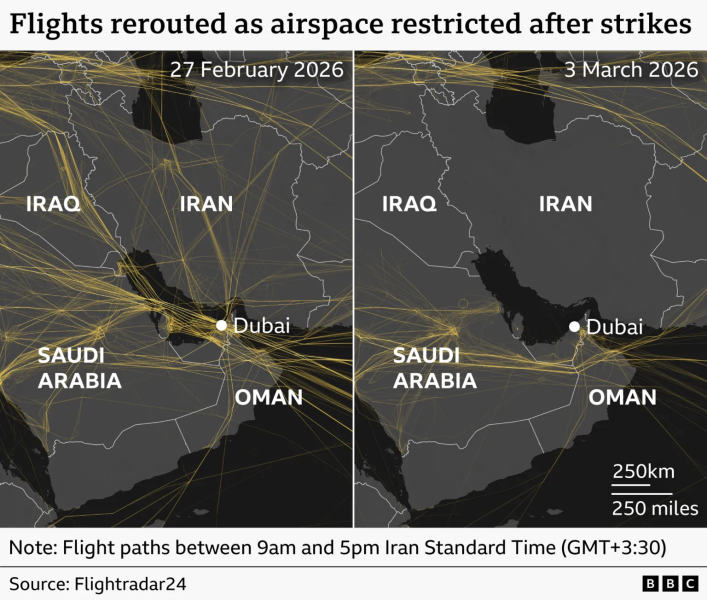
The disruption is particularly significant because the Middle East normally acts as a key crossroads for global aviation. Routes across Iran, Iraq and the Gulf region typically carry large volumes of traffic linking Europe, Asia and Africa.
But with much of that airspace now considered unsafe, airlines are diverting flights around the region.
Western carriers had already been avoiding Russian airspace since the 2022 invasion of Ukraine, forcing many long-haul flights to take longer routes. The additional closure of Iranian and Iraqi airspace has further complicated those plans.
According to aviation data from Flightradar24, aircraft are now clustering in a roughly 100-kilometre-wide corridor across northern Azerbaijan, a country about the size of Portugal. This corridor has become one of the few viable passages connecting Europe with parts of Asia.
David Mumford, an international operations specialist at aviation risk group Opsgroup, said the traditional central route across the Gulf region is effectively unusable.
“The central corridor across Iran, Iraq and the Gulf is effectively closed,” he explained. “Most traffic is going either north via the Caucasus and Afghanistan, or south via Egypt, Saudi Arabia and Oman.”
Both alternatives involve longer flight paths, which increase fuel consumption and extend journey times.
Longer journeys and tighter scheduling
Passengers are already beginning to feel the effects of the disruption, with flight times increasing on some routes between Europe and Asia.
Strickland said airlines must juggle multiple challenges when planning new flight paths, including weather conditions, congestion in the remaining corridors and the ripple effect delays can cause to aircraft schedules.
“Flights already doing circuitous routing have even less choice,” he said.
Congestion could become particularly noticeable during peak travel periods. Flights from Europe to Asia typically depart in the afternoon and evening, while services returning from Asia often arrive in Europe early in the morning.
This means many aircraft may be trying to pass through the same limited corridors at similar times of day.
While most airlines are managing to operate non-stop services despite the longer distances, a few have already had to adapt.
Australian airline Qantas, for example, has introduced a refuelling stop in Singapore for its Perth-to-London service, which had previously operated as a non-stop flight.
Wider risks for global aviation
The situation could deteriorate further if Azerbaijan becomes more directly involved in the conflict.
David Kaminski, air transport editor at aviation news service FlightGlobal, warned that a wider escalation could dramatically restrict available airspace across the region.
If Azerbaijan were drawn deeper into the conflict, airlines could face what he described as an “airspace brick wall” stretching from Saudi Arabia to northern Russia.
“The disruption would be vast,” he said.
Gulf aviation model under pressure
The crisis also threatens the business model of Gulf airlines that have built global networks around major hubs such as Dubai, Abu Dhabi and Doha.
Carriers including Emirates, Etihad and Qatar Airways have transformed those cities into major transit points connecting travellers from Europe with destinations across Asia.
If the conflict continues for an extended period, however, the flow of passengers through those hubs could decline, potentially benefiting rival aviation centres.
Kaminski suggested nearby cities such as Riyadh or Istanbul might try to capitalise if travel patterns shift permanently.
In the short term, aviation experts say airlines will continue adjusting routes day by day while closely monitoring security developments across the region.
Join the discussion? 
Already a member? 
 Adapted by ASEAN Now · Source · 06.03 2026