



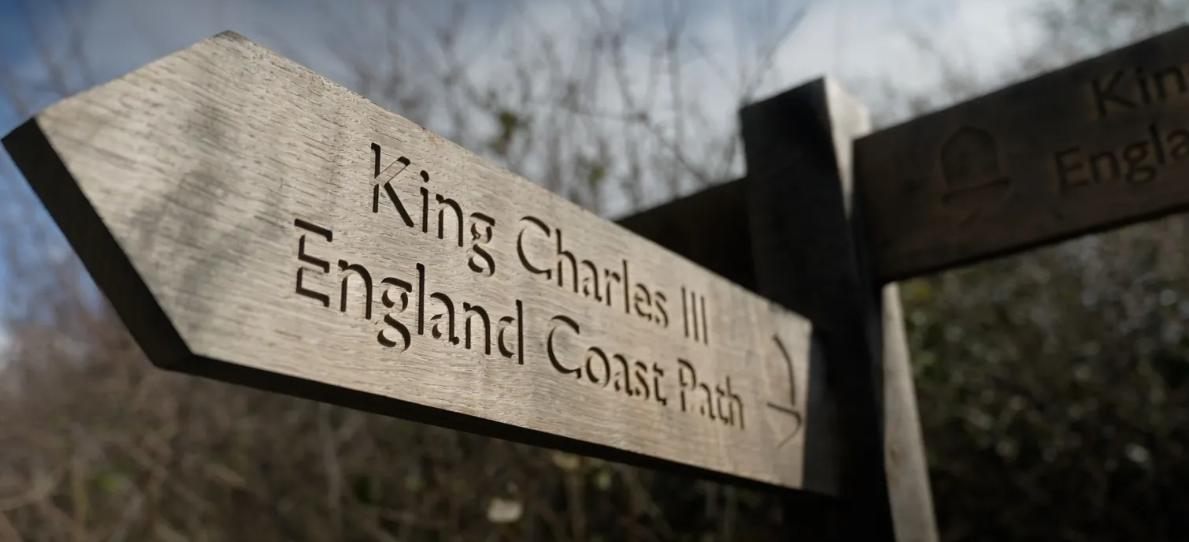

A new long-distance footpath encircling the entire coastline of England is being officially opened, marking the completion of one of the country’s most ambitious access projects.
Stretching 2,689 miles, the King Charles III England Coast Path is described by Natural England as the longest managed coastal walking route in the world.
For the first time, it offers a continuous trail around England’s shoreline, allowing walkers to follow the coast uninterrupted for extended distances.
Get today's headlines by email 
A continuous path around England
The route links together beaches, cliffs, estuaries and coastal towns, creating a unified walking path where previously there were gaps.
Although large sections of the trail already existed, more than 1,000 miles of new pathways have been created to connect them. Existing routes have also been upgraded, with improvements including resurfaced paths, new boardwalks, bridges and the removal of stiles to make access easier.
About 80% of the path is currently open, with most of the remaining sections expected to be completed by the end of the year.
Project leaders say the goal is not necessarily for people to walk the entire route, but to allow access at any point along the coast.
Years in the making
The project has taken 18 years to reach this stage and was first launched under former UK Prime Minister Gordon Brown’s government.
Its development required new legislation, including the Marine and Coastal Access Act passed in 2009, which enabled greater public access to coastal land.
According to those involved, the path opens up areas that were previously inaccessible, including stretches of beaches, dunes and cliff tops.
Neil Constable, who led the project for Natural England, described the initiative as a defining achievement, emphasising that people can now reach the coast from anywhere in England and continue walking along it in either direction.
Landscapes and highlights
The trail passes through a wide range of landscapes, from sandy beaches and salt marshes to dramatic cliffs and historic seaside towns.
One of the notable sections includes the chalk cliffs of the Seven Sisters in East Sussex, which also form part of a newly designated National Nature Reserve.
In some areas, walkers will encounter practical challenges. For example, parts of the route require ferry crossings, such as over the River Mersey in north-west England.
In south Devon, walkers must cross the River Erme on foot at low tide due to the absence of a bridge or ferry, adding a more adventurous element to the journey.
Designed for a changing coastline
The path has been built with environmental changes in mind, particularly the impact of coastal erosion and rising sea levels.
For the first time in English law, provisions allow sections of the route to be moved inland if the coastline shifts. This “rollback” system ensures the path can remain continuous even as the landscape changes.
Recent weather has already demonstrated the need for flexibility. A section of the trail near Charmouth in Dorset was temporarily lost due to a landslip following heavy rainfall.
Local managers were able to quickly reroute the path inland, restoring access within weeks.
Expanding access to the coast
The project represents a significant expansion of public access to England’s coastline, an issue long championed by walking groups.
The Ramblers said the new route allows people not only to walk along the coast but also to access land between the path and the sea, including beaches where visitors can stop and explore.
The trail also connects with the Wales Coast Path, which was completed in 2012 and runs for 870 miles around Wales.
Together, these routes raise the possibility of a continuous coastal walk around much of Great Britain, although Scotland does not have a single official coastal path.
A long-distance challenge
If combined with accessible sections of Scotland’s coastline, a full circuit of Britain could stretch to around 9,000 miles.
At an average pace of 15 miles per day, such a journey would take close to two years to complete without rest days.
For most walkers, however, the new English coast path is expected to be enjoyed in smaller sections, offering easier access to some of the country’s most varied and scenic coastal environments.
Join the discussion? 
Already a member? 
 Adapted by ASEAN Now. Source 19 March 2026