



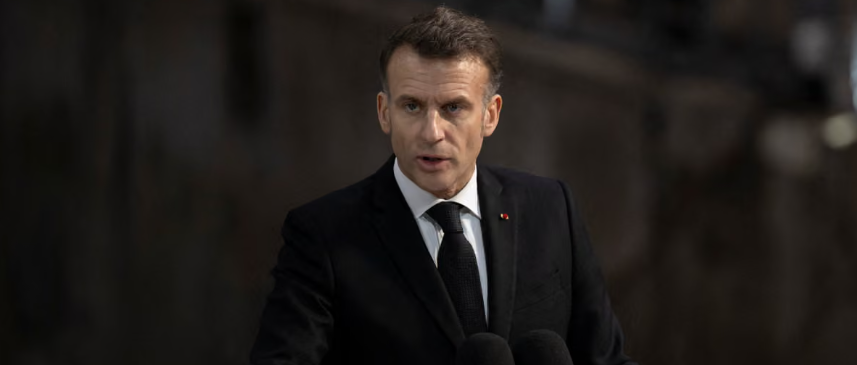

France will increase the size of its nuclear arsenal for the first time in decades and step up weapons cooperation with European allies, President Emmanuel Macron has announced, citing mounting geopolitical instability and the need for stronger continental deterrence.
Speaking from the Île Longue nuclear submarine base in Brittany, Macron said a “period of geopolitical upheaval, fraught with risk” required France to reinforce its nuclear doctrine. France is the European Union’s only nuclear-armed state.
Get the latest headlines in your email 
An expansion of the arsenal, currently estimated at about 290 warheads — a figure unchanged since 1992 — was “essential”, Macron said. He declined to specify how many additional warheads would be ordered, stressing that the move was intended to preserve credible deterrence rather than trigger an arms race.
“This is not an arms race,” he said. “It is essential that our adversaries cannot even glimpse the possibility of hitting France without the certainty of suffering damage they would not recover from.”
Potential deployment across Europe
Macron said Paris could deploy nuclear-capable Dassault Rafale fighter jets to partner countries such as Germany and Poland under what he described as a policy of “advance deterrence”.
However, he made clear that France would not share decision-making authority over the use of its nuclear weapons. The “ultimate decision” would remain solely with the French president, and the definition of France’s “vital interests” would stay sovereign.
Talks on closer nuclear cooperation have already begun with the UK, Germany, Poland, the Netherlands, Belgium, Greece, Sweden and Denmark, according to Macron. The new framework could also include conventional participation by allied forces in French nuclear exercises and joint visits to strategic sites.
Europe reassesses security role
Macron pointed to Russia’s war against Ukraine, China’s expanding military capabilities and shifts in U.S. defence strategy as reasons Europe must take greater responsibility for its own security.
The announcement comes amid unease among European governments over the reliability of U.S. security guarantees under President Donald Trump, whose approach to transatlantic alliances has unsettled long-standing defence assumptions.
France and Germany said in a joint statement they had established a high-level nuclear steering group. The arrangement would “add to, not substitute for,” NATO’s nuclear deterrence framework.
German Chancellor Friedrich Merz previously confirmed holding initial discussions with Macron on nuclear cooperation. Meanwhile, Polish Prime Minister Donald Tusk said Warsaw was in talks with Paris and other allies, declaring: “We are arming up together with our friends so that our enemies will never dare to attack us.”
Swedish Prime Minister Ulf Kristersson also confirmed Stockholm would participate in discussions, describing the moment as the most critical for European defence since the Second World War.
Macron said the strengthened doctrine would “complicate the calculations of our adversaries” and ensure France’s deterrent remains credible in an increasingly uncertain global landscape.
Join the discussion? 
Already a member? 
 Adapted by ASEAN Now · Source · 02.03 2026
-
 1
1
-
 1
1