



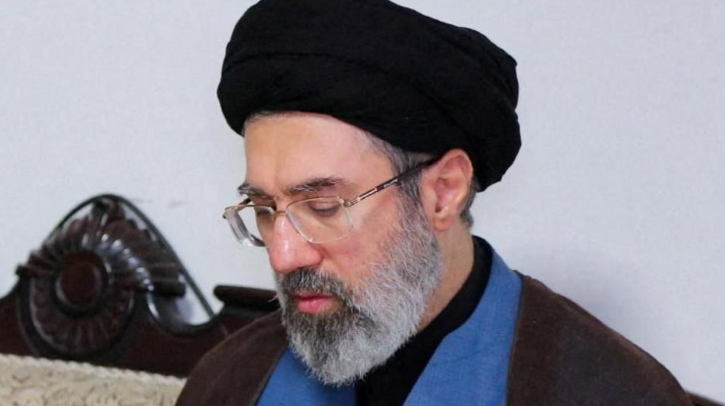

Son of Ayatollah Khamenei Chosen to Lead Iran
Mojtaba Khamenei has been named the new supreme leader of Iran following the death of his father, Ali Khamenei, marking a significant and controversial transition in the leadership of the Islamic Republic.
The decision was confirmed by senior Iranian officials after the country’s clerical body responsible for selecting the supreme leader moved to appoint Mojtaba as successor. The choice comes at a time of intense regional conflict and internal uncertainty following the killing of the long-time Iranian leader.
Get the latest headlines in your email 
Supporters within the political and military establishment have described Mojtaba as a capable figure who understands both the religious and political foundations of the Iranian system.
A Low-Profile Figure With Powerful Connections
Born on 8 September 1969 in Mashhad, Mojtaba Khamenei is the second of Ali Khamenei’s six children. He received his early education at the religious Alavi School in Tehran.
At the age of 17 he served for brief periods during the Iran‑Iraq War, the eight-year conflict that deeply shaped Iran’s political outlook and its distrust of the United States and Western powers.
In 1999 he moved to the clerical centre of Qom to continue religious studies. It was only around that time that he began wearing clerical clothing, signalling his deeper involvement in the country’s religious establishment.
Despite his prominent family ties, Mojtaba has largely stayed out of public view. Unlike many senior Iranian figures, he has never held an official government post and rarely appears in public or gives interviews.
Long-Standing Influence Behind the Scenes
Although he has maintained a low public profile, Mojtaba Khamenei has long been suspected of wielding considerable influence behind the scenes.
Leaked US diplomatic cables published by WikiLeaks described him as “the power behind the robes”, suggesting he played a key role as a gatekeeper to his father.
Over the years analysts and political insiders have speculated that he helped shape key decisions within the Iranian leadership. Some reports have linked him to involvement in presidential elections, influence over the volunteer militia known as the Basij, and close relationships with the powerful Islamic Revolutionary Guard Corps.
However, none of these roles were formally acknowledged within the structure of the Islamic Republic.
Controversy Over Possible Dynastic Succession
The appointment of Mojtaba Khamenei has drawn attention because both his father and the founder of the Islamic Republic had previously criticised hereditary political rule.
Ruhollah Khomeini, who led the Iranian Revolution of 1979, strongly opposed dynastic leadership under the former Mohammad Reza Pahlavi monarchy.
Critics therefore see Mojtaba’s rise as potentially resembling the hereditary system the revolution once rejected.
The United States government had previously imposed sanctions on Mojtaba in 2019, identifying him as someone acting on behalf of the Iranian supreme leader.
Support From Iran’s Security Establishment
Following the announcement, Iran’s security and political institutions moved quickly to back the new leader.
Ali Larijani, secretary of the country’s Supreme National Security Council of Iran, said the decision showed Iran’s political system remained stable despite pressure from foreign enemies.
He said opponents had hoped the country would fall into a leadership crisis after the death of Ali Khamenei, but the selection process had moved forward successfully.
Iran’s state broadcaster IRIB and the semi-official Tasnim News Agency also carried statements from the Islamic Revolutionary Guard Corps praising Mojtaba Khamenei’s appointment.
The IRGC described him as a knowledgeable and capable leader and pledged “respect, devotion and obedience” to the new supreme leader.
A Powerful Role at a Critical Moment
As supreme leader, Mojtaba Khamenei will hold ultimate authority over Iran’s political system, including the armed forces, judiciary and major strategic decisions.
His leadership begins at a moment of heightened regional tension and international pressure on Tehran.
How he chooses to wield that power—and whether he continues his father’s political direction—will likely shape the future of Iran and its role in the Middle East for years to come.
Join the discussion? 
Already a member? 
 Adapted by ASEAN Now · Source · 08 03 2026