




From Antarctic Giant to Fragmenting Relic
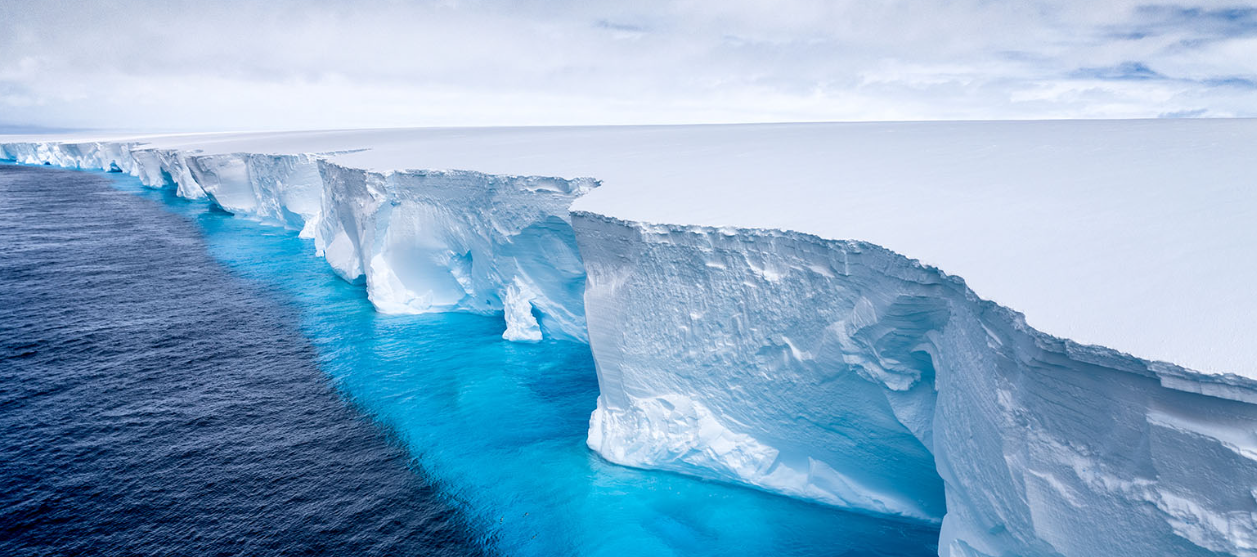
One of the most remarkable icebergs ever tracked by scientists is nearing the end of its life after drifting across the oceans for nearly four decades. Known as Iceberg A23a, the vast block of ice was once the largest iceberg on Earth, but it is now rapidly breaking apart and may vanish completely within weeks.
Researchers say the iceberg’s long and unpredictable journey has offered a rare chance to study how giant masses of Antarctic ice behave as they drift into warmer waters.
“It’s been an extraordinary journey,” said Prof Mike Meredith of the British Antarctic Survey. “But it is on its last legs now.”
Born from a Massive Antarctic Break
A23a’s story began in 1986 when it calved from the Filchner Ice Shelf in Antarctica, a huge floating extension of the continent’s ice sheet in the Weddell Sea. At the time, the iceberg covered roughly 4,000 square kilometres—more than twice the size of Greater London.
Soon after breaking away, the iceberg became stuck on the seabed in the Weddell Sea. For more than 30 years it remained effectively motionless, embedded in the muddy ocean floor.
It was not until 2020 that satellite data revealed the iceberg had finally broken free and begun drifting again.
Scientists believe A23a is the oldest iceberg currently being tracked by satellite. Dr Christopher Shuman, formerly of the University of Maryland, Baltimore County, compared following its movements to watching a suspenseful television drama.
“You don't know what you're going to see next,” he said.
Dramatic Breakup in Warmer Waters
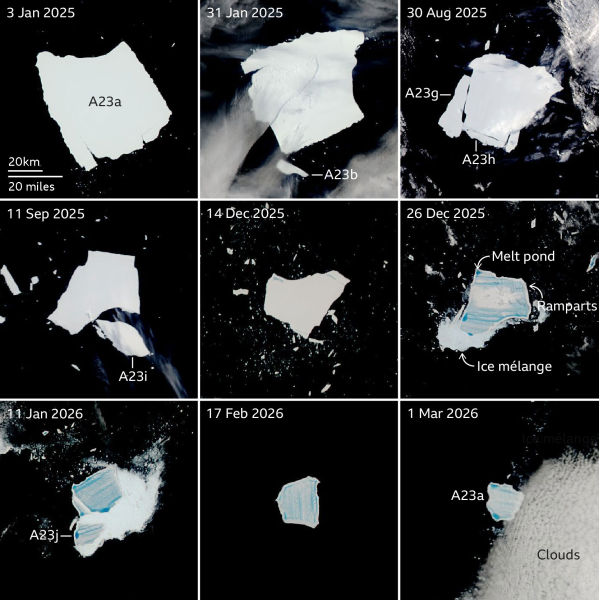
At the start of 2025 the iceberg remained enormous, large enough that it could almost have stretched across the English Channel from the Isle of Wight to the coast of France.
But its decline accelerated over the following months. By mid-2025 A23a had shrunk by about a quarter as chunks broke away and warm seawater eroded its base and sides.
In late summer it drifted above the North‑west Georgia Rise, an underwater mound about 1,500km east of the Falkland Islands. There the iceberg appeared to spin slowly in a rotating column of ocean water.
Scientists think these mechanical stresses helped tear the already weakened iceberg apart. Several huge fragments broke away and were large enough to be named separately, including A23g, A23h and A23i.
Melting from Above and Below
Further damage occurred in late 2025 when pools of vivid blue meltwater formed across the iceberg’s surface. The water collected within rim-like ridges called ramparts and gradually seeped into cracks.
This process, known as Hydrofracturing, widens existing fractures and can trigger sudden break-ups. As the water drains through the ice, the weight forces cracks open further, sometimes causing large pieces to split away.
Scientists observed signs of this type of structural failure late in the year, leaving behind a “mélange” of smaller ice fragments surrounding the main iceberg.
A Natural Laboratory for Climate Research
Although the break-up of large icebergs is a natural process, researchers say A23a’s journey provides important clues about how Antarctica might respond to a warming climate.
Floating ice shelves act as stabilising barriers for the Antarctic ice sheet. If they weaken or collapse, glaciers behind them can flow more rapidly into the ocean, contributing to rising sea levels.
According to Dr Catherine Walker of the Woods Hole Oceanographic Institution, drifting icebergs like A23a effectively become moving research platforms.
“They’re travelling natural laboratories,” she said. Studying how they evolve in warmer conditions can help scientists understand how Antarctic ice shelves might behave in the future.
The Iceberg’s Final Days
In recent weeks ocean currents have carried what remains of A23a more than 700km northeast through the South Atlantic. Surface water temperatures near 10°C are accelerating its melt.
Satellite imagery suggests further cracking and fragmentation is already underway. By early March the iceberg had shrunk to about 180 square kilometres.
Once it falls to roughly 70 square kilometres, scientists will stop formally tracking it.
After nearly 40 years drifting across the ocean, A23a’s long journey appears to be entering its final chapter. Scientists believe that within weeks the last traces of the once-mighty iceberg will have melted into the sea.
Join the discussion? 
Already a member? 
 Adapted by ASEAN Now · Source · 07.03 2026
-
 1
1