



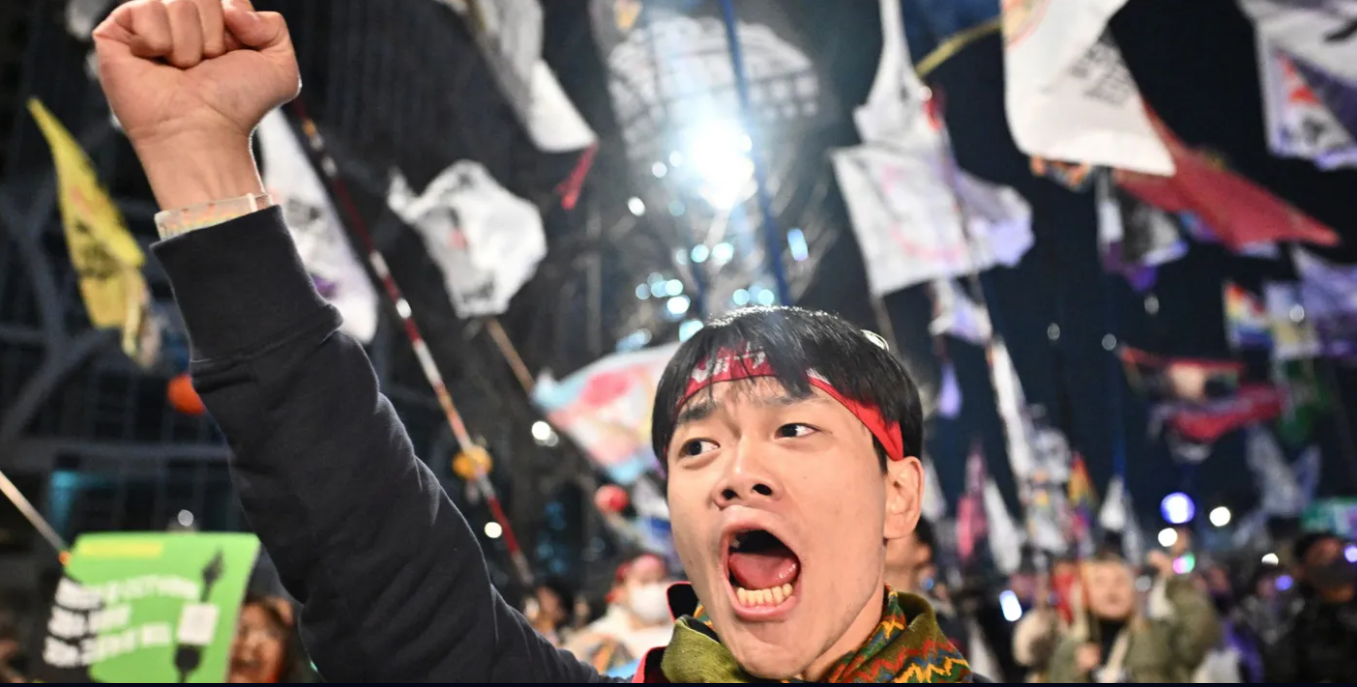

Yoon Suk Yeol, once president of South Korea, faced a dramatic downfall from office to prison after declaring martial law on December 4, 2024. His decision to impose military rule threw the country into turmoil. However, within six hours, South Koreans mobilized to thwart the insurrection attempt, demonstrating the nation’s resilient democracy.
Get the latest headlines in your email 
The declaration triggered mass protests, Yoon’s impeachment, and his eventual conviction for masterminding an insurrection, resulting in a life sentence. This rapid accountability sends a powerful message about the strength of democratic institutions. Gi-Wook Shin, director of the Korea program at Stanford University, noted this as a rare example of democratic resilience amid rising global authoritarianism.
On the night of the insurrection attempt, Yoon announced martial law, claiming “anti-state forces” threatened the country. He issued decrees banning political activities and censoring media. In defiance, thousands of citizens gathered at the National Assembly, urging lawmakers to reject the martial law bid. With determination, the assembly voted against the attempt, leading to public calls for Yoon’s removal. He was impeached on December 14 and arrested in early January after confining himself to the presidential residence.
South Korean institutions, including the National Assembly, courts, media, and civil society, played crucial roles in defending democracy. These bodies swiftly activated constitutional safeguards, preventing executive overreach. Six months later, voters rejected Yoon’s party, electing opposition candidate Lee Jae Myung in a decisive victory, reinforcing the democratic process.
Protests have been an integral part of South Korea's democratic journey. Citizens are known for their willingness to mobilize and protect democratic values. This tradition of protest, deeply rooted in the country’s history, was evident as songs and chants from previous demonstrations were revived, unifying people against Yoon’s actions.
South Korea’s protest culture is partly shaped by its past struggles with political interference and military rule. The nation transitioned to democracy only in the late 1980s, making the memories of dictatorship fresh. For many older citizens, Yoon’s martial law declaration was a stark reminder of past authoritarian regimes. This historical awareness drove swift civilian action across generational lines.
For global audiences, the strong public response may have contrasted with South Korea’s modern, polished image. Su-kyoung Hwang, a senior lecturer in Korean studies, emphasizes that this outcome reflects a long history of learning and resilience against oppression.
The events highlighted generational differences in reactions. Younger South Koreans were confused, while older citizens felt fear, recalling past dictatorships' use of martial law to suppress dissent. Leaders like Park Chung Hee and Chun Doo Hwan had used similar tactics, making older generations wary of authoritarian resurgence.
Ultimately, the swift response to Yoon’s attempt to impose martial law underscores the strength and determination of South Korea’s democratic institutions and citizens. It serves as a powerful reminder that democracy thrives not only on formal structures but also on active participation and vigilance.
Join the discussion? 
Already a member? 
 Adapted by ASEAN Now · Source · 22 Feb 2026