



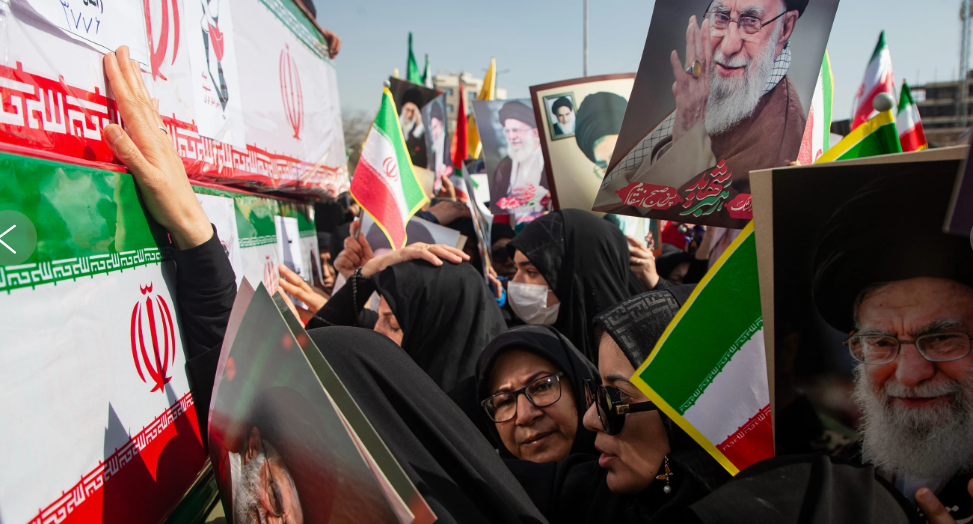

US President Donald Trump has said he believes Washington should play a role in selecting Iran’s next supreme leader, as the conflict between the US, Israel and Iran continues to widen across the Middle East.
Speaking to Axios on Thursday, Trump dismissed Mojtaba Khamenei—widely seen as a leading contender to replace his father, Ali Khamenei—as “a lightweight”.
“We want someone that will bring harmony and peace to Iran,” Trump said.
Khamenei, Iran’s long-time supreme leader, was killed during the opening wave of US-Israeli strikes earlier in the conflict. Trump suggested the US should help shape the leadership transition, comparing the situation to Washington’s intervention in Venezuela.
“I have to be involved in the appointment, like with Delcy in Venezuela,” he said, referencing the rise of Delcy Rodríguez following a US operation that captured former Venezuelan leader Nicolás Maduro.
Trump’s comments are likely to fuel debate over whether the US and Israel are seeking to overthrow the Islamic Republic entirely or simply force major changes in Tehran’s policies.
War widens across Middle East
The conflict has intensified steadily since the opening strikes, spreading instability across at least 14 countries in the region.
Iran has launched missile and drone attacks targeting Israel, US military bases and several American-allied Gulf states. The fighting has also disrupted oil shipments and global air travel.
According to officials in the region, the conflict has killed at least 1,230 people in Iran, more than 120 in Lebanon and around a dozen in Israel. Six US troops have also been reported killed.
Meanwhile, Israel has continued airstrikes targeting Iran’s missile infrastructure. Israel’s military chief, Eyal Zamir, said Israeli forces had destroyed about 80% of Iran’s air-defence systems and roughly 60% of its missile launchers.
Despite those losses, Zamir warned that the threat remains.
“The threat has not yet been removed,” he said.
Iranian response remains defiant
Iranian officials have rejected suggestions that Tehran is seeking negotiations with Washington.
Foreign Minister Abbas Araghchi said Iran saw no reason to engage in talks with the US after what he described as repeated attacks during previous diplomatic efforts.
“When we negotiated with them twice, every time they attacked us in the middle of negotiations,” he told NBC News.
Araghchi also accused the US Navy of committing “an atrocity at sea” after the Iranian frigate IRIS Dena was sunk in the Indian Ocean near Sri Lanka. Iranian officials say at least 87 crew members were killed when the vessel was torpedoed while returning from naval exercises.
Sri Lankan authorities said 32 sailors were rescued. Another Iranian warship was later escorted to a naval base near Colombo.
Iranian rhetoric has also intensified. Senior cleric Abdollah Javadi Amoli called on state television for the shedding of both Israeli and “Trump’s blood”, an unusually direct call for violence from a senior ayatollah.
Regional tensions escalate
The conflict is increasingly drawing in neighbouring countries and allied groups.
Israel issued evacuation warnings for residents in southern Beirut before launching strikes on areas believed to be controlled by the Iran-backed group Hezbollah. Lebanese officials say more than 120 people have died since the latest escalation began.
UN peacekeepers reported seeing and hearing ground combat in southern Lebanon as Israeli forces crossed the border.
Elsewhere in the region, several Gulf countries reported missile or drone attacks. Kuwait activated air-defence systems near the US embassy, while a drone was shot down close to the Al Dhafra Air Base in the United Arab Emirates, where US forces are stationed.
Authorities in Bahrain said an Iranian missile struck a state-run oil refinery, causing a fire that was later extinguished without casualties.
In Azerbaijan, President Ilham Aliyev accused Iran of carrying out a drone attack near an airport in the Nakhchivan region, injuring four airport workers. Tehran denied responsibility.
Global impact grows
Shipping routes have also been affected, with attacks reported on vessels in the Gulf of Oman and the Strait of Hormuz—a critical energy corridor through which roughly a fifth of the world’s oil passes.
The disruption has already pushed global oil prices higher and weighed on US stock markets.
Meanwhile, Israeli authorities said major religious sites in Jerusalem’s Old City—including the Western Wall and the Church of the Holy Sepulchre—would close temporarily after air-raid sirens sounded in Tel Aviv and Jerusalem amid continued missile threats.
With hostilities showing no sign of easing, officials across the region warn the conflict could expand further in the coming days.
Join the discussion? 
Already a member? 
 Adapted by ASEAN Now · Source · 05.03 2026