



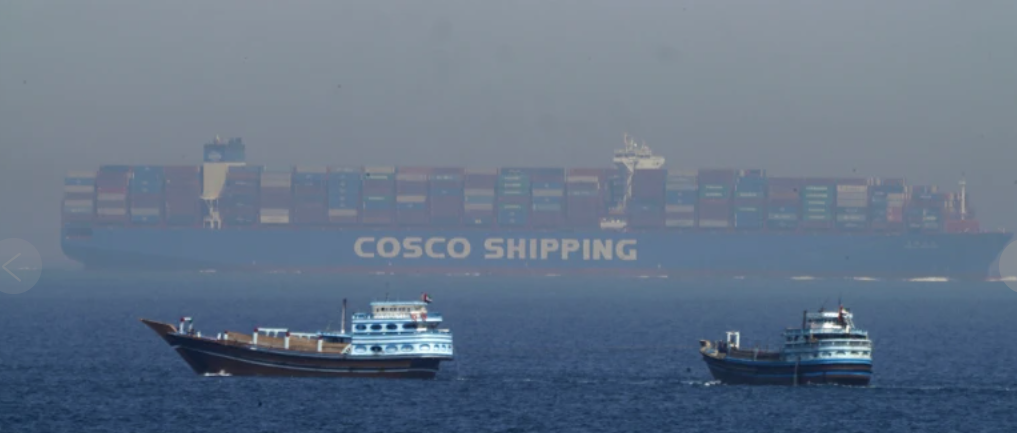

Attacks Raise Global Energy Concerns
Attacks on commercial vessels in the Persian Gulf continued on Wednesday as tensions surrounding the war involving Iran escalated and the critical Strait of Hormuz remained effectively closed.
The United States said it had destroyed more than a dozen Iranian vessels suspected of laying naval mines, an effort aimed at preventing Tehran from fully sealing off the narrow maritime route.
The passageway plays a crucial role in global energy supply, carrying a large share of the world’s oil and liquefied natural gas shipments.
Get the latest headlines in your email 
Iran has vowed to block oil exports in the region, declaring it would not allow “even a single liter” of energy resources to reach its enemies.
Meanwhile, Donald Trump said there were no confirmed reports that Iran had placed mines in the strait, though he warned of strong military retaliation if the waterway were formally closed.
A Vital Artery for Global Trade
The Strait of Hormuz is a narrow channel connecting the Persian Gulf with the Gulf of Oman.
At its narrowest point, the waterway measures about 33 kilometers (21 miles) across, making shipping lanes tight and difficult to navigate.
Although the territorial waters of both Iran and Oman border the passage, the route is considered an international shipping corridor open to vessels from all countries.
Nearby states such as the United Arab Emirates, home to the city of Dubai, also depend heavily on the strait for energy exports and trade.
Approximately 20% of the world’s oil and natural gas shipments pass through the passage, making it one of the most strategically important maritime choke points on the planet.
A Historic Trade Route
The strait has played a key role in trade for centuries.
Historically, goods such as ceramics, silk, textiles and ivory travelled through the region along maritime routes linking Asia with the Middle East and Europe.
In the modern era, the strait serves as the primary export route for oil and gas from countries including Saudi Arabia, Kuwait, Iraq, Qatar, Bahrain, the United Arab Emirates and Iran.
Much of this energy supply is shipped to Asian markets, particularly China.
Although pipelines in Saudi Arabia and the UAE allow some oil exports to bypass the strait, most energy shipments from the Gulf still rely on this narrow route.
Rising Attacks on Shipping
Since the war began, attacks targeting vessels in and around the Strait of Hormuz have increased significantly.
According to the International Maritime Organization, at least 12 incidents involving merchant vessels had been recorded as of Wednesday.
The organization’s secretary-general, Arsenio Dominguez, said that at least seven sailors had been killed during these incidents.
Meanwhile, the British military-run United Kingdom Maritime Trade Operations center reported 17 separate security incidents in the wider region, including the Persian Gulf and the Gulf of Oman.
Of those reports, 13 were confirmed attacks and four were categorized as suspicious activity.
The incidents involved a variety of vessels including tankers, cargo ships and tugboats.
Global Shipping Disrupted
Although the Strait of Hormuz has not been formally declared closed, the rising attacks have effectively halted most commercial traffic.
Major shipping companies have already suspended operations in the area.
The Danish shipping giant Maersk announced it had stopped sending vessels through the strait until further notice.
Other major ocean carriers, including Hapag-Lloyd, CMA CGM and MSC, have issued similar warnings.
According to logistics expert Tom Goldsby of the University of Tennessee, many vessels are now stranded in the Persian Gulf.
Around 400 oil tankers are currently idle in the region as companies wait for the security situation to improve.
Insurance and Military Plans
To help restore confidence in shipping through the region, the United States is introducing a reinsurance program through the U.S. International Development Finance Corporation.
The program would cover up to $20 billion in losses related to damage to ships or cargo caused by the conflict.
Political risk insurance is intended to protect companies from financial losses caused by war, violence or unstable political conditions.
Marine insurers had previously begun cancelling policies or sharply increasing rates for ships operating in the area.
Trump has also suggested the U.S. Navy could escort oil tankers through the strait if necessary.
Meanwhile, a separate initiative led by France aims to organise multinational naval escorts once the most intense phase of the conflict subsides.
Join the discussion? 
Already a member? 
 Adapted by ASEAN Now · Source · 11.03 2026