
sometimewoodworker
Advanced Member
-
Joined
-
Last visited
Everything posted by sometimewoodworker
-
While I don’t disagree that there may well be standard deductions I have only seen the one listed above, also the person I spoke to today did not know of any deduction specifically for pension income and given his position I would expect him to know. I remember that a deduction has been mentioned in some of the posts however I have not seen an authoritative link giving that information and would like to see some support for that.
-
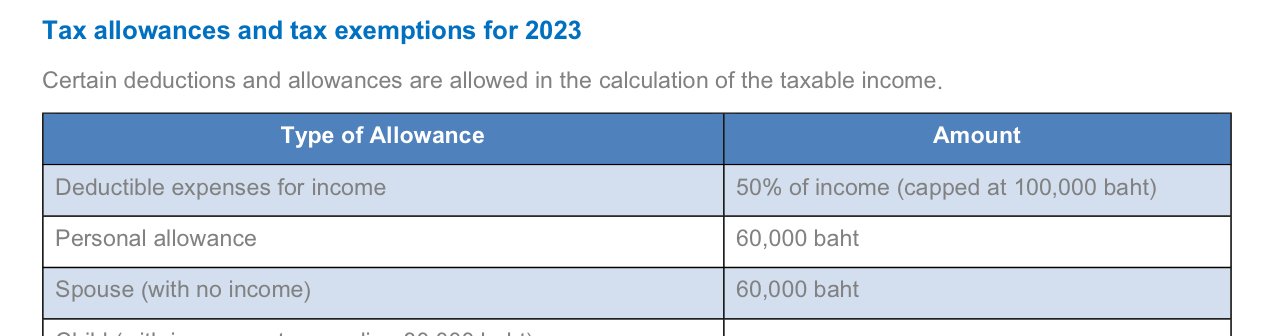
Having just concluded my meeting, the above are Personal expenses this is on all the examples of one of the big 4 firms and it is a standard allowance that avoids having to give details of receipts etc that are spent to get the pension or earned income. Here are some of the allowances
-
I am referring, as was clear from the original context which your quote has divorced it from, to the U. K. TDC and that hasn’t changed in 40 years or so. Once again that it may be considered a U.K. government pension by you Tom Cobley and Somchai in the TRD is absolutely irrelevant because it is NOT a pension paid in respect of services of a governmental nature rendered to that State or subdivision or local authority and it is only a pension paid in respect of services of a governmental nature rendered to that State or subdivision or local authority that is exempt from assessment as income because of Article 19 of the U.K. DTC (NB it is a DTC not a DTA for the U.K.) It is clear that it is not by whom the pension is paid. It is for what the pension is paid that is the governing factor. The only mention of pensions are in Article 19 Governmental Services and only cover services provided to the U.K. government So though in general the pension is paid by the U.K. government it could easily be privatised and contracted out to a random pension provider and it would still be considered exempt from Thai taxation FWIW having just had a meeting with a Tax Director with one of the big 4 firms, agrees with the advice given to you.
-
sometimewoodworker replied to OneMoreFarang's topic in Jobs, Economy, Banking, Business, InvestmentsYes, sort of, mine was a month out of date, I ordered a new on the app, you don’t have to have the physical card you can just get the info in the application. Possibly had I caught it in time I would have been able to keep the old number.
-
sometimewoodworker replied to OneMoreFarang's topic in Jobs, Economy, Banking, Business, Investmentsthe no numbers on the front maybe a new feature
-
sometimewoodworker replied to OneMoreFarang's topic in Jobs, Economy, Banking, Business, InvestmentsIt’s an SCB one, no embossing, no number on the front, and yes it has a new CCV

-
sometimewoodworker replied to OneMoreFarang's topic in Jobs, Economy, Banking, Business, InvestmentsInteresting point on my most recent Thai card. There is no ccv on the card, it is only available on the app and only for 45 seconds at a time.
-
Your experience is very different from mine, I got my increase on my next payment each time I called and notified them, so around 3~4 weeks
-
It doesn’t matter that it looks like a government pension. Because it is only pensions in respect of services of a governmental nature rendered to that State or subdivision or local authority thereof that are covered by the DTC. I certainly isn’t one of those
-
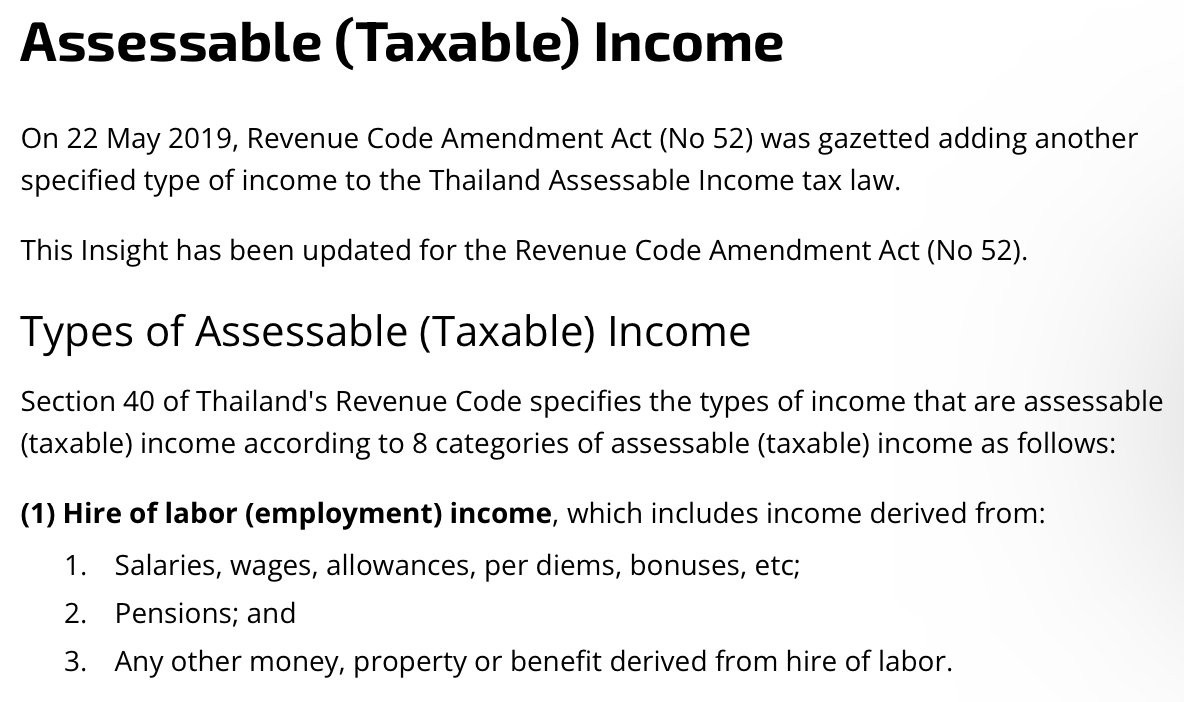
You say or quote the above. However the TRD disagrees with that statement in bold, see section 40 (1) 2 that Thailand may pay pensions that are under the threshold to actually pay tax doesn’t mean that hey are not taxable
-
The advice of a tax consultant was not predicated by any idea of hiding the source of the required 250k but an expert opinion as to if it would class as assessable or not assessable for Thai taxation. It is an uncommon source and could easily be seen as either. If the opinion is that it is not assessable that would obviate the requirement to be non resident when it is paid out. I am almost certainly going to be non resident for 1 tax year because I have a significant capital gain to realise and capital gains are certainly assessable.
-
It is unlikely that you will find out how TRD will regard it unless it is paid to you while you are tax resident, also remitted while you are tax resident and most importantly the TRD decides to audit your return. As until that point the TRD doesn’t need to do anything. So given that you intend to be non tax resident the year it is claimed there is nothing to investigate or decide. However if it is only for that reason that you want to be nonresident you may find that a professional tax accountant’s opinion is less expensive.
-
If you actually worded you post in the way you intended it to be read you wouldn’t be creating confusion, but I have sympathy on your inability to understand long term and short term numbers.
-
You haven’t noticed that until the few days that the pound was at almost 47 and that was the highest point it reached for the last 5 years. So unless you term the stratospheric rise free fall you don’t know what rubbish you are spouting. if you actually pay any attention to currencies you will see that it is the Baht that is jumping against all other countries
-
given the wording And that the pension is now tax free it strongly suggest to me that you no longer have a civil service pension, but you swapped the civil service pension for a QROPS pension and that it is certainly not covered by the DTC so if funds are remitted to Thailand they are definitely assessable. I think you will find that you effectively sold your civil service pension and bought a QROPS pension I suspect that a specialist will agree with the assessment. However you also need to carefully read all of the literature and documents surrounding the transfer as they may give an answer I do not think that any DTC/DTA is phrased to allow any income to be untaxed, it specifies which income is only taxable in the home country and must not be taxed in the country of residence. The personal tax allowance in the respective countries govern how much, if any, tax is due
-
The devil is in the details. Your need to pay tax or not depends on the source of the pensions, the allowances you have in Thailand, and the total you remit. You may have a tax liability you may not, it is reasonably easy to calculate. You certainly are not in the “can benefit from a tax consultant” bracket. Those who need to be concerned are those for whom any reduction in income (so any Thai tax liability) is a problem.
-
Your civil service pension was exclusively taxed in the U.K. and also exempt from assessment in Thailand. Unless (extremely unlikely) your overseas QROPS pension is still taxed exclusively in the U.K. you have probably moved the funds outside the U.K. DTC and it is likely that it is now assessable income if remitted to Thailand. It is likely that moving into QROPS pension was done in part to save U.K. tax, but even if not it is no longer a civil service pension so likely now assessable income if remitted. However you need to consult a specialist in the field.
-
Because however much they they are paid in Thailand, working in Thailand they pay no tax to the TRD, their remuneration is exempt because of the DTC
-
You seem to totally misunderstand double taxation and double taxation agreements. double taxation is the same income being taxed in both countries (most income is double taxed) the DTAs DTCs provide that tax outside Thailand on income remitted to Thailand is offset against that Thai due, this is a simplistic rendering and excludes the more complicated sections. country A calculates income and tax due and subsequently paid remit the money to country B country B calculates the tax due on the remittance, deducts the tax paid in country A, if the result is zero or negative, no tax is due to country B if the result is positive country B collects the remaining tax due again a simplified explanation
-
The DTC DOES explicitly state that the pensions covered are in respect of services of a governmental nature rendered to that State or subdivision or local authority
-
You really should read the DTC completely. The only pensions covered are, as I said in article 19 Governmental Services. It specifically covers services of a governmental nature rendered to that State or subdivision or local authority the state pension is not paid for services of a governmental nature. it is not covered by article 19. Article 19 is the only section mentioning pensions Q.E.D. Since the state pension is not listed in the DTC it is not covered it is irrelevant by whom it is paid because it is not in the DTC

-
The date of 2024 is not mine. do please read the complete post before making corrections to other people’s posts and claiming them to be from me.
-
he is wrong on the vast majority of pensions, he is wrong about the no tax. If income is taxed outside Thailand is irrelevant to its being assessable in Thailand. The possible changes that the U.K. government may make have no effect on the assessablity of the income in Thailand
-
The only mention of pensions in the UK/THAILAND DOUBLE TAXATION CONVENTION is in Article 19 Governmental Services section 2 a Do note that anything not explicitly defined and written in the DTC is not covered by the DTC The misunderstanding that the U.K. state pension is governed by the DTC is yours and your misreading or misunderstanding of what is written NB that does not apply to Thai citizens living in Thailand
-
it is not the tax authorities who initially judge it is you It is assessable income if it is interest. If it is capital and interest the capital part may not be (probably isn’t) assessable you may later be audited and have to justify your decisions