
Skip to content
View in the app

A better way to browse. Learn more.

ASEAN NOW

A full-screen app on your home screen with push notifications, badges and more.

To install this app on iOS and iPadOS
  1. Tap the Share icon in Safari
  2. Scroll the menu and tap Add to Home Screen.
  3. Tap Add in the top-right corner.
To install this app on Android
  1. Tap the 3-dot menu (⋮) in the top-right corner of the browser.
  2. Tap Add to Home screen or Install app.
  3. Confirm by tapping Install.

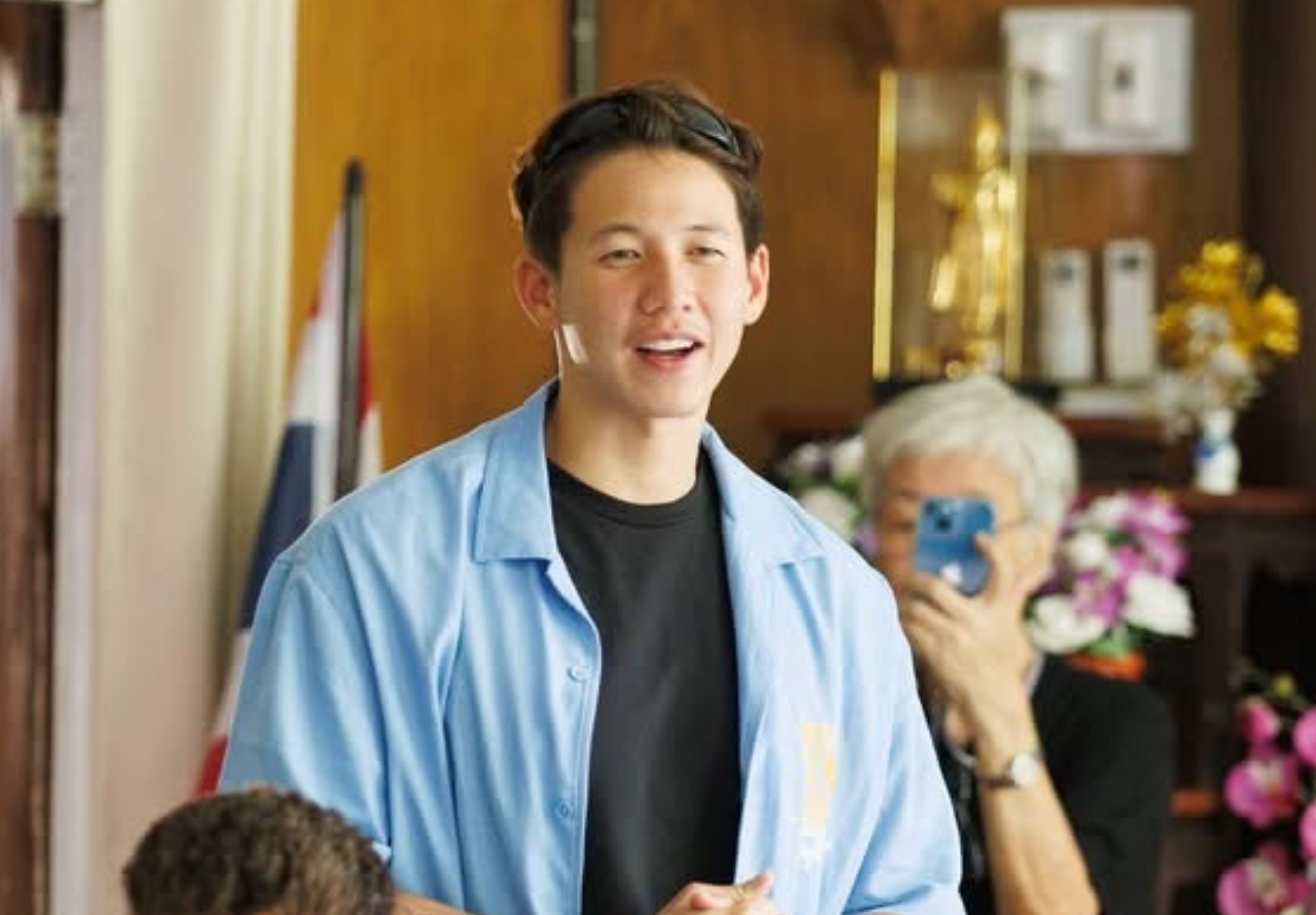
Activist urges foreign workers to learn Thai

Conservation activist Siranudh "Psi" Samutt has called on foreign employees in Thailand to be able to speak Thai, arguing that workers should not rely solely on English while employed in the country.

His comments, posted on his X account @Psisamutt on Saturday, August 8, drew broad support from Thai social media users and renewed discussion about language expectations in tourist areas and workplaces.

Psi said he normally answers in Thai when foreign restaurant staff address him in English. If they cannot take his order in Thai, he said, he asks to speak to a Thai member of staff instead.

"I'm in Thailand, and I prefer to speak Thai," he wrote. Psi said he viewed foreign workers who were employed in Thailand but could not speak Thai as taking advantage of the country.

Online debate over language at work

The activist also compared the situation with Thai people working abroad, saying they are expected to develop language skills in countries including Japan and the United States because of those nations' strong cultures and global influence.

He criticised businesses which, he said, reduce costs by employing migrant workers even though Thailand's minimum wage for Thai workers is not high. Psi called on employers to hire Thai staff and urged Thai workers to improve their skills.

The post attracted considerable attention, with many Thai users backing his position. Some said they had had to communicate in English throughout trips to Phuket and Koh Tao, while others reported encountering Indonesian and Filipino staff at hotels in tourist locations.

Several commenters said they felt uncomfortable having to use English when travelling or receiving services in their own country. They said they had tried to communicate with foreign staff in English but believed those employees had made less effort to learn Thai.

Some users called for a government Thai-language test for foreigners applying for work, similar to requirements they said exist in other countries. However, the discussion followed an activist's social media post; no new government language requirement was announced in the material provided.

Thailand's foreign workforce is substantial. A Department of Employment report released in November last year put the number of foreign employees at around 3.9 million to 4 million, including migrant workers employed under memorandums of understanding.

The report said foreign worker numbers rose sharply during 2025 before beginning to decline after peaking around the middle of the year.

Join the discussion? Create account. orange.png


image.png

13 August 2026

User Feedback

Recommended Comments

ikke1959 Diamond Member

ikke1959

Advanced Member
59 minutes ago, MartinL said:

I'm sure you mean 'Latin' script (mostly) ......

But you might be closer to the truth than you realise!

sorry you are right... I wasnot quite awake.. I mix up with numbers

emptypockets Platinum Member

emptypockets

Advanced Member
1 hour ago, Cameroni said:

Yet another nationalist who hates foreigners. Probably one of these guys who went hunting foreigners with slingshots on Phuket.

The fact is English is a very easy language, spoken by the entire world. Thai, on the other hand, is the devil's language which even Chinese people complain about being too hard to learn.

I speak 3 languages fluently, but I've never seen a language that is so diabolical to learn as Thai.

Many people consider English to be one of the hardest languages to master.

VocalNeal Star Member

VocalNeal

Advanced Member
1 hour ago, Mr Janneman said:

As a Dutch person, I speak reasonably good English, and as an international language, I can make myself understood almost anywhere. But in large parts of England and Australia, I had no idea what people were talking about.

You can always tell a Dutchman but you can tell him much. 😉

Wooden shoes, wooden head, Wooden (would'nt) listen.

VocalNeal Star Member

VocalNeal

Advanced Member
1 hour ago, Karma80 said:

then I expect a reasonable and clear pathway to permanent residence and citizenship rather than what it is now.

There is a clear pathway. And part of it is a commitment to learn Thai. But it involves having a job and therefore more importantly paying taxes.

JAG Ruby Member

JAG

Advanced Member
7 minutes ago, VocalNeal said:

But in large parts of England and Australia, I had no idea what people were talking about.

Don't worry, as an English man I have the same problem!

In fact there is a school of thought that many of those speaking don't actually know what they are talking about.

And now we are to be governed from "oop North, 'appen!"

VocalNeal Star Member

VocalNeal

Advanced Member
5 minutes ago, JAG said:

Don't worry, as an English man I have the same problem!

In fact there is a school of thought that many of those speaking don't actually know what they are talking about.

And now we are to be governed from "oop North, 'appen!"

Tha' knows?

Some people don't know the difference between a tortoise and turtle.

A tortoise is an animal with a thick, hard shell that it can move its head and legs into for protection.

Whereas turtle is how much the bill is in Hull.

(Credit: I'm Sorry I Haven't a Clue)

Tabby is a big church in Yorkshire.

Cameroni Star Member

Cameroni

Advanced Member
5 hours ago, ikke1959 said:

The only difficulty in Thai language are the different tones.

No, that's not the case.

The US Foreign Service Institute still ranks Thai as a Category III "Hard Language" due to major structural differences from English.

Tones are part of it, of course, but Thai has a four dimensional writing system. The Thai script does not use a standard Western alphabet; it is an abugida.

Consonant Overload: There are 44 consonants representing only 21 spoken sounds. The extra letters exist because they are split into three "consonant classes" (low, mid, high) which dictate how tone rules apply to the word.

Floating Vowels: There are 32 vowel forms. Unlike English, where vowels follow consonants sequentially, Thai vowels are written above, below, before, or after the root consonant.

Written Thai features no spaces between words. Spaces are only used to mark the end of a sentence or clause. For a learner, reading requires decoding where one word ends and the next begins.

Thai features several phonetic elements that do not exist in English. The "Ng" Sound: Thai has words that start with the sound "ng" (ง), like ngoo (snake), which is highly unnatural for English speakers to pronounce at the beginning of a word.

Aspirated vs. Unaspirated Plosives: The language distinguishes sharply between aspirated consonants (like a hard, breathy 'P') and unaspirated ones (like a sharp, dry 'P' closer to a 'B' sound). Romanized transliterations often fail to capture this difference.

Vocabulary changes depending on who you are speaking to. Thai utilizes various polite particles (like khrap for men and kha for women) and has entirely separate vocabulary tiers for casual speech, formal situations, and royalty.

Thai makes dutch seem like a walk in the park.

JAG Ruby Member

JAG

Advanced Member
(edited)
6 minutes ago, VocalNeal said:

Tha' knows?

Some people don't know the difference between a tortoise and turtle.

A tortoise is an animal with a thick, hard shell that it can move its head and legs into for protection.

Whereas turtle is how much the bill is in Hull.

(Credit: I'm Sorry I Haven't a Clue)

Tabby is a big church in Yorkshire.

For a Cloggie (British Army affectionate slang term for our Dutch colleagues) I am impressed at your knowledge of the quintessentially British Radio Programme "I'm Sorry I haven't a clue"!

I hadn't heard that definition of "tabby" before; bedannkt.

One of the funniest comments I heard was during a big NATO Command Post Exercise in a tunnel complex near Maastricht. A group of us were drinking coffee when a British General passed. We all stood up, and he responded with a genial wave cum salute and the greeting "Carry on chaps"; before clip clopping down the tunnel in his heel tapped shoes. A German officer observed "in the German Army we are not allowed to wear shoes which make a noise." To which, quick as a flash, a Dutchman responded "Oh dear, does that mean we won't hear you coming next time"!

Brilliant!

Edited by JAG

241195_1469957797 Senior Member

241195_1469957797

Member

I suggest something! First, teach the Thai students English, which is officially part of the school curriculum from primary school onwards, but in practice fails due to the teachers' lack of English skills. Absolutely terrible.

Sir Dude Gold Member

Sir Dude

Advanced Member

Finger-wagging self-styled "activists" using nationalism to stir the pot and get attention can be sanctimonious and irritating whilst they feel the righteousness surge within them.

Not everyone can be a language genius and most learn enough to get by. No mention, however, of how much it would help Thailand if most business and service Thai employees could speak English properly, like the Filipinos can, though.

Kung69 Explorer Member

Kung69

Member
3 hours ago, Front Row said:

Personally, I hear undertones of some xenophobia in his published comments.

He is aiming at Myanmar - and other - refugees, poor immigrants, not European expats. The equivalent of UK's Reform party.

MIke B Bad Gold Member

MIke B Bad

Advanced Member

Extremely naive if one considers more senior posts, CEO, COO, CFO...et al.....who might be 'posted' to a whole range of countries each with its own language......are they going to learn Thai, then Tagalog, then French, then German?

I guess the activist is more concerned with cheap labour on building sites.

ronnie50 Platinum Member

ronnie50

Advanced Member
1 hour ago, Cameroni said:

Written Thai features no spaces between words. Spaces are only used to mark the end of a sentence or clause. For a learner, reading requires decoding where one word ends and the next begins.

That might have been one reason Google translate had so much trouble translating Thai to English. It took a few years before it got up to the standard it has today. Still not great.

Krabi King Advanced Member

Krabi King

Member
8 hours ago, Georgealbert said:

foreign workers who were employed in Thailand but could not speak Thai as taking advantage of the country.

If this is about workers from the region, taking advantage also definitely has a Thai side. Many jobs filled are labour jobs Thai people don't want to do, like janitor, housekeeping or construction. For minimum wages.

8 hours ago, Georgealbert said:

others reported encountering Indonesian and Filipino staff at hotels in tourist locations.

Clear communication with tourists and a certain level of service is expected at bigger resorts. While Thais are great at hospitality in general, it's still very hard to find qualified staff with a certain professional attitude and a good command of English. Also good education is the key. Philippinos and Indonesians seem to have an advantage in these areas.

That said, anybody staying long term in a different country should make an effort to connect. Learning a bit of the language is a good start.

Caldera Ruby Member

Caldera

Advanced Member

He's right. I've never understood why so many foreigners who have lived in Thailand for decades have never made an effort to learn Thai.

orchidfan Gold Member

orchidfan

Advanced Member
5 hours ago, Ralf001 said:

I ask my staff a question in Thai they answer me in English !

I remember chuckling when I worked in Hong Kong (20yrs) seeing local Hong Kong mothers talking to their kids in Cantonese on the bus, and the kids (who all attended a private International School) replying in English.

But this was a high end, expensive "resort" housing development for wealthy or highly paid folk.

I never learnt more than the basics in Cantonese.....too bloody difficult, and in my profession English was the required language.

Luckily, because of the British 99 year lease, most local people speak and understand English. Documents and signage is in both languages.

Even the cops must pass quite high standards of spoken and written English. Cantonese AND Mandarin !!

Burma Bill Diamond Member

Burma Bill

Advanced Member

Across the border in Cambodia, most younger employees in tourism and retail businesses speak and understand English, uually associated with a big smile! As a foreigner you are not expected to speak Khmer, other than a respectful Orkun (Thankyou).

brewsterbudgen Star Member

brewsterbudgen

Advanced Member
1 hour ago, Caldera said:

He's right. I've never understood why so many foreigners who have lived in Thailand for decades have never made an effort to learn Thai.

I'll help.

  1. It's perfectly possible to live here comfortably, unless you live in the sticks.

  2. It's very difficult to learn.

  3. It's not a language that will be any use anywhere else in the world.

msbkk Silver Member

msbkk

Advanced Member
2 minutes ago, brewsterbudgen said:

I'll help.

  1. It's perfectly possible to live here comfortably, unless you live in the sticks.

  2. It's very difficult to learn.

  3. It's not a language that will be any use anywhere else in the world.

While it is difficult to learn most foreigners do not make any real effort to learn Thai. This argument is the most common excuse.

To be able to communicate in basic Thai has many advantages and can help you to get in closer contact with the locals. And it is very

interesting to understand what your own wife or girlfriend and her family are really talking and thinking about you. And helps you to

explore places which otherwise would be impossible for you to visit.

Create an account or sign in to comment

Account

Navigation

Search

Search

Configure browser push notifications

Chrome (Android)
  1. Tap the lock icon next to the address bar.
  2. Tap Permissions → Notifications.
  3. Adjust your preference.
Chrome (Desktop)
  1. Click the padlock icon in the address bar.
  2. Select Site settings.
  3. Find Notifications and adjust your preference.