

Skip to content
View in the app

A better way to browse. Learn more.

Thailand News and Discussion Forum | ASEANNOW

A full-screen app on your home screen with push notifications, badges and more.

To install this app on iOS and iPadOS
  1. Tap the Share icon in Safari
  2. Scroll the menu and tap Add to Home Screen.
  3. Tap Add in the top-right corner.
To install this app on Android
  1. Tap the 3-dot menu (⋮) in the top-right corner of the browser.
  2. Tap Add to Home screen or Install app.
  3. Confirm by tapping Install.

Thailand Driving Out Foreigners It Once Courted

Thailand is pursuing two major policy directions that appear to conflict with one another: opening its economy to foreign business while intensifying enforcement against foreign-linked property ownership structures.

Get today's headlines by email image.png

The contrast has become increasingly visible following reforms to the Foreign Business Act. In April 2025, the Cabinet approved the most significant overhaul of the law in 25 years. In January 2026, it confirmed plans to remove ten business categories, including software development, from restricted lists, allowing foreign companies to operate without local partners or special licences. The reforms form part of the Thailand 4.0 strategy aimed at improving competitiveness and attracting investment.

Now authorities have launched an extensive crackdown on nominee company structures used by some foreigners to control land. New rules require Thai shareholders in foreign-linked companies to prove that invested funds genuinely belong to them. Authorities have also introduced data-sharing systems between agencies and analytical tools designed to identify suspicious ownership arrangements.
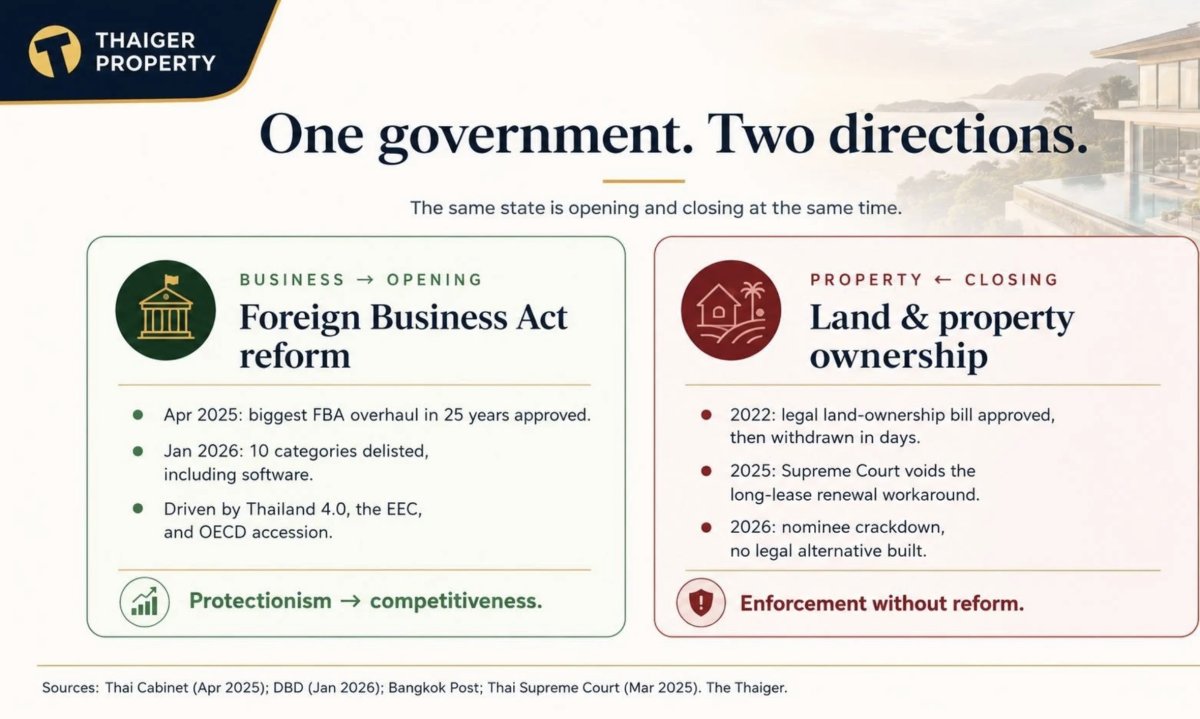
image.jpeg

Enforcement activity has increased significantly. In May 2026, a major operation on Koh Phangan resulted in 22 arrests and the seizure of more than 40 rai of land. Police are also using criminal procedures in investigations involving alleged nominee arrangements.

The crackdown targets structures where Thai shareholders act only as legal fronts while foreigners effectively control assets. Authorities argue such arrangements violate Thai law and amount to fraud. However, concerns have emerged that some long-term foreign residents who purchased property through company structures recommended by legal advisers years ago may also be affected.

The debate is rooted in previous attempts to reform foreign property ownership rules. In late 2022, Thailand’s Cabinet approved a proposal that would have allowed qualifying foreigners to legally own small residential land plots. Supporters argued that foreigners already gained access to property through leases, condominium ownership quotas and nominee companies, and that the proposal would provide a transparent legal alternative.

The proposal was withdrawn less than two weeks later following political opposition. In March 2025, the Supreme Court also ruled against a long-lease renewal structure that many foreign buyers had relied upon for additional security.

Supporters of reform argue that restrictive laws encourage the very workarounds now being targeted. They point to broader business reforms as evidence that Thailand has already accepted the principle of creating legal pathways while enforcing existing laws against abuse.
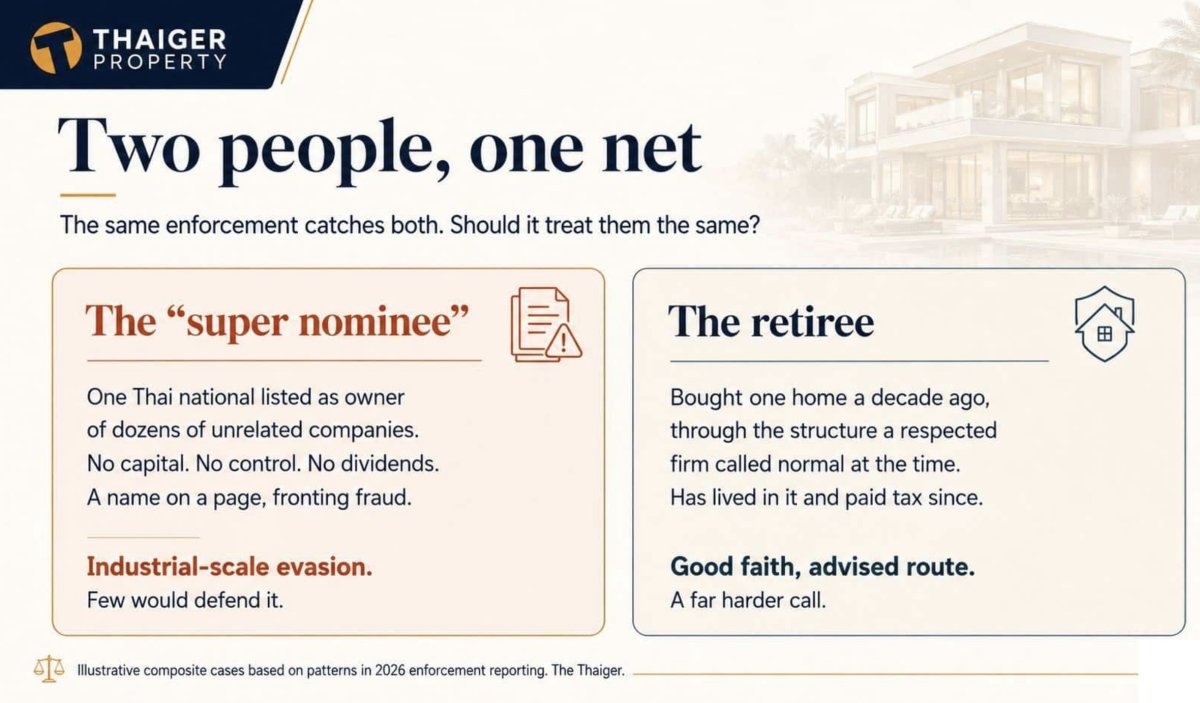
image.jpeg

Some observers believe the current crackdown may be part of a broader strategy to clear out unlawful structures before introducing new legal ownership frameworks. Others warn that enforcement without further reform could discourage investment and prompt foreign capital to move elsewhere.

Regional competition is increasing. Malaysia permits foreign freehold ownership subject to minimum-price requirements, while Indonesia offers foreigners registered property rights lasting up to 80 years. Other neighbouring countries have also introduced clearer frameworks for foreign property investment.

The Thaiger reported that the attention will now focus on whether Thailand introduces new legal routes for foreign property ownership or long-term leases. Proposals frequently discussed include reviving elements of the 2022 ownership framework, strengthening lease protections and updating condominium regulations.

The outcome could determine whether Thailand’s property policies ultimately align with its broader efforts to attract foreign investment and support economic modernisation.
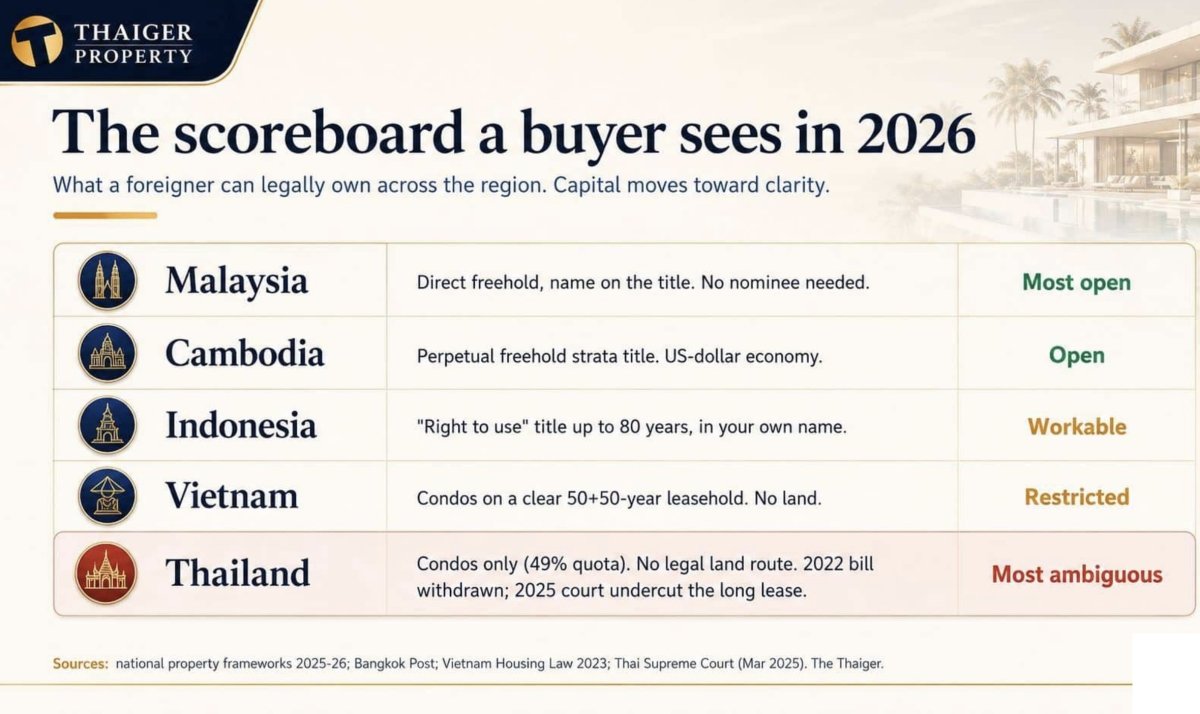
image.jpeg

Pictures courtesy of The Thaiger

Join the discussion? image.png

Already a member? image.png

image.png Adapted by ASEAN Now TheThaiger 22 June 2026

User Feedback

Recommended Comments

Yumthai Gold Member

Yumthai

Advanced Member
35 minutes ago, JerryM said:

"Several legal structures, loopholes and informal arrangements have existed for years in markets such as Phuket, Pattaya, Samui and Bangkok, often involving both foreign investors and Thai facilitators," he said.

Often but not always? How so?

JerryM Gold Member

JerryM

Advanced Member
13 minutes ago, Yumthai said:

Often but not always? How so?

Informal arrangements using Private "Proxy" Agreements: Foreigners used private, unregistered agreements (such as secret loans or non-voting shares) to retain full economic control while putting the title deed in a Thai spouse's or local associate's name

Yumthai Gold Member

Yumthai

Advanced Member
13 minutes ago, JerryM said:

Informal arrangements using Private "Proxy" Agreements: Foreigners used private, unregistered agreements (such as secret loans or non-voting shares) to retain full economic control while putting the title deed in a Thai spouse's or local associate's name

That's what I imply, it's "always involving both foreign investors and Thai facilitators". Foreigners alone can't achieve anything.

JerryM Gold Member

JerryM

Advanced Member
5 minutes ago, Yumthai said:

That's what I imply, it's "always involving both foreign investors and Thai facilitators". Foreigners alone can't achieve anything.

Maybe the 'often' referred to Thai professional facilitators like lawyers or accountants who are not always involved in informal arrangements as noted.

But my reason for the quote was this:

Mr Surachet said such structures are not new and remain widespread because investigations are complex, document-heavy and time-consuming.

impulse Star Member

impulse

Advanced Member

For those with nominee exposure, it could get worse:

The Pending Forfeiture Law: On February 24, 2026, the Thai Cabinet formally approved an Ombudsman report instructing the DOL to amend Section 94. The proposed amendment will eliminate the "forced sale with proceeds" exit and replace it with outright forfeiture to the State without compensation (ตกเป็นของแผ่นดิน).

Ouch. Does anyone know if that was passed and "Gazetted" and currently in force? That would sure 'splain the new zeal on the part of officialdom.

JerryM Gold Member

JerryM

Advanced Member

From Gemini:

In Thailand, Section 94 of the Land Code Act has not yet had its long-debated, stricter amendments finalized. Currently, the law mandates that unlawfully acquired foreign land must be sold within 180 days to 1 year, allowing the owner to keep the proceeds. However, the Thai government is actively reviewing proposals to amend this to allow state confiscation without compensation.

From https://lexbangkok.com/nominee-land-ownership-thailand-confiscation-risk/

The most consequential proposed change involves Section 94 of the Land Code. Currently, when the government identifies unlawfully held land, the owner is required to dispose of the property, but they can receive proceeds from the sale. The proposed amendment would eliminate this entirely.

Gecko123 Platinum Member

Gecko123

Advanced Member
35 minutes ago, JerryM said:

From Gemini:

In Thailand, Section 94 of the Land Code Act has not yet had its long-debated, stricter amendments finalized. Currently, the law mandates that unlawfully acquired foreign land must be sold within 180 days to 1 year, allowing the owner to keep the proceeds. However, the Thai government is actively reviewing proposals to amend this to allow state confiscation without compensation.

From https://lexbangkok.com/nominee-land-ownership-thailand-confiscation-risk/

The most consequential proposed change involves Section 94 of the Land Code. Currently, when the government identifies unlawfully held land, the owner is required to dispose of the property, but they can receive proceeds from the sale. The proposed amendment would eliminate this entirely.

Confiscation sounds totally draconian to me. If this law is passed, I predict that the resulting cases will clog up the courts for years to come.

Take for example a case where an ex-pat has named his wife and some of her relatives as shareholders in the corporation where the wife has a bonafide financial and operational interest in the business but her relatives don't. And how about all the legal malpractice suits coming from people who relied on flawed legal advice?

Does it not strike anyone else as grossly unfair that just because a corporate structure violated land law that everyone should forfeit their entire investment in both the land and the improvements? Forced divestment seems like a far more equitable remedy. I can't believe that the Thai supreme court would uphold the fairness of this land seizure law if it were ever to be passed.

JerryM Gold Member

JerryM

Advanced Member

What I have read is the rationale is that a foreigner has purchased Thai property under an illegal structure but, as of now, he is able to sell the property within 1 year (?) so there is no loss.

That is now looked by some as little or no punishment for the law incursion in the nominee purchase.

Gecko123 Platinum Member

Gecko123

Advanced Member
12 minutes ago, JerryM said:

What I have read is the rationale is that a foreigner has purchased Thai property under an illegal structure but, as of now, he is able to sell the property within 1 year (?) so there is no loss.

That is now looked by some as little or no punishment for the law incursion in the nominee purchase.

Thank you for this insight. I would argue that fines and perhaps, in extreme cases, criminal charges would be the more equitable remedy.

ronnie50 Platinum Member

ronnie50

Advanced Member
15 hours ago, atpeace said:

THis is going to be painful for many. Below is from an article in Bangkok Post.

Koh Samui & Koh Phangan: Roughly 90% (9 in 10) of all villa buyers utilize a Thai corporate/nominee structure to secure their properties.

Phuket is estimated at 60%

If that's the case, then this 'crackdown' like so many others, will fade away after a week or two. Once they got their headlines, that was their goal.

ronnie50 Platinum Member

ronnie50

Advanced Member

..anyway, it's always been better value to rent than buy here (anything, house, condo, etc.)

atpeace Platinum Member

atpeace

Advanced Member
13 minutes ago, ronnie50 said:

If that's the case, then this 'crackdown' like so many others, will fade away after a week or two. Once they got their headlines, that was their goal.

13 minutes ago, ronnie50 said:

If that's the case, then this 'crackdown' like so many others, will fade away after a week or two. Once they got their headlines, that was their goal.

13 minutes ago, ronnie50 said:

If that's the case, then this 'crackdown' like so many others, will fade away after a week or two. Once they got their headlines, that was their goal.

They got their headlines last year and now they are implementing the crackdown. I might be wrong and for condo owners that didn't have bad intentions and just thought it was just bending the rules a little, I hope it winds down quickly. I doubt it will though....

ronnie50 Platinum Member

ronnie50

Advanced Member
3 minutes ago, atpeace said:

They got their headlines last year and now they are implementing the crackdown. I might be wrong and for condo owners that didn't have bad intentions and just thought it was just bending the rules a little, I hope it winds down quickly. I doubt it will though....

Well then, given the numbers you posted, the authorities have got a LOT of work ahead of them.

atpeace Platinum Member

atpeace

Advanced Member
15 minutes ago, ronnie50 said:

..anyway, it's always been better value to rent than buy here (anything, house, condo, etc.)

I would agree in some situations but many other reasons other than investment gains why a person might invest in real-estate. FOr example, wife owns a nice piece of land and you can build a home that meets your needs for little money. That is what I did but there were other options that availed themselves after I started construction. If I did it all over again, I would have signed a 30 year lease on a piece of property on a bluff over the Mekong river for 3,000 baht a month.

Sir Dude Gold Member

Sir Dude

Advanced Member

The reason Thailand is struggling is not because of its laws, it's the lack of trust that they will still be the same in 10 years time and the threat of a 180 within months due to the swirling chaos of Thai politics. What Thailand lacks is good business sentiment and confidence, which is fragile to say the least these days. You can have tight regulations, like many countries do on business and land ownership (Singapore etc.), but that doesn't hurt them as businesses and people can work with that... it's the unpredictability of Thailand's flip-flopping that makes investors, large and small, hesitate or go elsewhere to more predictable countries.

The "hang them high" expats who whine and complain on forums and shout loudly about one side of the debate or the other are not that relevent really... it's the investor who stays silent, reads the room, and pulls the money to go somewhere else as it is not a sound business decision. Thailand has to be more predictable and reliable to get the investment it needs to escape the middle-income trap it is in, and that only comes through investors knowing the laws will stay the same for a long while, so plans can be made and you can factor in all those costs of doing business or buying stuff.... sadly now you can't and that's too risky for most businesses. Classic example is the Cannabis espisode, changed the law, people invested billions, and then a sudden 180 due to changing political whims... that is what Thailand has to fix to get trust back. Choose a set of laws and stick with them with only minor tweeks every decade or so... instead of this constant mess and chaos we see now.

atpeace Platinum Member

atpeace

Advanced Member
2 hours ago, JerryM said:

What I have read is the rationale is that a foreigner has purchased Thai property under an illegal structure but, as of now, he is able to sell the property within 1 year (?) so there is no loss.

That is now looked by some as little or no punishment for the law incursion in the nominee purchase.

It is a catch 22 because buying a property that was illegally acquired is illegal. Most buyers know this and hence will not buy such properties. In the worst case scenario, after that one year it will be legally auctioned off and then there probably will be buyers picking up properties for cheap.

couchpotato Gold Member

couchpotato

Advanced Member
2 hours ago, JerryM said:

What I have read is the rationale is that a foreigner has purchased Thai property under an illegal structure but, as of now, he is able to sell the property within 1 year (?) so there is no loss.

That is now looked by some as little or no punishment for the law incursion in the nominee purchase.

Your interpretation of this is incorrect.

ronnie50 Platinum Member

ronnie50

Advanced Member
7 minutes ago, atpeace said:

I would agree in some situations but many other reasons other than investment gains why a person might invest in real-estate. FOr example, wife owns a nice piece of land and you can build a home that meets your needs for little money. That is what I did but there were other options that availed themselves after I started construction. If I did it all over again, I would have signed a 30 year lease on a piece of property on a bluff over the Mekong river for 3,000 baht a month.

7 minutes ago, atpeace said:

I would agree in some situations but many other reasons other than investment gains why a person might invest in real-estate. FOr example, wife owns a nice piece of land and you can build a home that meets your needs for little money. That is what I did but there were other options that availed themselves after I started construction. If I did it all over again, I would have signed a 30 year lease on a piece of property on a bluff over the Mekong river for 3,000 baht a month.

Yes, my wife also has a house a few pieces of land in her name with chanotes. I coud have done the same as you suggested, but didn't see any point. Each person has their own motivations of course. My main point is that in a major city like Bangkok, it's always been cheaper to rent than buy. The condo we rent in central Bangkok is in an upmarket area, and would 'sell' (if they could) for 10 million. It would take us nearly 30 years of renting to come close to that price. Before this place, we rented a 3 bed 2 bath house with a small garden right smack in central Bangkok for a monthly rent in the low 5 figures - for 20 years. A very good deal for sure, but there are many others out there..

ronnie50 Platinum Member

ronnie50

Advanced Member
14 minutes ago, Sir Dude said:

Thailand has to be more predictable and reliable to get the investment it needs to escape the middle-income trap it is in

I agree with your post about investor confidence. I just pulled this line out to add a comment that investment is not what's holding Thailand back from escaping the middle-income trap, at least that's not the main thing, it's the lack of social investment by the rulers of the country (for decades). The state education system is an anachronysm - like something out of 18th century England. The wealth is controlled by the hands of a tiny minority - with an ethnic dimension that can't be ignored. Workers are badly abused here by small to medium sized employers with a near-poverty wage of just over 300 THB per day for all but the more skilled - and even then their pay is barely enough to pay the rent and buy food. Lack of a skilled workforce is one result. Lack of business sense or innovation by that small number of upper middle class is another. They come up with catchy names for their small businesses for cake and coffee shops, but can't think beyond the simple stuff. And they all pile into the latest thing their freinds are doing - open a hostel or a 'co-working' space with no customers. Meantime, you can't get a seat in a Starbucks anywhere (even if you wanted one that is)

JerryM Gold Member

JerryM

Advanced Member
49 minutes ago, couchpotato said:

Your interpretation of this is incorrect.

Thailand nominee crackdown exposes property law loopholes

MONDAY, JUNE 22, 2026

Section 94 questioned over its “deterrent effect”

One issue under question is a legal loophole in Section 94 of the Land Code, which provides that if a foreigner unlawfully acquires land, the Director-General of the Department of Lands may order the disposal of that land within a period of not less than 180 days but not more than one year.

If the order is not complied with, the state can put the property up for auction.

In practice, the measure may appear to be a clear penalty, but from a law-and-economics perspective, Thai law still does not impose financial penalties severe enough.

The key reason is that even if a holder is found to have bought land illegally, after the property is sold, the offender can still recover the principal as well as any profit from the land price increase in line with market conditions.

In other words, if land prices rose throughout the holding period, the investor may still receive returns even though they are ultimately forced to sell the property out of the system.

https://www.nationthailand.com/news/general/40067708

couchpotato Gold Member

couchpotato

Advanced Member
24 minutes ago, JerryM said:

Thailand nominee crackdown exposes property law loopholes

MONDAY, JUNE 22, 2026

Section 94 questioned over its “deterrent effect”

One issue under question is a legal loophole in Section 94 of the Land Code, which provides that if a foreigner unlawfully acquires land, the Director-General of the Department of Lands may order the disposal of that land within a period of not less than 180 days but not more than one year.

If the order is not complied with, the state can put the property up for auction.

In practice, the measure may appear to be a clear penalty, but from a law-and-economics perspective, Thai law still does not impose financial penalties severe enough.

The key reason is that even if a holder is found to have bought land illegally, after the property is sold, the offender can still recover the principal as well as any profit from the land price increase in line with market conditions.

In other words, if land prices rose throughout the holding period, the investor may still receive returns even though they are ultimately forced to sell the property out of the system.

https://www.nationthailand.com/news/general/40067708

Very interesting. I stand corrected. Don't think many people know about that clause, and I wonder if it is actually used in cases.

JerryM Gold Member

JerryM

Advanced Member
6 minutes ago, couchpotato said:

Very interesting. I stand corrected. Don't think many people know about that clause, and I wonder if it is actually used in cases.

OK. And not that I agree with it.

JerryM Gold Member

JerryM

Advanced Member
1 hour ago, Xonax said:

Picture how a single illegal nominee company actually came into being.

From the linked article:

So we will ask the question the whole chain raises, and we will ask it plainly, and we will leave it with the people who know this market far better than any single article can. If this was designed by professional hands, sold by professional hands, stamped by official hands, and tolerated for twenty profitable years by the state itself, why is the foreigner at the end of the line the only one being asked to pay for it?

Tell us where you land.

Where I land is this: It is strictly a matter of legal mechanics. All those ancillary services as above may be liable for prosecution, but it will only be indirectly.

The foreign purchaser is the person whose name is on the deed document.

Create an account or sign in to comment

Account

Navigation

Search

Search

Configure browser push notifications

Chrome (Android)
  1. Tap the lock icon next to the address bar.
  2. Tap Permissions → Notifications.
  3. Adjust your preference.
Chrome (Desktop)
  1. Click the padlock icon in the address bar.
  2. Select Site settings.
  3. Find Notifications and adjust your preference.