





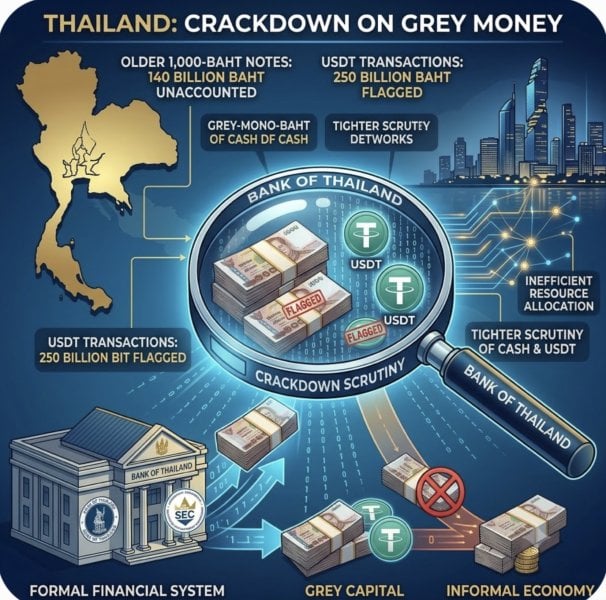
Thailand's central bank says around 140 billion baht in two older series of 1,000-baht banknotes has not returned to the financial system as normally expected. The Bank of Thailand (BoT) is also preparing tighter checks on large cash transactions and suspicious digital-asset transfers, particularly involving USDT.
The BoT governor said the two banknote series are around 20 to 30 years old. Their absence from normal circulation may indicate that some cash is being held outside the formal economy or used in transactions that do not pass through financial institutions.
However, the central bank stressed that the figure is an "abnormality signal", not proof that all of the missing notes are connected to illegal activity.
Tighter scrutiny of large cash movements
The BoT is stepping up efforts to block channels used by so-called grey capital - money linked to opaque or potentially unlawful activity. Planned measures include tougher monitoring of high-value cash deposits and exchanges involving large quantities of banknotes.
It is also working with the Securities and Exchange Commission (SEC) to examine the use of digital assets. USDT, a stablecoin designed to track the US dollar, has drawn particular attention because of a large number of transactions flagged as unusual.
The authorities are using data-analysis systems to trace money flows more closely. For foreigners living in Thailand, the measures could mean greater questions or documentation requirements when making unusually large cash deposits, exchanging substantial amounts of baht, or moving funds through digital-asset platforms.
Routine banking, legitimate remittances and lawful foreign-exchange transactions are not identified in the central bank's comments as targets. But residents and visitors should keep clear records showing the source and purpose of major transfers, particularly where cash or crypto assets are involved.
USDT transactions worth 250 billion baht flagged
Over a five-month period, suspicious USDT transactions were found to total about 250 billion baht. This represented roughly 40% of the transactions brought in for review.
The governor said Thailand's economic problem was not a shortage of capital, but inefficient allocation of resources, described as "misallocation". Some funds were not reaching businesses with potential, instead circulating in the informal economy, grey capital networks and transactions that are difficult to verify.
The BoT said financial-system loopholes must be closed alongside wider structural reforms.
Join the discussion? 

6 August 2026
-
 1
1
Recommended Comments
Create an account or sign in to comment