



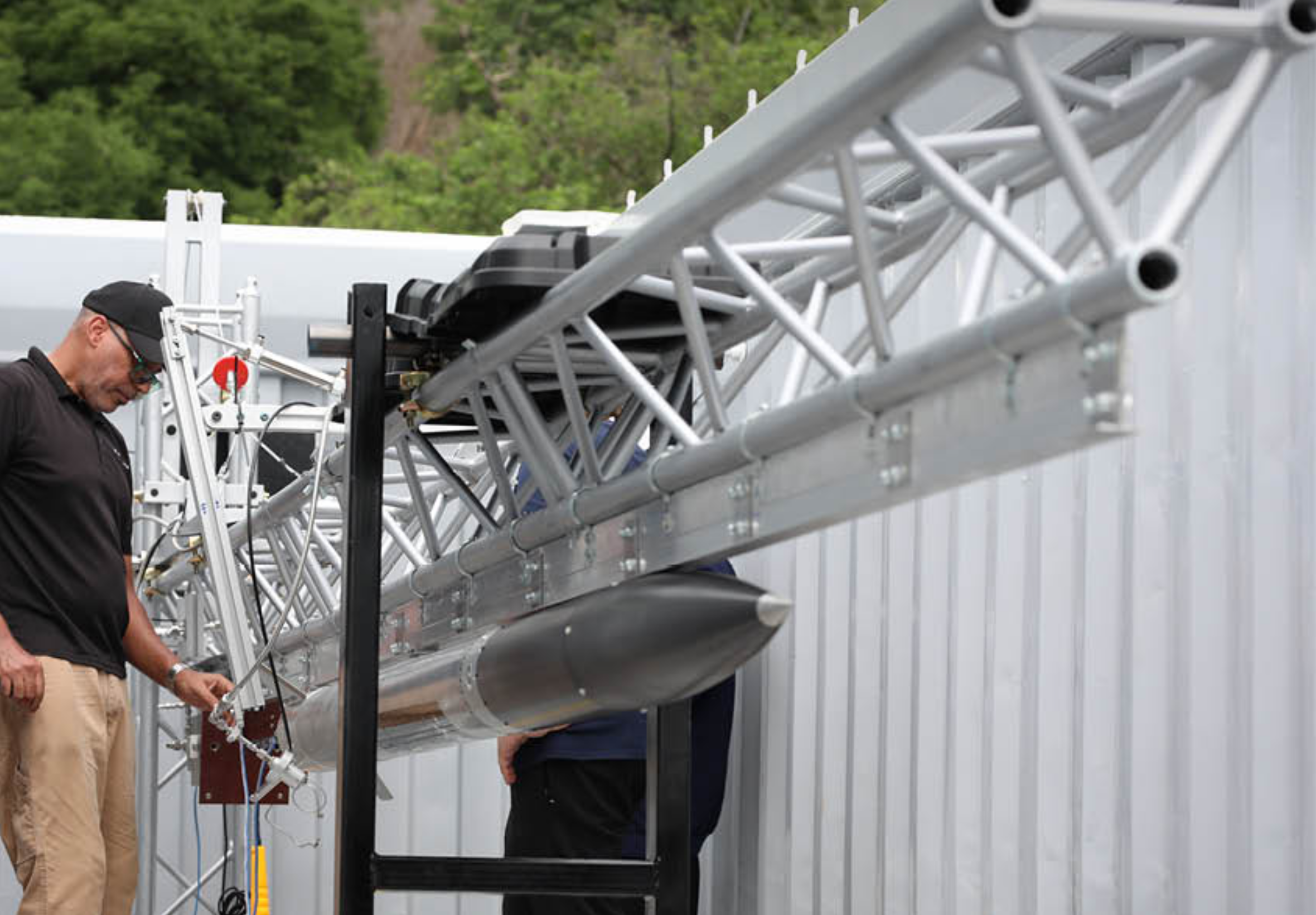

Thailand's first attempt to test-launch a privately developed rocket was halted on safety grounds in Lop Buri on 11 August 2026, after engineers identified technical and launch-pad problems.
The exercise, involving government agencies, the army and Equatorial Space (Thailand) Co Ltd, was intended to test the systems and regulations needed for a proposed Thailand Spaceport rather than simply the rocket itself.
The Technical Feasibility Test & Regulatory Framework Study for Thailand Spaceport took place at an artillery battalion within the Artillery Centre in Lop Buri province. It was organised by the Geo-Informatics and Space Technology Development Agency (GISTDA), the Defence Technology Institute, the Royal Thai Army and Equatorial Space (Thailand).
It marked the first time Thailand had allowed a private company to participate in a live domestic rocket-launch test.
Testing a future spaceport framework
The trial was conducted through a Spaceport Regulatory Sandbox, bringing state agencies, private firms and security bodies together to assess whether Thailand is ready to establish a spaceport.
Dr Nattawat Hongkanjanakul, GISTDA spokesman and director of its Space Economy Promotion Bureau, said the rocket was developed by Equatorial Space (Thailand). It used hybrid propulsion, measured 3.96 metres long and weighed 32.3kg without fuel.
The unguided rocket had been scheduled to reach an altitude of four kilometres.
Officials were also examining preparations, coordination between agencies, area controls, safety arrangements, airspace management, licensing procedures and regulatory oversight.
Safety decision stops launch
The rocket did not leave the ground after technical problems emerged during preparations.
Engineers were able to address some issues, including unstable nitrous oxide gas temperatures that were not sufficiently stable for loading and firing. They also replaced a communications cable between the rocket and the ignition-control software.
However, the launch was ultimately called off after a safety assessment found that the motor used to raise the launch platform did not have enough power. The team also needed to re-examine the platform's structural strength and design to prevent a serious danger during firing.
Dr Nattawat said space projects were highly complex, making safety and learning during development essential. Although the launch did not succeed, he described the test as a "real classroom" that had exposed issues to be corrected before the next attempt.
The regulatory sandbox may be relevant in future to overseas aerospace firms, insurers and manufacturers considering participation in Thailand's developing space sector. GISTDA said a spaceport could support connected industries including modern transport, insurance and manufacturing as part of the country's space economy.
GISTDA and the Defence Technology Institute will now review the results and reassess the private company's readiness. A new launch-test date will be set if the problems are resolved and the company is fully prepared.
Join the discussion? 

14 August 2026
Recommended Comments
Create an account or sign in to comment