



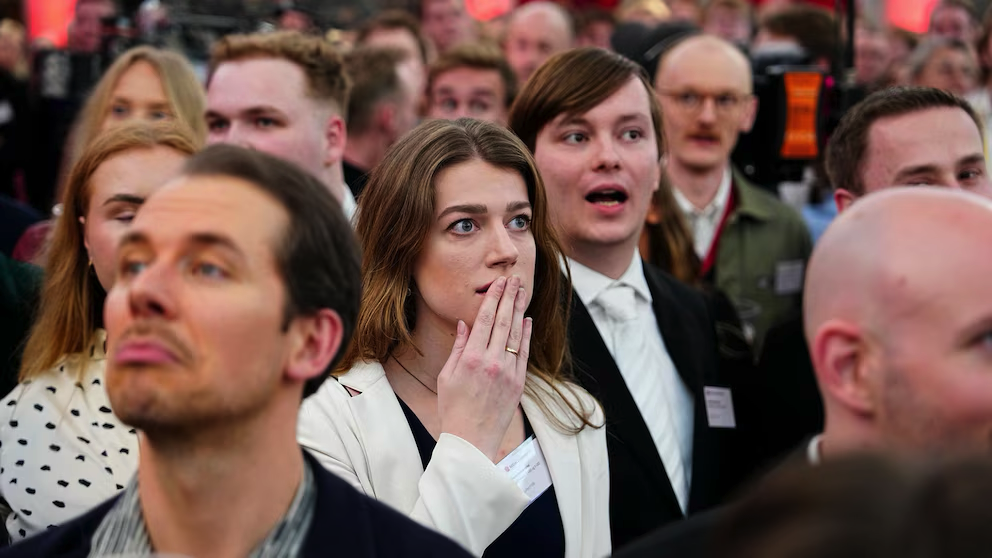

Exit polls in Denmark suggest a setback for Prime Minister Mette Frederiksen and her governing coalition following an early general election, raising uncertainty over who will form the next government.
Get today's headlines by email 
According to projections by the Megafon research institute for broadcaster TV 2, all three parties in Frederiksen’s coalition are expected to lose ground. The figures indicate that neither the left-leaning nor right-leaning blocs are likely to secure a parliamentary majority.
Coalition support weakens
Frederiksen’s centre-left Social Democrats are projected to remain the largest party, but with around 21% of the vote—down significantly from their 27.5% share in the 2022 election.
The outcome could leave Lars Løkke Rasmussen, the foreign minister and former prime minister, in a pivotal position. His centrist Moderate party may determine whether Frederiksen can remain in office for a third term.
Campaign shaped by domestic concerns
Frederiksen, 48, called the election months ahead of schedule, apparently hoping her leadership during tensions involving Donald Trump and his interest in Greenland would strengthen her standing with voters.
However, the campaign largely focused on domestic issues, particularly rising living costs, pensions and taxation. Analysts say these concerns appear to have outweighed foreign policy considerations at the ballot box.
A lawmaker from the Social Democrats acknowledged that the government’s attention to international crises, including support for Ukraine, may have come at the expense of domestic priorities.
Fragmented political landscape
Denmark’s proportional representation system typically produces coalition governments, often after prolonged negotiations. No single party is expected to come close to a majority in the 179-seat Folketing.
Frederiksen’s current administration is notable for bridging the traditional divide between left- and right-leaning parties, but that model now faces uncertainty.
Two centre-right figures are positioning themselves as potential alternatives. Defence Minister Troels Lund Poulsen of the Venstre party and Alex Vanopslagh of the Liberal Alliance both aim to form a new government, though exit polls suggest their parties may also struggle to gain decisive ground.
Meanwhile, the anti-immigration Danish People’s Party is projected to improve its performance compared with its weak showing in the previous election.
Greenland issue fades
Despite earlier tensions over Greenland, the issue played a limited role during the campaign. There is broad political agreement in Denmark over the territory’s status within the kingdom.
Relations between Copenhagen and Washington have stabilised in recent months, following earlier disputes over US ambitions in the Arctic region.
With no clear majority emerging, negotiations to form a government are expected to be complex and could determine whether Frederiksen retains power or a new coalition takes shape.
Join the discussion? 
Already a member? 
 Adapted by ASEAN Now. Source 25 March 2026